

Kimpov Eap’s studio is in her home, to the right as you enter; there is always a canvas in progress or freshly finished on her easel. It is a room where other works of hers hang, and a window lets in natural light. Nothing on her canvases immediately explains the history behind them. And perhaps that is the first clue: her painting does not illustrate the past or trauma; it metabolizes them, turning them into color and expression.
“I decided to simply be happy,” she says.
The statement is not rhetorical. It does not have the tone of someone proclaiming exemplary triumph. It is a serene assertion, made without emphasis. Between Cambodia, devastated by the Khmer Rouge regime, and her current life in Montreal, she does not construct a personal myth; she affirms an act of will.
But before the genocide in Cambodia, there was another life.
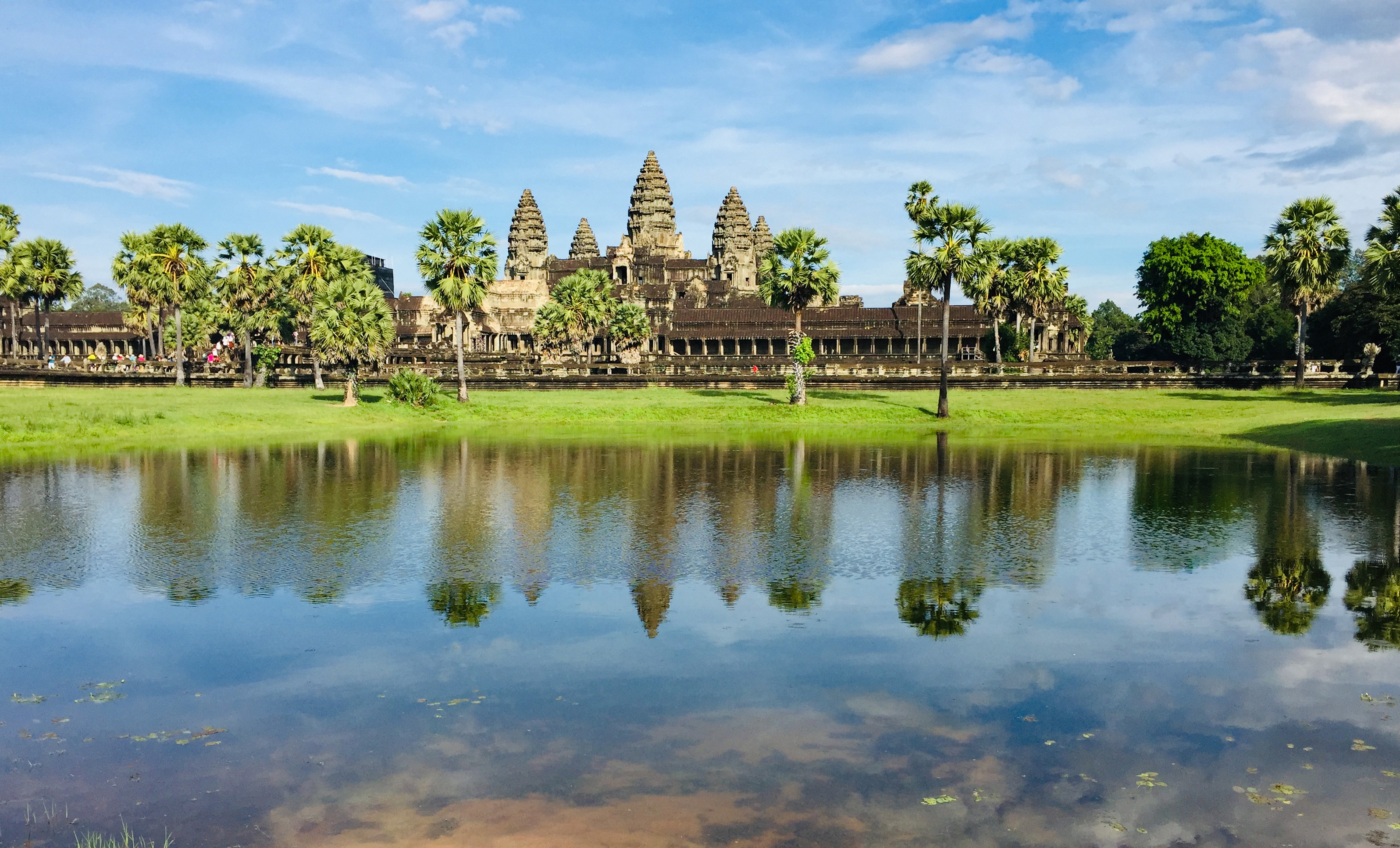
View of Angkor Wat in Cambodia. Photo courtesy of Gaëtan Sheridan.
Kimpov Eap was born in the Kralanh district, in Siem Reap province, in northwest Cambodia. Before the devastation, there was childhood. Her personal history intersects with one of the most devastating episodes of the second half of the twentieth century. In April 1975, the Khmer Rouge (the Communist Party of Kampuchea led by Pol Pot) took Phnom Penh and established Democratic Kampuchea. The regime evacuated entire cities, abolished urban life, and subjected the population to forced labor under military supervision. Between 1975 and 1979, a quarter of Cambodia’s population died from execution, hunger, disease, and exhaustion.
Kimpov’s life was marked by this period. Her husband was taken by soldiers and never returned. She lost two of her children. What appears in her biography as absence also belongs to a collective devastation.
When asked about her beginnings, the picture is different.
“I had a happy childhood,” she recalls. The youngest of eight siblings, daughter of a merchant, she grew up surrounded by her mother’s affection. She never knew her father (he died when she was just a baby) but she never felt abandoned. She attended school, learned French from the fourth grade onward, had friends, a routine. At fifteen, she married a teacher. “He was very attentive. He took good care of our home.” They had children. Happiness, in her account, is not idealized; it is concrete.
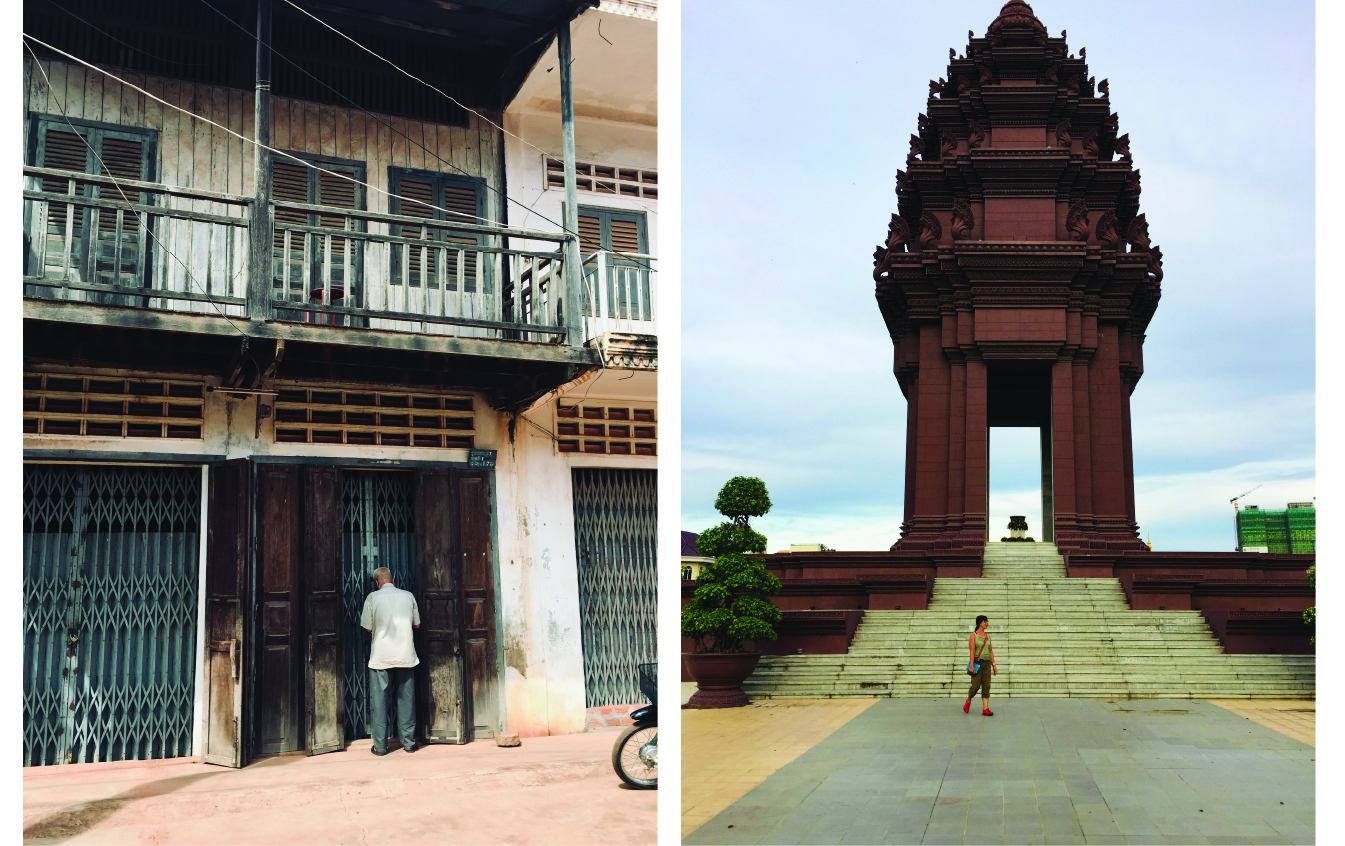
On the left is Kimpov's house in Kralanh-Kampong Thkov, Cambodia, where she grew up with his mother and siblings. On the right is Kimpov visiting his country in recent years.
Then the soldiers arrived. One day, they gathered all the men from the village. Her husband was among them. They took him. He never returned. From that moment, her story was suspended.
Like many other women with children, she was expelled from her home and forced to work the land, in the rice fields. Her body no longer belonged to her. She walked until her feet bled, carrying sacks of soil. Hunger was not metaphorical. At one point, her children ate a raw mouse out of hunger.
She does not raise her voice when recounting this. She does not emphasize horror. She speaks as one who lists inevitable facts. Perhaps extreme suffering does not need embellishment. Or perhaps memory, when fully traversed, no longer demands dramatization.
“We are innocents who suffer because of the power games of those who wish to control us,” she says in a discreet speech for one of her exhibitions. “We ask for nothing more than peace and the privilege of subsisting.”
In 1979, she managed to escape to Thailand with her children. She lived in a refugee camp. There, she heard of people being sent to other parts of the world: France, the United States. She thought, “I want to go.” They arrived in Canada in 1980, first to Maniwaki, north of Gatineau, then Montreal. She recalls the plane and arriving at a military base.
—Did you arrive at the airport?
—We arrived at the Longue-Pointe military base (east of Montreal). Thirteen families from Maniwaki sponsored my family so that we could be adopted. They came to get us. Father Auguste Legault and Jacques Braso were there. They told me, “We are going to Maniwaki. We are going to Maniwaki, and we stay because we were listening to them.”Kimpov does not know whether the plane was military or commercial. The detail lost importance. What remained was the desire to find a brother, to reconnect with a bond that confirmed her world had not completely disappeared.
As a refugee in the early 1980s, she eventually had to pay for her passage: “I don’t know, but we paid for that plane. After a few years, we paid it all. You have to pay.”
After paying for her passage, after settling that debt with the Canadian state, painting arrived nineteen years later. In 1999, she painted her first work. She did not begin with abstractions but with studies, portraits, and still lifes, just a small part of her oeuvre, which seems to reside solely in her inner world.
“Art is my friend. I speak with it. It inspires me. It lives within me. It always brings me happiness, never unhappiness,” she says. The formulation is simple, yet radical.
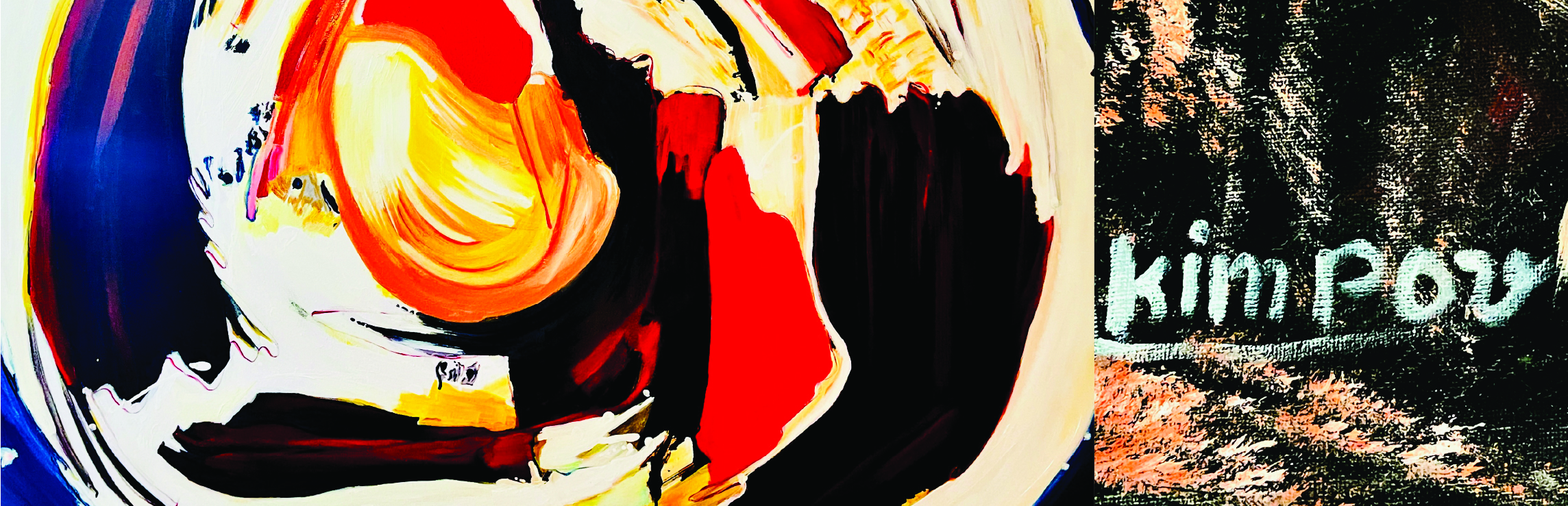
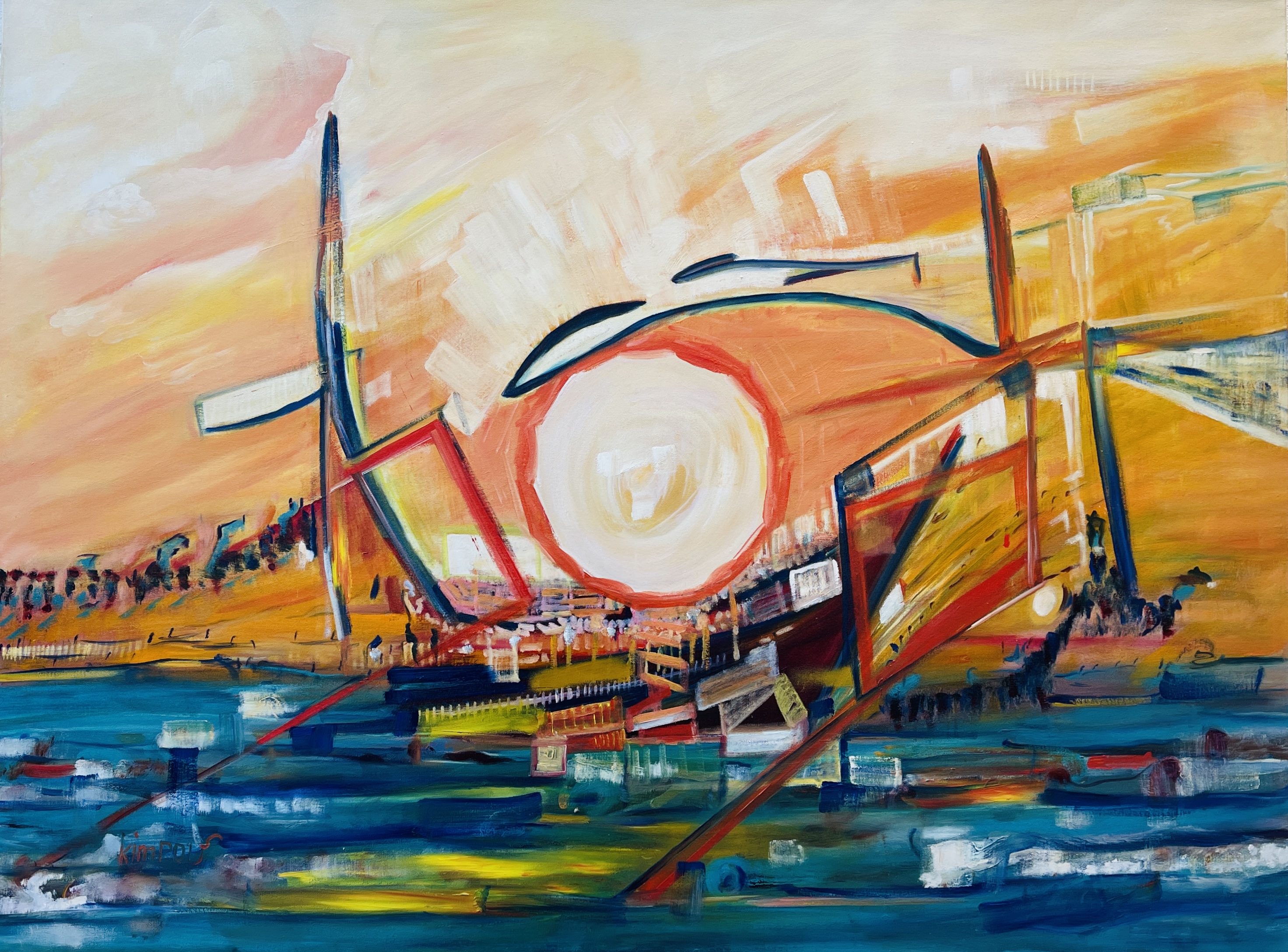
Excerpt from the painting: Silence is strength.
Art does not appear in her account as therapy in a technical sense, but as companionship. As a constant presence. As an interlocutor that manifests itself.
In Montreal, Kimpov first studied fashion design, then visual arts. Later, due to a bicycle accident, she trained as an osteopath to relieve her own bodily pain. Her life was not organized around trauma, but around practices: working, raising children, studying, learning, painting, and rebuilding herself.
“Between what happened there and here… here is my paradise.” Not because she forgets or renounces the past, but because she chose not to live solely from the wound. In her story, transformation does not present itself as a spectacular feat. It is a continuous, almost silent gesture. An internal reorganization that allows the past to exist without governing the present.
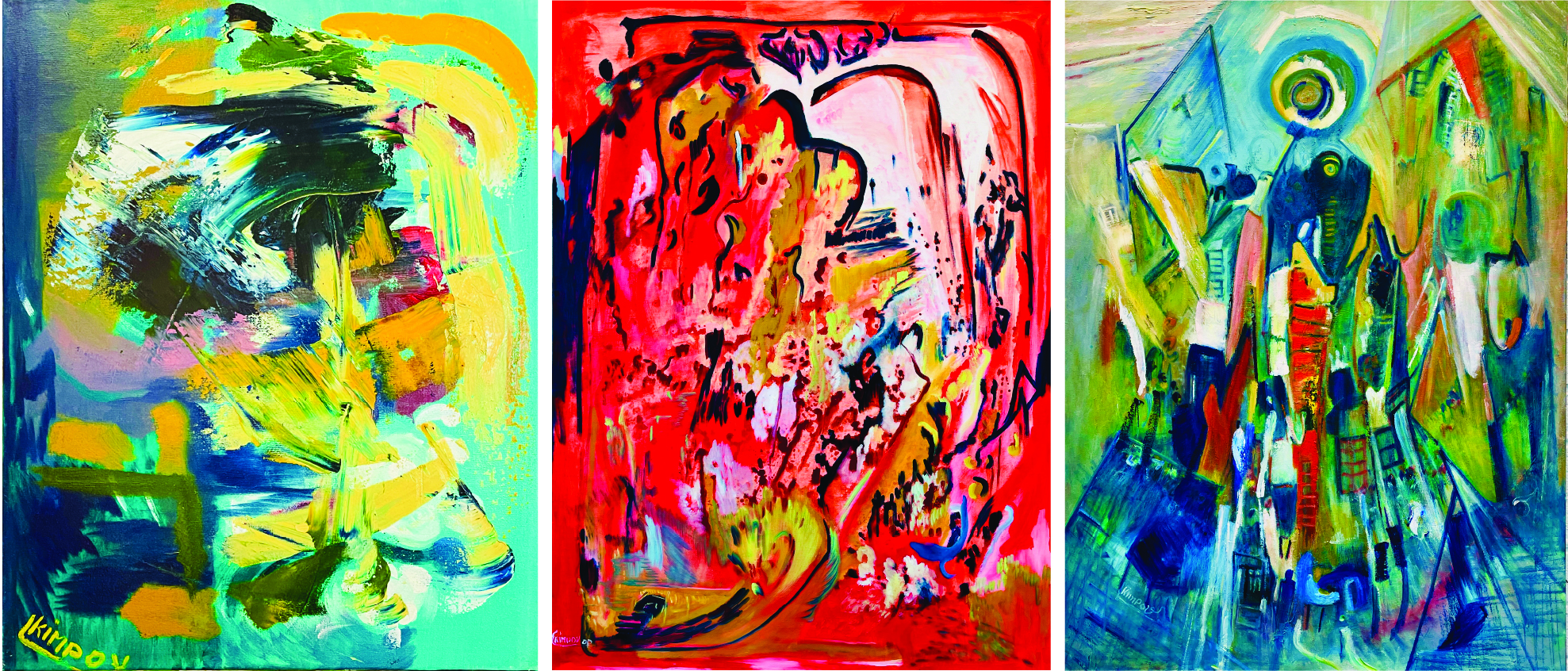
Perhaps this is why her paintings do not depict recognizable scenes of war or exile. Violence does not appear as a direct image. What appears is energy. Movement. Intensity. As if lived experience had shifted from narrative to the very matter of color. But that is another layer. In the next, painting ceases to be biographical context and becomes its own territory.
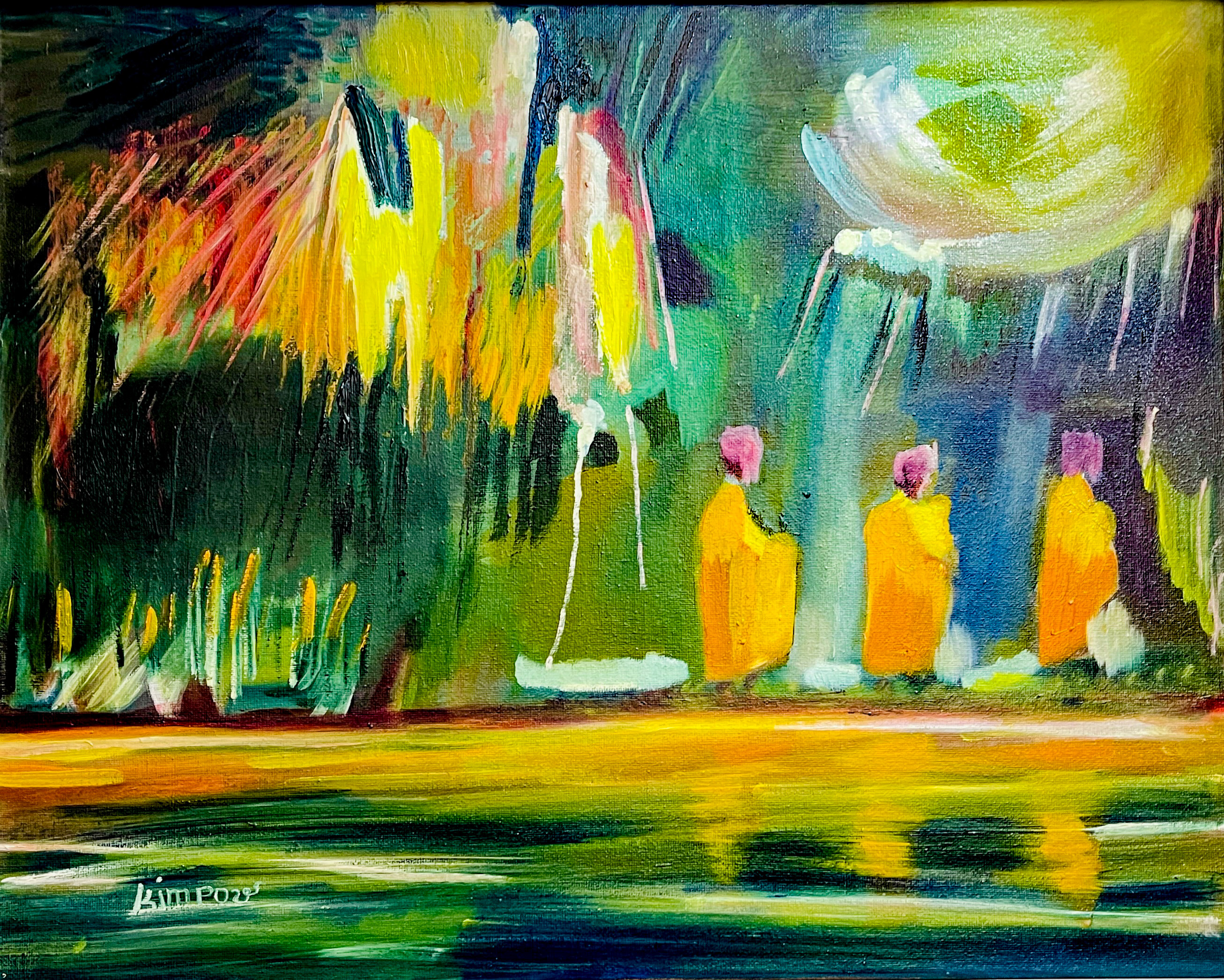
Kimpov’s paintings. From left to right: Father Effect, The Bonfire (Birth), The Master of Silence.
The Invisible Structure
If the first layer of her story reveals decision (the conscious choice to live in light), the second reveals gesture. Painting does not arise in Kimpov as an illustration of the past, but as an internal reorganization. She does not seek to represent war or narrate exile; she seeks something else. “I look for surprise,” she says. And in that word lies a profound key. Surprise implies openness, availability, the relinquishment of absolute control. It implies accepting that something may emerge without having been foreseen.
When she speaks of her creative process, she does not describe a rigid method or conceptual program. She does not calculate the composition in advance nor precisely define the outcome. She takes the brush, intuitively chooses a color, and lets the work unfold. Only afterward, stepping back, does she recognize the balance. That moment of retreat (observing what has emerged) is essential. It is not chaotic improvisation, but a cultivated trust in one’s own perception.
Here an unexpected link to her other profession appears. Kimpov has been an osteopath for over fifteen years, working with the body, with invisible tensions, with misalignments that are not always seen but felt. In consultation, she structures, adjusts, aligns. And when she speaks of that act, she uses words that could also apply to painting: balance, energy, circulation. “When I structure, it feels good,” she explains. It is almost like stretching. The act of ordering is not only technical; it is bodily, intimate.
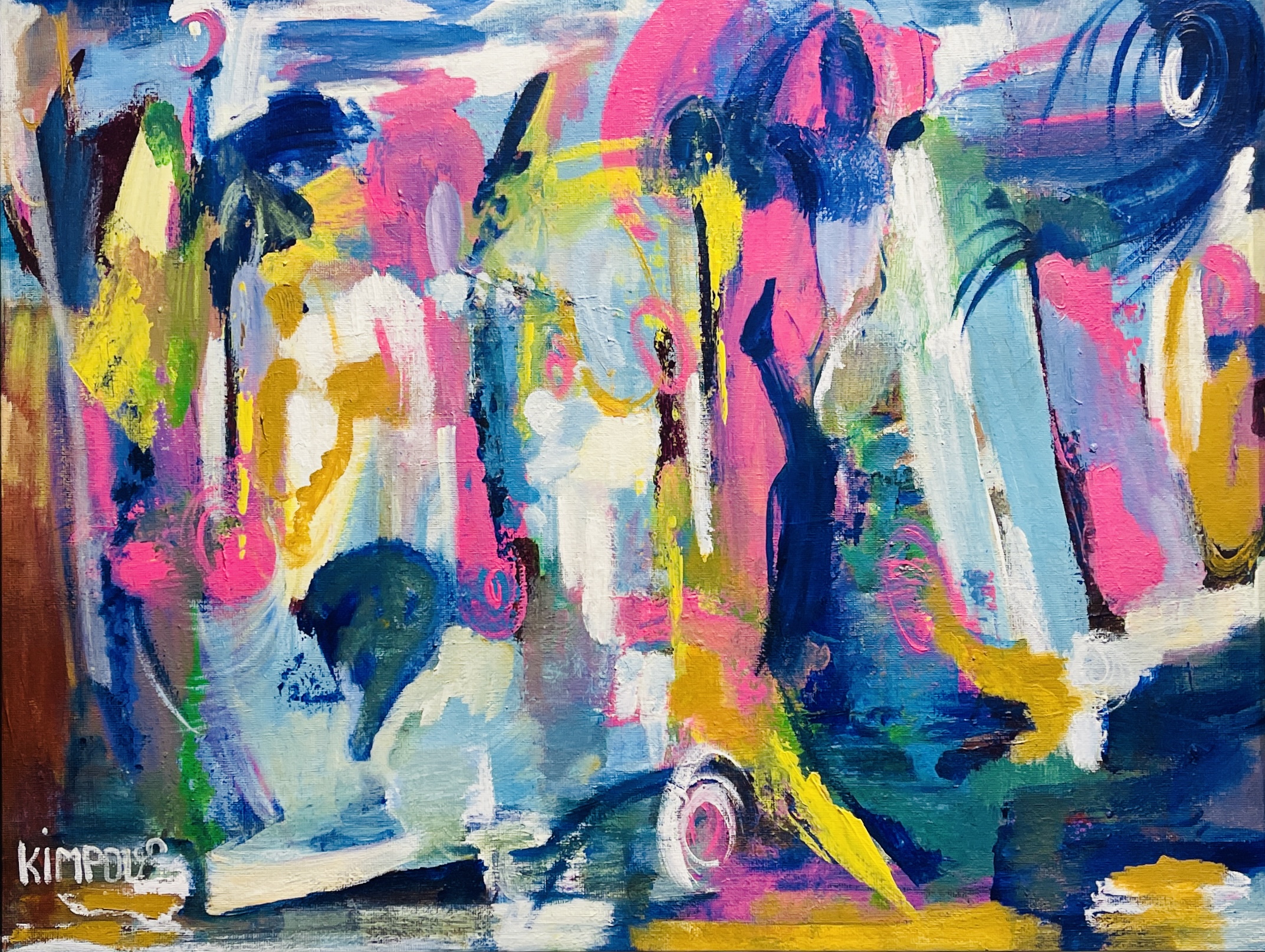
Something similar happens on her canvases. What at first glance appears as a chromatic explosion (reds advancing, blues overlapping, lines crossing the surface) contains an internal logic of redistribution. It is not cold or minimalist abstraction. Nor is it purely gestural in the sense of expressive outburst. It is abstraction shaped by bodily experience. Tension is not eliminated; it is reorganized. Intensity does not disappear; it finds its course.
Above: painting by Kimpov, Untitled.
It is revealing that when asked whether she paints in order not to forget, she responds that she does not. She does not paint memory as archive or monument. She paints from the energy that remains afterward. Her work is not testimonial in the literal sense; it does not need to show recognizable scenes to be true. For some viewers, even before knowing her biography, her canvases can convey an intensity capable of moving, unsettling, or inviting deep reflection.
After having experienced the loss of her husband, the death of two children, and displacement, she does not speak of art as a substitute or dramatic salvation. She speaks of art as companionship, as an everyday presence, as joy. There is a quiet ethic at work here: the right to pleasure after suffering, the legitimacy of creating for one’s own delight, and the desire for others to see what one paints.
Her paintings are not anchored in a tragic past; they vibrate in the present. They celebrate, without naivety, the possibility of balance. When she verbally affirms that Quebec is her paradise, she is not denying the past. She is situating her life on a new axis. And that axis is perceptible in the painting: there is dynamism, but also stability; intensity, but also warmth. The freedom she exercises in front of the canvas is not only aesthetic; it is existential. Choosing a color without fear, allowing a form to emerge without censorship, accepting surprise: all of this is part of a broader practice of affirmation.
Ultimately, Kimpov Eap does not paint what it once was. She paints what remains in motion. Her work does not seek to fix memory, but to keep it circulating, transformed into something that does not paralyze, but propels. In that circulation (between body and color, between structure and spontaneity, between past and present) resides the deep coherence of her life. The same woman who once worked the land until her hands bled now holds the brush with a different firmness. As she herself says: “It’s as if I were digging the earth, the rock; I keep searching. I have found things, but I continue; maybe I can discover something more.”
If you would like to see Kimpov’s paintings, the exhibition Sans Crainte will be on view at the Centre multifonctionnel Guy-Dupré (500, rue Saint-Laurent, La Prairie) from January 21 to April 26.
This is the first of two articles based on an interview conducted with Kimpov. The second article is titled The Memory of Color. The interview was made possible with the support of Gaëtan Sheridan.
Kimpov Eap and the Intimate Architecture of Color