

Noticias Destacadas

At Viva Resorts by Wyndham, fun is part of the all-inclusive experience. Across its collection of beachfront resorts in the Dominican Republic, Mexico and the Bahamas, guests can fill their days with sports, water activities, entertainment, excursions and time together, creating a vacation that is as active, social or relaxing as they want it to be. With beautiful Caribbean beaches as the backdrop, Viva offers travelers more ways to enjoy every moment of their stay.

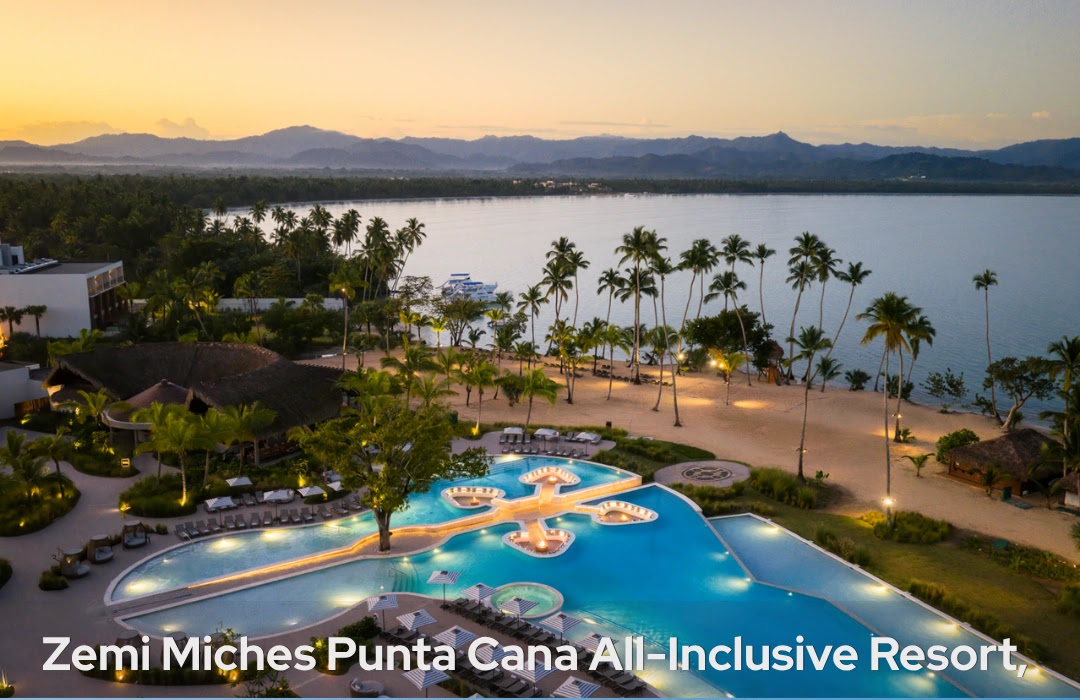
Miches, Dominican Republic — Zemi Miches Punta Cana All-Inclusive Resort, Curio Collection by Hilton, has been recognized with the prestigious AAA Four Diamond distinction, one of the highest honors in the AAA Diamond program for hospitality establishments in North America.

Un nuevo vuelo directo desde Montreal invita a descubrir los Andes, la Amazonía, la costa del Pacífico y las islas Galápagos.
Tras el anuncio del nuevo vuelo directo de Air Canada entre Montreal y Quito, a partir del 4 de diciembre, la Oficina Regional de Quito, la Cámara de Turismo de Pichincha (CAPTUR) y la aerolínea organizaron un encuentro en el Hotel W de Montreal para presentar los atractivos turísticos de la capital ecuatoriana y las experiencias que ofrece el país, incluidas las emblemáticas islas Galápagos.

Air Transat, en collaboration avec GoTürkiye, souligne le succès d’un voyage de familiarisation organisé du 12 au 18 septembre 2026 en Türkiye avec une dizaine de partenaires de l’industrie touristique canadienne. Réunissant des professionnels au départ de Toronto et Montréal, cette initiative a permis de mettre en valeur la richesse culturelle, historique et gastronomique de la destination tout en renforçant les liens entre les marchés canadien et turc.

Les Îles de Guadeloupe sont à l’honneur dans le nouveau film de voyage réalisé par Les Aventuriers Voyageurs, qui met en scène Gino Chouinard, animateur vedette de l’émission matinale Salut Bonjour. Le film est à découvrir dans les salles de cinéma du Québec dès le 18 octobre.
En quête de liberté après des années passées au rythme intense de l’émission matinale Salut Bonjour, Gino Chouinard s’offre une immersion au coeur des Îles de Guadeloupe, une destination où la nature luxuriante, la douceur de vivre, l’authenticité et l’âme créole s’entrelacent avec force.
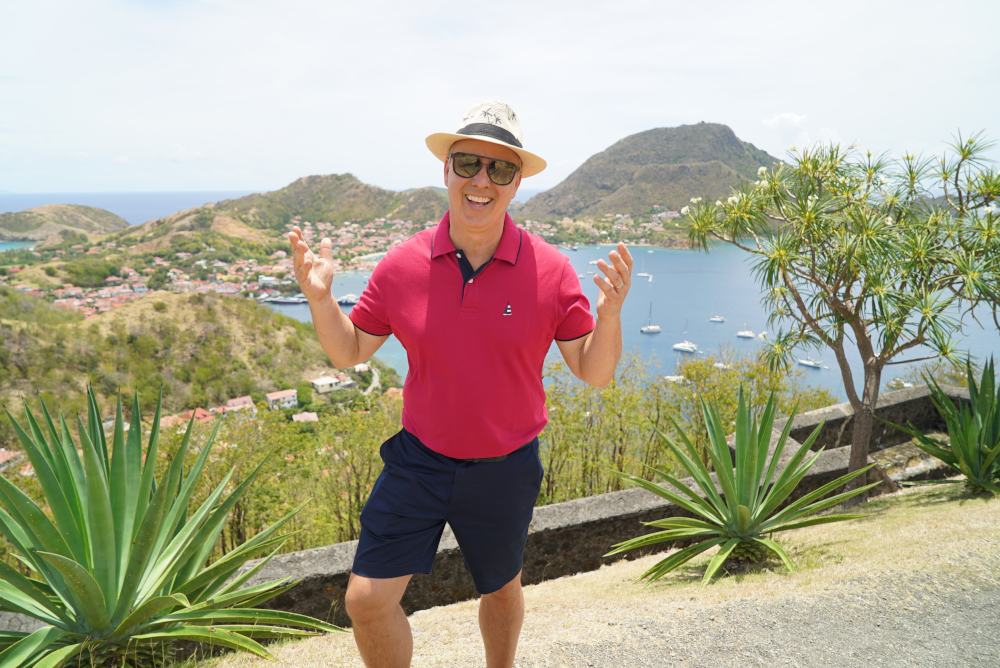
À seulement quatre heures de vol direct depuis Montréal toute l’année avec Air Canada, Air Transat, et depuis Québec en vols saisonniers, les Îles de Guadeloupe forment un archipel situé dans les Caraïbes françaises, composé de six îles aux personnalités bien distinctes : Basse-Terre, Grande-Terre, Marie-Galante, La Désirade, Terre-de-Haut, Terre-de-Bas (Les Saintes).
Chacune possède sa propre identité, son énergie et son caractère, offrant ainsi une grande diversité d’expériences aux voyageurs en un seul voyage. Il est également facile et accessible de passer d’une île à l’autre, plusieurs liaisons en ferry quotidiennes en traversier permettant de les rejoindre en moins d’une heure. Tourné aux quatre coins de l’archipel, ce film de 90 minutes accompagne Gino à la découverte des Îles de Guadeloupe, entre paysages d’exception, culture et traditions.
Bienvenue au coeur des Îles de Guadeloupe, à travers la visite des marchés locaux et des distilleries, une immersion au coeur de Pointe-à-Pitre, Ville d’Art et d’Histoire, une escapade à travers le Parc National de Guadeloupe et sa mangrove, ou encore une excursion à Marie-Galante, l’île aux cent moulins et aux champs de cannes à perte de vue. À bord d’un catamaran, Gino met le cap vers Terre-de-Haut (Les Saintes) et prend part à un atelier culinaire autour de la fabrication du tourment d’amour. Au fil d’échanges authentiques et d’expériences immersives, il part à la rencontre de celles et ceux qui font vivre et rayonner la destination au quotidien.
Ce film de voyage animé par Gino Chouinard sera présenté dans plus de 60 cinémas au Québec avec Les Aventuriers Voyageurs dès le 18 octobre. Vous pouvez visionner la bande-annonce et connaître l’horaire des représentations sur le site www.lesaventuriersvoyageurs.com.

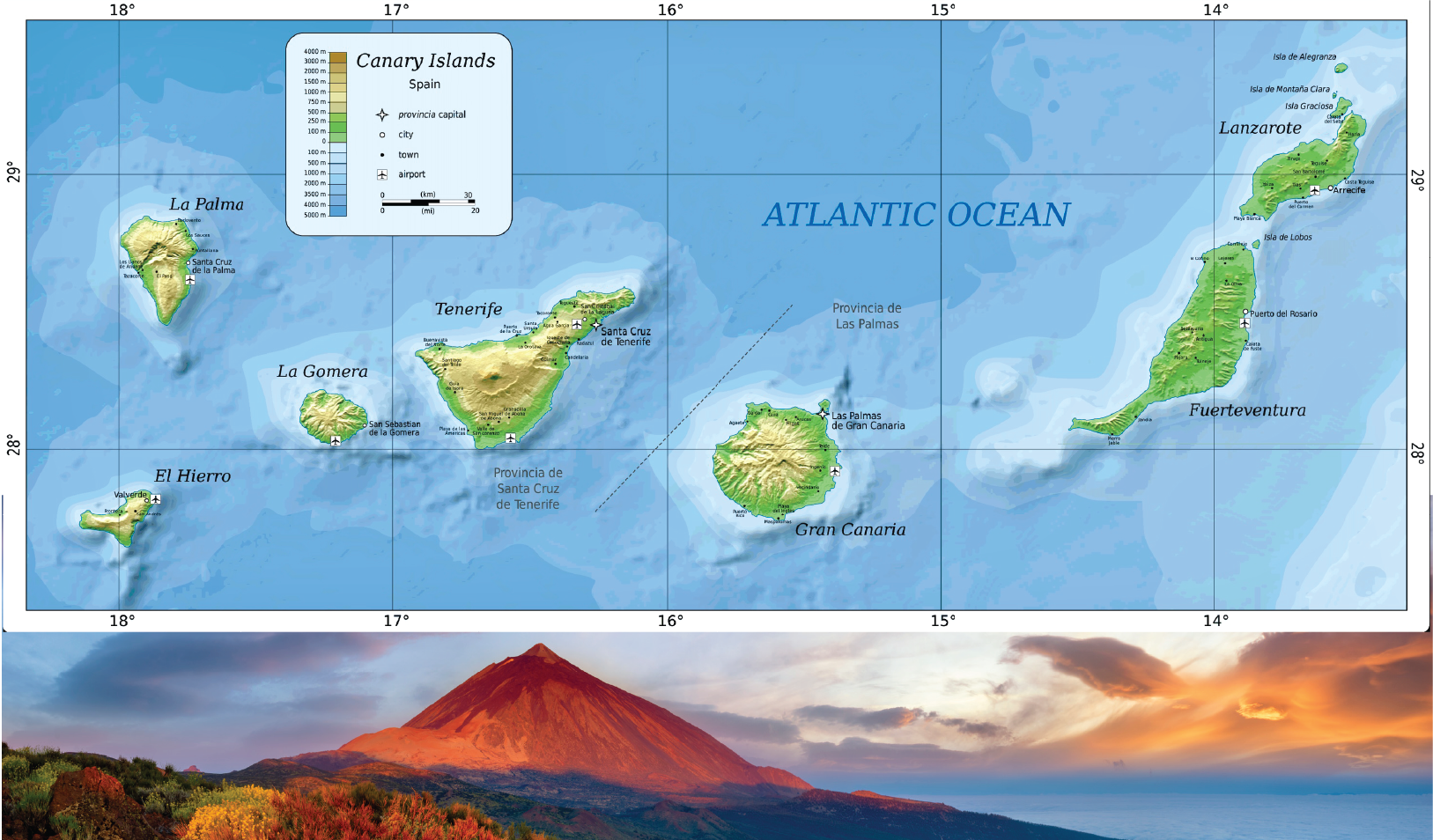
À Montréal, en octobre, la lumière commence déjà à changer, la température baisse et l’hiver se profile au loin. C’est dans ce contexte que les îles Canaries sont venues dans la métropole le temps d’une soirée, non seulement pour présenter deux nouvelles liaisons aériennes, mais aussi pour rapprocher leurs paysages, leur culture et leur hospitalité des voyageurs qui pourraient bientôt leur rendre visite.
L’événement, qui s’est tenu le lundi 5 octobre au Centre PHI, dans le Vieux-Montréal, a réuni des représentants de compagnies aériennes, d’offices de tourisme, de groupes hôteliers et d’autres acteurs de l’industrie touristique des îles. Pendant quelques heures, ce lieu habituellement consacré à l’art contemporain et à la création est devenu un point de rencontre entre Montréal et un archipel situé au large de la côte nord-ouest de l’Afrique, qui fait partie de l’Espagne et de l’Union européenne.
Une rencontre avec le secteur touristique
L’occasion comportait aussi un élément très concret: pour la première fois, les voyageurs au départ de Montréal pourraient rejoindre directement les îles Canaries par deux des principaux aéroports de l’archipel. Air Canada commencera à exploiter sa liaison Montréal-Tenerife le 31 octobre, tandis qu’Air Transat inaugurera sa liaison directe entre Montréal et Grande Canarie le 12 décembre. Les deux transporteurs proposeront un vol par semaine pendant la saison hivernale.

Air Canada a présenté sa nouvelle liaison directe entre Montréal et Tenerife, dont le premier vol est prévu le 31 octobre 2026. Le service sera offert une fois par semaine, le samedi, jusqu’au 24 avril 2027.
La présentation ne suivait pas le format habituel d’une conférence où le public reste assis à écouter une succession de discours. À leur arrivée, les participants ont reçu une carte au format horizontal qui servait de guide pour parcourir les différentes offres touristiques présentées ce soir-là.
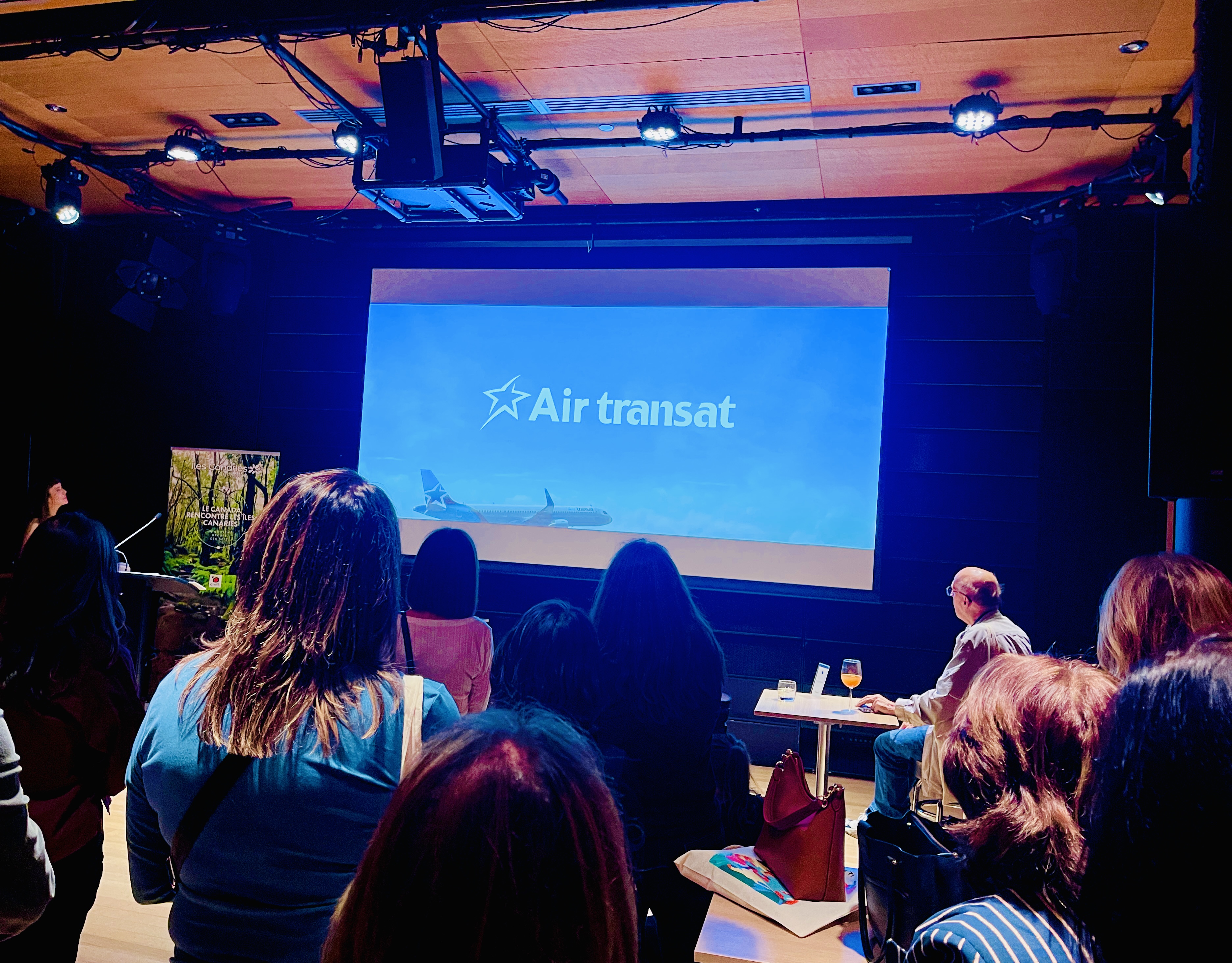
Air Transat a présenté sa nouvelle liaison directe entre Montréal et Las Palmas de Gran Canaria. Le premier vol est prévu le 12 décembre 2026, et le service sera offert une fois par semaine, le samedi, jusqu’au 4 avril 2027.
Environ 24 tables étaient installées, chacune consacrée à un hôtel, à un groupe hôtelier, à un office de tourisme ou à un autre représentant des îles. Pour participer au tirage au sort qui clôturerait la soirée, il fallait en visiter au moins 12 et faire signer la carte à chacune. Ainsi, ce qui aurait pu être une longue série de présentations s’est transformé en un parcours animé où conseillers en voyages et journalistes circulaient d’une table à l’autre.
Parmi les groupes hôteliers présents figuraient Bahía del Duque et les hôtels Tais, à Tenerife; le groupe Fred. Olsen et son Hôtel Jardín Tecina, à La Gomera; Spring Hotels Group et Coral Hotels, également à Tenerife; Cordial Hotels & Resorts et Bohemia Suites & Spa, à Grande Canarie; Abama Hotels et Gran Hotel Taoro, à Tenerife; LIVVO Hotel Group, à Grande Canarie; le groupe Meliá et l’Hôtel Hacienda del Conde, ainsi que le groupe Hyatt, entre autres.
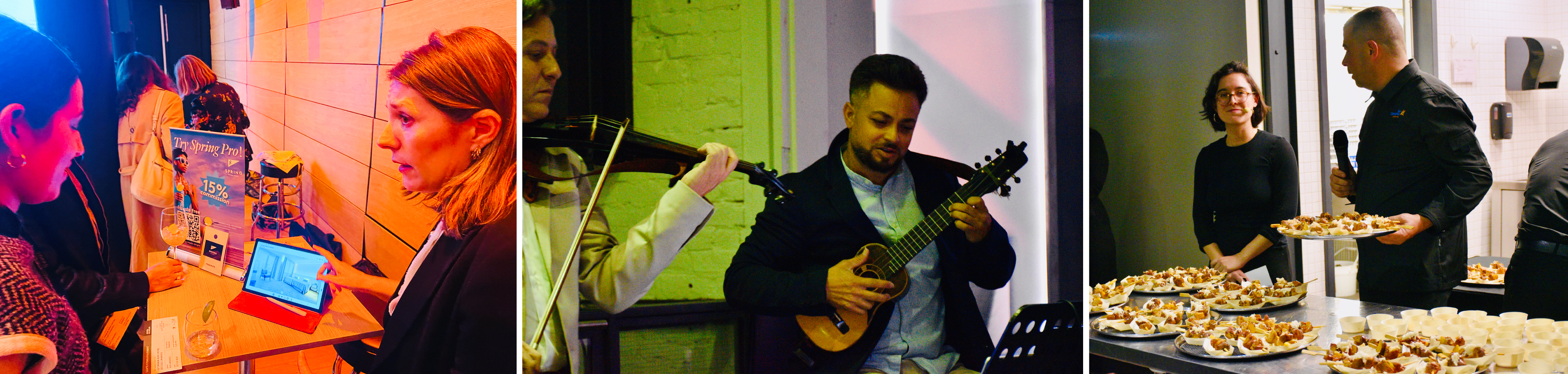
Chaque table offrait une approche différente de l’archipel. Les représentants présentaient directement l’emplacement de leurs établissements, le nombre et le type de chambres, les installations et les services qui les distinguent. Certains utilisaient des tablettes ou des ordinateurs pour montrer des photos et présenter les caractéristiques de leurs hôtels; d’autres s’appuyaient sur des dépliants, de petits présentoirs ou simplement sur la conversation.
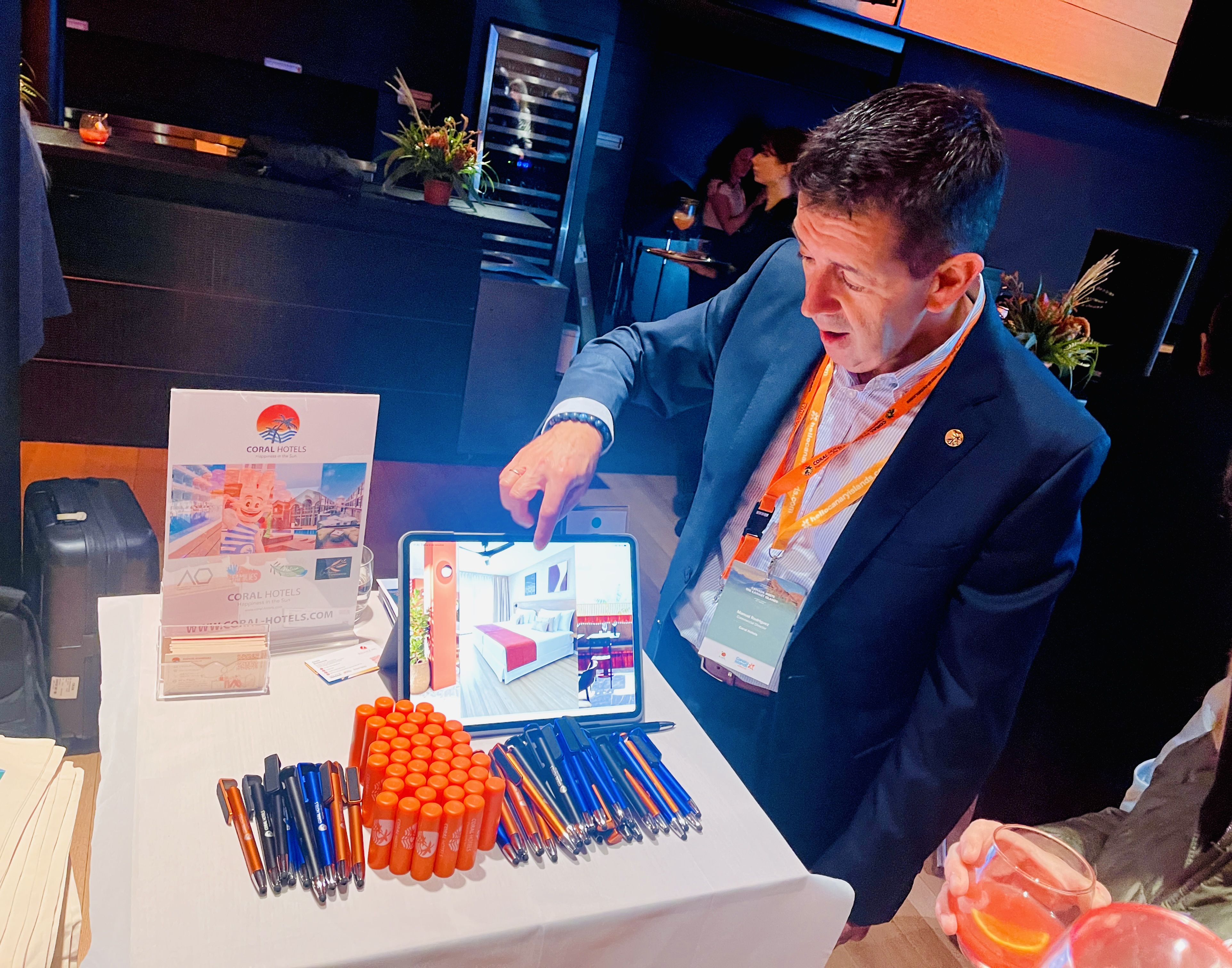
Manuel Rodríguez, directeur commercial de Coral Hotels.
À la table de Fred. Olsen et de l’Hôtel Jardín Tecina, il y avait aussi une petite attention qui allait au-delà de l’information touristique: des biscuits préparés à La Gomera que les participants pouvaient goûter. Un geste singulier qui donnait, le temps d’un instant, une saveur bien à elle à cette île jusque-là connue à travers un nom sur une carte.
Musique, saveurs et paysages des îles
Après le parcours des tables, le rythme a changé. Les participants sont passés dans un autre espace, aménagé avec des tables hautes et quelques canapés, où a commencé la partie plus sensorielle de la soirée. Un duo de musiciens originaires des îles Canaries a accompagné la rencontre au son de rythmes de l’archipel, avec des instruments à cordes, dont le violon et le timple, un petit instrument traditionnel canarien qui ressemble à une guitare.
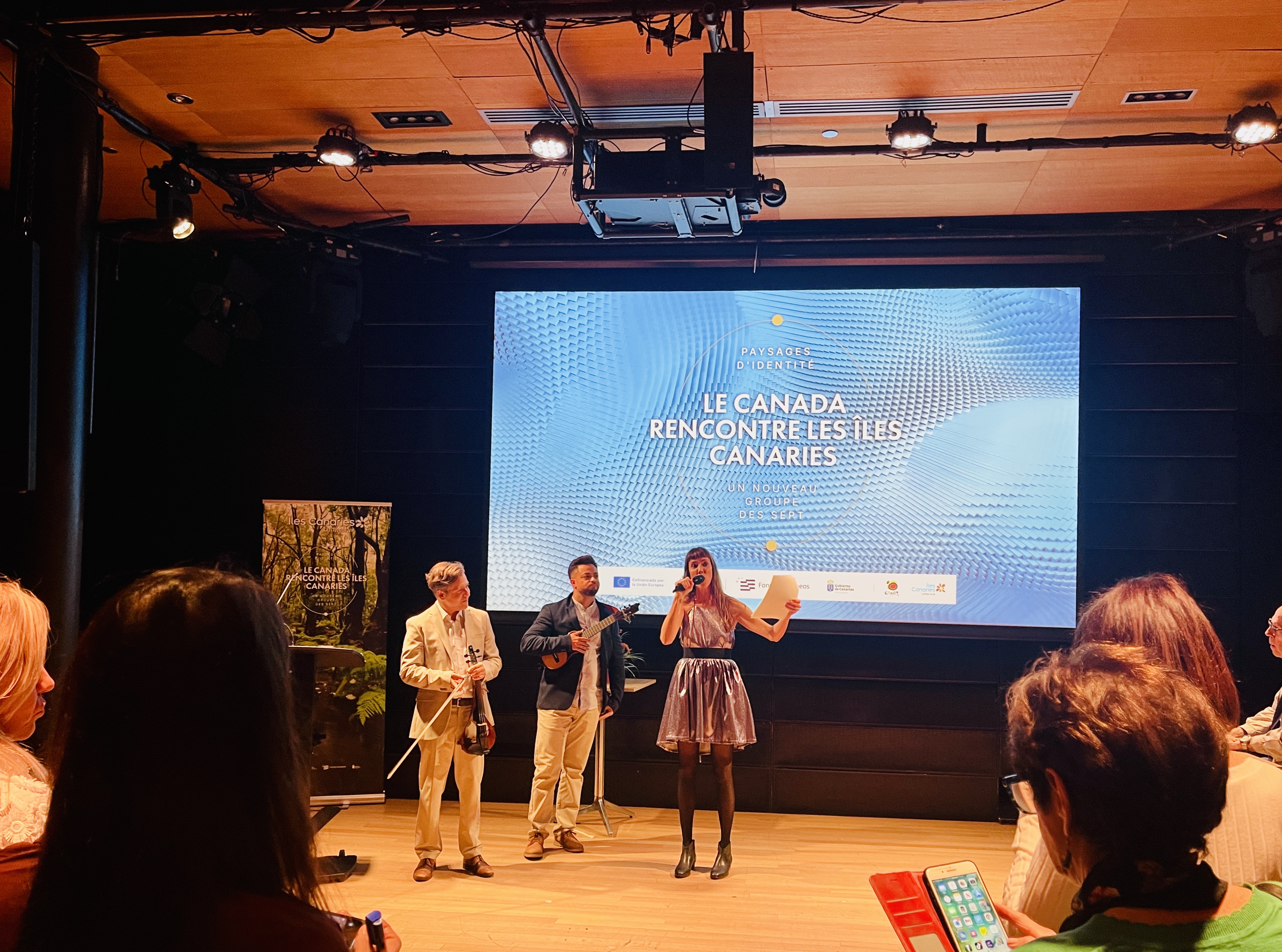
L'animatrice de la soirée, la présentatrice culturelle Catherine Pogonat, a présenté les musiciens canariens.
La musique n’était pas un élément isolé. Au fil de la soirée, la présence canarienne est devenue de plus en plus tangible: les représentants des hôtels et des offices de tourisme étaient venus à Montréal pour rencontrer directement le marché canadien, mais il y avait aussi un chef, une sommelière, des membres de l’équipe de cuisine, des musiciens et des produits provenant des îles elles-mêmes.
L’impression était celle d’une équipe resserrée et diversifiée qui avait choisi d’apporter bien plus que de l’information touristique. Plutôt que de se contenter d’expliquer ce que sont les Canaries, la soirée cherchait à les rendre perceptibles à travers différents langages: les images et les vidéos montraient les paysages; les représentants parlaient de leurs hôtels et de leurs territoires; la musique offrait une autre façon de découvrir l’archipel; et la gastronomie permettait de l’explorer par le goût.
Le changement d’espace a aussi modifié le rythme de la rencontre. Après les échanges professionnels: cartes de visite, dépliants, écrans et conversations sur l’hébergement et les services, les participants se sont rassemblés, un verre de vin à la main, dans l’attente de la dégustation. La présentation prenait une autre dimension: en plus de montrer les paysages et les possibilités d’hébergement, elle invitait à découvrir les îles par la musique et la gastronomie.
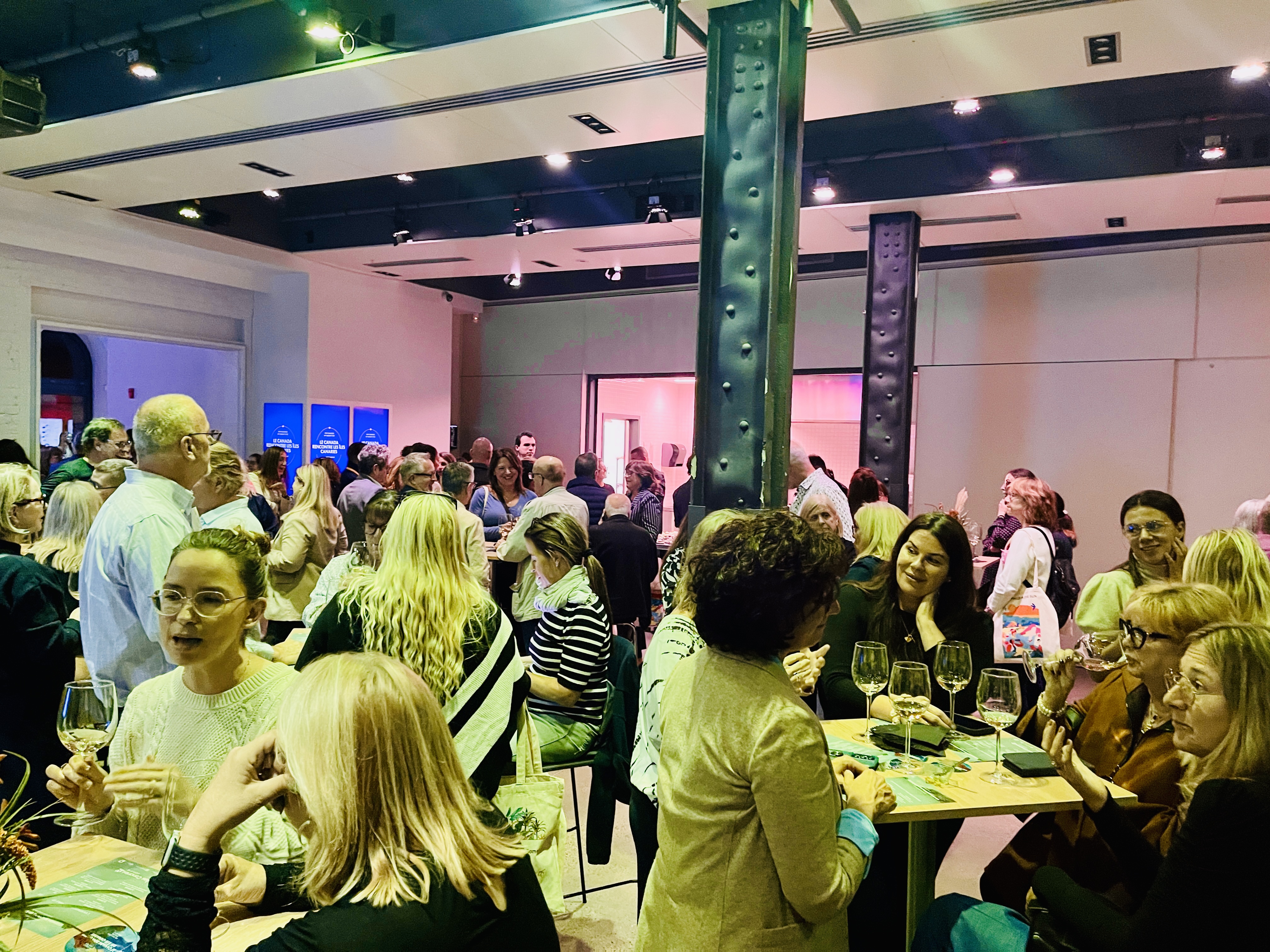
Dans une ambiance chaleureuse, verre de vin à la main, les participants s’apprêtent à déguster des tapas des îles Canaries lors de la rencontre organisée à Montréal.
La gastronomie est venue compléter cette découverte. Le chef Manuel Berriel et la sommelière Trinidad Fumero, tous deux originaires des Canaries, ont présenté les différentes tapas en expliquant leurs ingrédients, leur provenance et certaines particularités de la cuisine de l’archipel. Il ne s’agissait pas simplement de servir une dégustation: chaque préparation était accompagnée d’explications permettant de comprendre l’origine de ces saveurs et la façon dont différents produits et traditions se rencontrent dans la cuisine canarienne.
Les mojos, ces sauces typiques des Canaries, les fromages, le poisson, le lapin, les pommes de terre et le gofio ont été servis sous des formes très différentes. Le gofio, élaboré à partir de céréales grillées et profondément ancré dans les traditions alimentaires des îles, figurait aussi dans les desserts, montrant comment un ingrédient traditionnel peut être réinterprété dans une cuisine contemporaine.
Trois vins canariens accompagnaient les dégustations. La sommelière en expliquait les caractéristiques et les accords au fil du repas : un blanc pour les premières préparations, un rouge avec les saveurs plus intenses, puis un vin au profil plus doux avec les desserts. L’occasion a également permis de parler des cépages et des conditions particulières de la viticulture sur un territoire volcanique. L’archipel compte 11 appellations d’origine protégées (AOP).
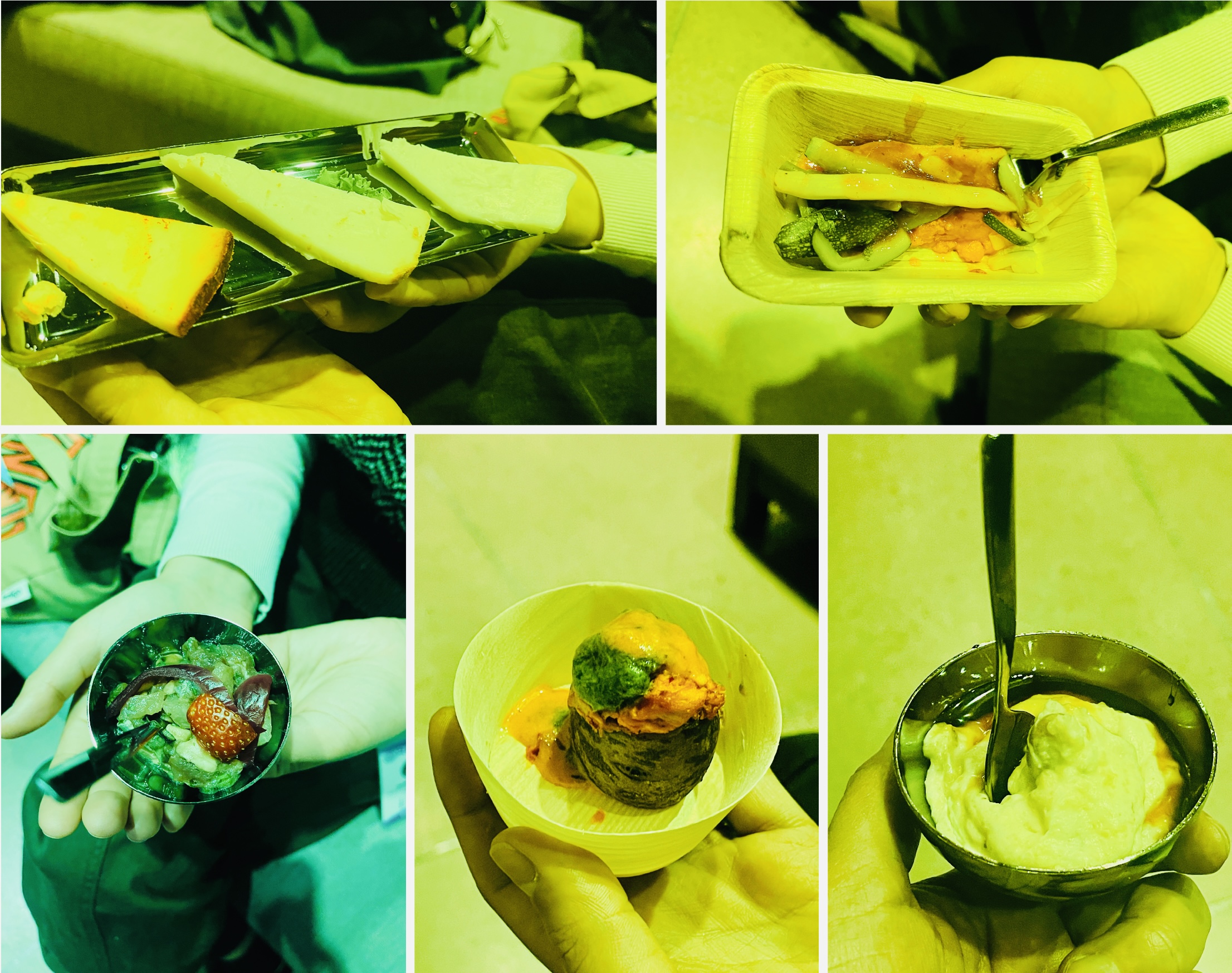
Un aperçu des saveurs des îles Canaries présentées lors de la dégustation gastronomique à Montréal.
Plus que de reproduire à Montréal un repas que l’on pourrait trouver dans n’importe quel restaurant espagnol, l’intention semblait être de montrer que les îles peuvent aussi se découvrir à travers leur propre tradition gastronomique. La cuisine devenait ainsi une autre forme de paysage: un paysage qui ne se contemple pas, mais qui se goûte.
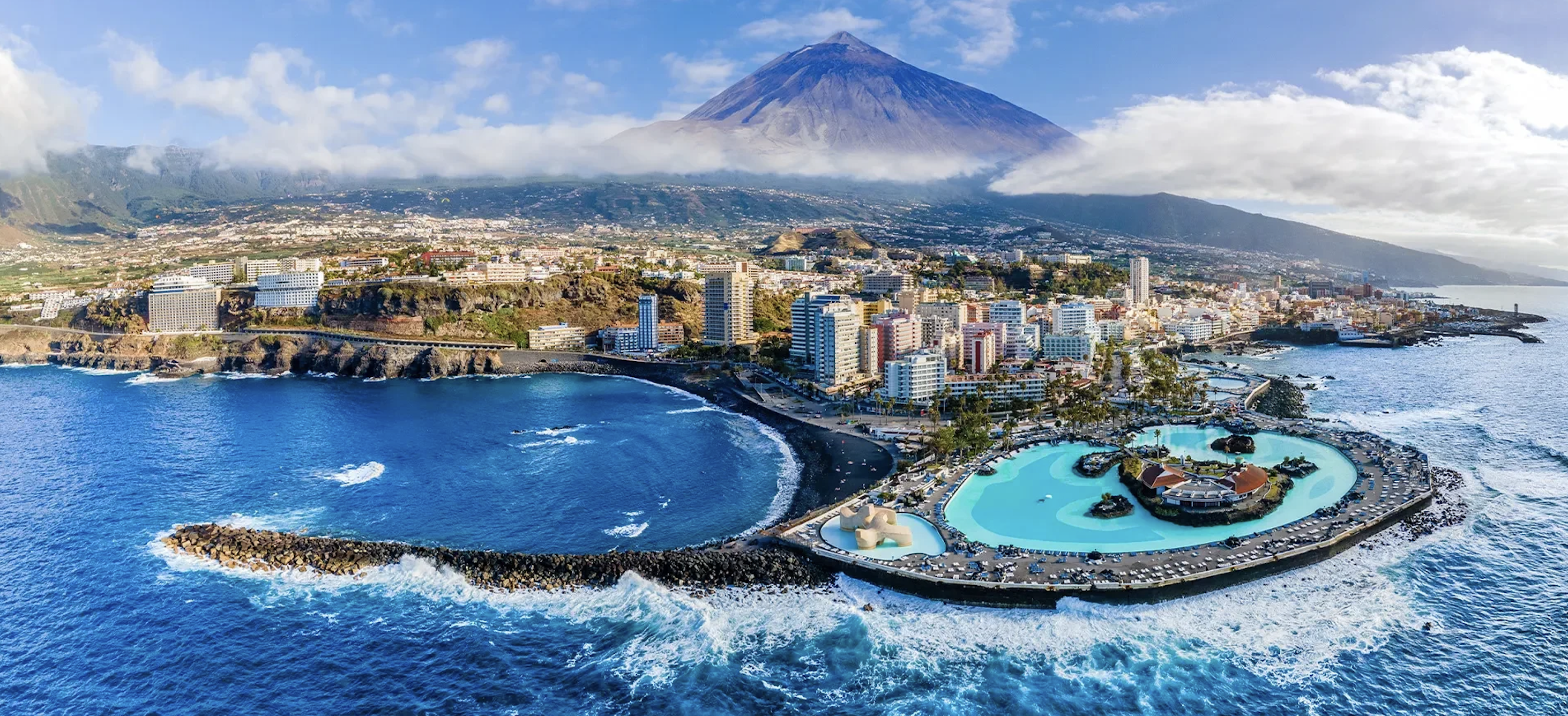
Les images projetées pendant la soirée venaient compléter ce que les tables des hôtels et la dégustation ne pouvaient raconter à elles seules. Plages, volcans, forêts, sentiers et ciels étoilés offraient autant de façons de parcourir un même territoire, géographiquement très éloigné de Montréal, mais présenté comme particulièrement accessible grâce aux nouvelles liaisons aériennes.
La nature occupait une place centrale dans la présentation. Plutôt que de miser uniquement sur l’idée de vacances au bord de la mer, les représentants ont insisté sur la diversité des paysages et des activités de l’archipel : randonnée, forêts, observation des étoiles et découverte des territoires volcaniques. La préservation des milieux naturels et le développement durable ont également été évoqués à plusieurs reprises.
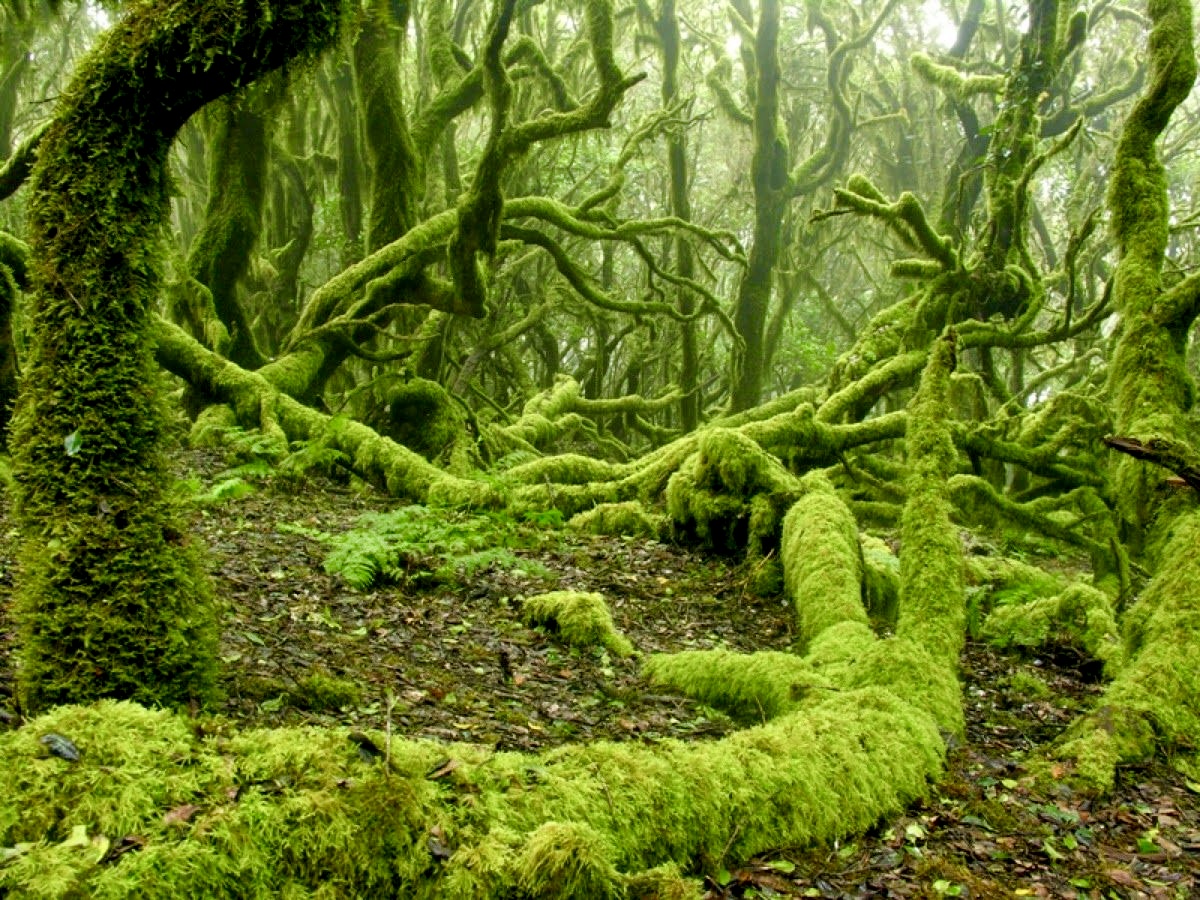
Parc national de Garajonay, à La Gomera. Photo : Bitácora Almedrón
Pour le public canadien, un autre argument était difficile à ignorer à l’approche de la saison froide: le climat. Les îles Canaries ont été présentées comme une destination aux températures douces toute l’année, une sorte de printemps presque permanent qui contraste avec les mois d’hiver à venir au Québec.
Mais l’élément le plus significatif de la soirée n’était peut-être ni une température précise ni l’image spectaculaire d’un volcan. C’était la possibilité de s’y rendre directement. Tenerife et Grande Canarie, deux des principales portes d’entrée de l’archipel, n’exigeraient plus nécessairement une correspondance en Europe pour les voyageurs au départ de Montréal.
Air Canada a présenté sa nouvelle liaison directe vers Tenerife, assurée par un Airbus A321XLR. D’une durée d’environ six heures et demie, le vol sera offert une fois par semaine, le samedi, pendant la saison hivernale. De son côté, Air Transat inaugurera le 12 décembre sa liaison Montréal-Las Palmas de Grande Canarie, également hebdomadaire, d’une durée approximative de sept heures et assurée par un Airbus A321LR.
Deux liaisons, deux îles d’arrivée et une même évolution: les Canaries passent du statut de destination que de nombreux voyageurs québécois associaient à un trajet plus long et à une correspondance en Europe à celui d’une destination accessible par vol direct, au moment où Montréal entre dans la saison froide.
Pendant la dégustation, un moment est venu rappeler la dimension institutionnelle de la soirée. L’ambassadeur d’Espagne au Canada, Alfredo Martínez Serrano, a pris la parole pendant le dîner, après que Catherine Pogonat eut annoncé sa présence et lui eut cédé la parole.
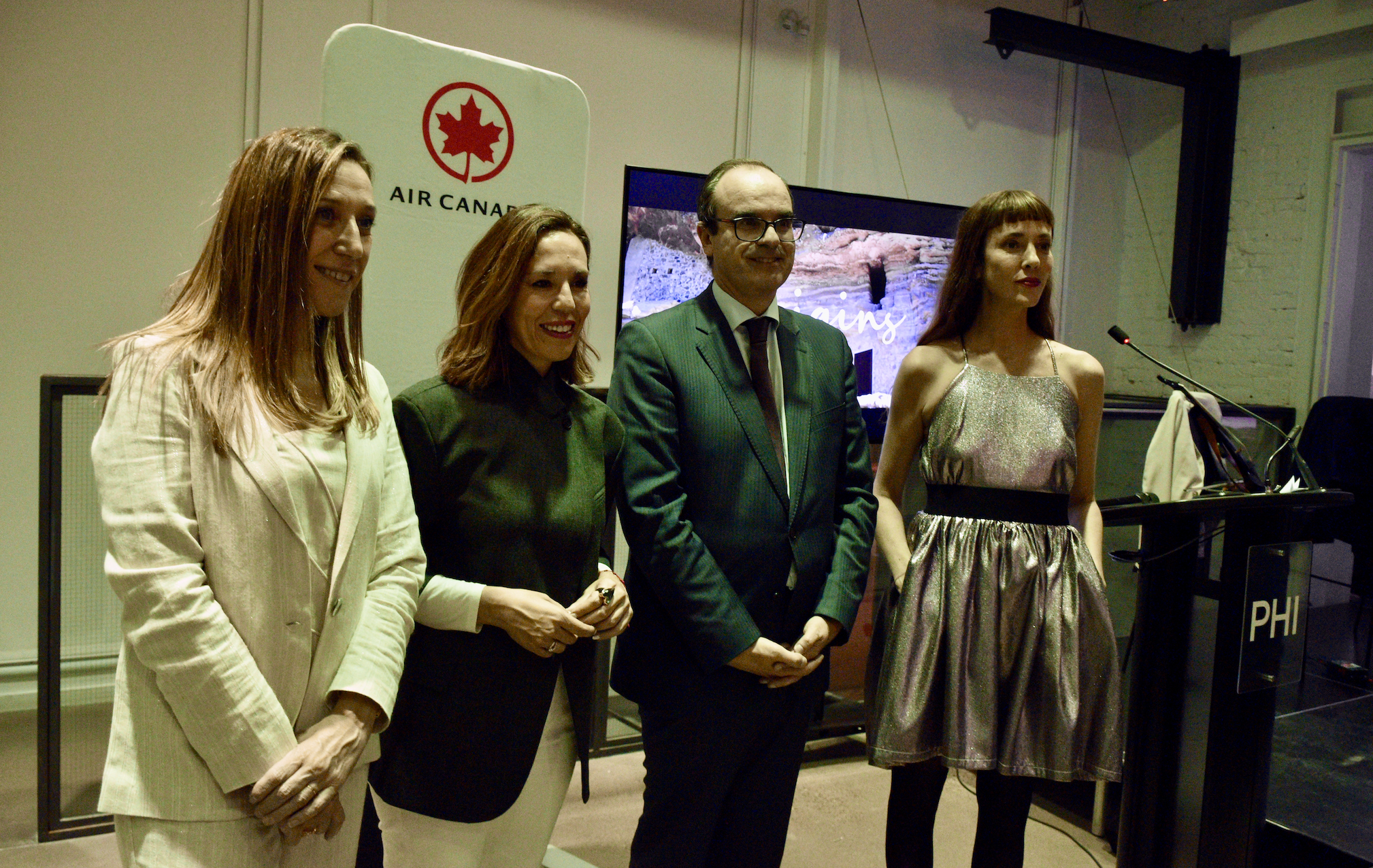
L’ambassadeur d’Espagne au Canada, Alfredo Martínez Serrano, en compagnie de Jessica de León Verdugo, ministre du Tourisme et de l’Emploi des îles Canaries, d’Isabel Martín Benítez, conseillère au tourisme à l’ambassade d’Espagne au Canada, et de Catherine Pogonat, qui animait la rencontre.
Son intervention a replacé dans une perspective plus large ce que les participants avaient jusque-là découvert à travers les images, les conversations, la musique et la gastronomie: les nouvelles liaisons s’inscrivent dans un intérêt plus large visant à renforcer les liens touristiques entre l’Espagne et le Canada et, plus particulièrement, à rapprocher les îles Canaries du marché québécois.
La présence de l’ambassadeur a également rappelé que, derrière une nouvelle liaison aérienne, il y a plus qu’une possibilité supplémentaire de voyager. Pour les autorités espagnoles et canariennes, établir un accès direct depuis Montréal représente une porte d’entrée vers un marché canadien qui devait jusqu’ici recourir plus souvent à des correspondances en Europe pour rejoindre l’archipel.
Le lendemain, une partie de la délégation devait poursuivre sa tournée à Toronto pour y présenter la destination. Pour plusieurs représentants canariens, le voyage avait aussi une dimension personnelle: ils découvraient Montréal pour la première fois et étaient curieux de connaître une ville qui, contrairement aux îles, était déjà entrée dans l’automne.
Le parcours des tables avait aussi sa récompense finale. Une fois atteint le nombre minimal de visites indiqué sur la carte, les participants pouvaient prendre part à un tirage au sort qui témoignait, lui aussi, de l’ampleur de la présence canarienne à Montréal.
Les établissements participants avaient offert de nombreux prix: des séjours dans des hôtels de différentes îles et, dans certains cas, des forfaits comprenant également une voiture de location. Air Canada et Air Transat avaient ajouté des billets d’avion à la liste. Après une soirée consacrée à expliquer où dormir, quoi faire, quoi manger et comment s’y rendre, le tirage au sort introduisait une possibilité très concrète: celle de découvrir personnellement ce qui, jusque-là, avait été présenté à travers un écran, une conversation, un verre de vin ou une tapa.
C’est peut-être là que résidait l’aspect le plus intéressant de la soirée. Les îles Canaries ne se sont pas présentées à Montréal uniquement comme une destination ensoleillée où échapper à l’hiver. La proposition était beaucoup plus vaste et reposait surtout sur le contact direct: des représentants qui parlaient de leurs territoires, des images qui montraient leurs paysages, de la musique interprétée par des artistes canariens, une gastronomie présentée par ceux qui la connaissent de l’intérieur et de nouvelles liaisons aériennes capables de transformer cette distance géographique en un trajet de quelques heures.
À l’approche du froid, les îles Canaries cherchent à occuper une place différente dans l’imaginaire des voyageurs canadiens. Pas seulement comme un lieu où se rendre, mais comme un territoire qui, le temps d’une soirée, a fait le voyage en sens inverse et est venu se présenter ici.
En Montreal, octubre ya comienza a cambiar la luz, la temperatura desciende y el invierno se anuncia a lo lejos. En ese contexto, las Islas Canarias llegaron a la ciudad una noche de octubre, no solamente para presentar dos nuevas rutas aéreas, sino para intentar acercar su paisaje, su cultura y su hospitalidad a quienes podrían convertirse en sus próximos visitantes.
El encuentro, celebrado el lunes 5 de octubre en el Centre PHI, en el Viejo Montreal, reunió a representantes de aerolíneas, oficinas de turismo, hoteles y otros actores de la industria turística de las islas. Durante unas horas, el espacio dedicado habitualmente al arte contemporáneo y a la creación se convirtió en un punto de encuentro entre Montreal y un archipiélago situado frente a las costas del noroeste de África, perteneciente a España y a la Unión Europea.
Un encuentro con el sector turístico
La ocasión tenía además un elemento muy concreto: por primera vez, los viajeros de Montreal contarían con conexiones directas con las Islas Canarias a través de dos de sus principales aeropuertos. Air Canada comenzará a operar su ruta Montreal–Tenerife el 31 de octubre, mientras Air Transat inaugurará el 12 de diciembre su conexión directa entre Montreal y Gran Canaria. Ambas serán rutas semanales durante la temporada de invierno.
Air Canada ha presentado su nueva conexión directa entre Montreal y Tenerife, cuyo primer vuelo está previsto para el 31 de octubre de 2026. El servicio se ofrecerá una vez a la semana, los sábados, hasta el 24 de abril de 2027.
La presentación no siguió el formato habitual de una conferencia en la que el público permanece sentado mientras escucha una sucesión de discursos. A la entrada, los asistentes recibieron una tarjeta horizontal que funcionaba como guía de un recorrido por las distintas propuestas turísticas presentes esa noche.
Air Transat presentó su nueva conexión directa entre Montreal y Las Palmas de Gran Canaria. El primer vuelo está previsto para el 12 de diciembre de 2026 y el servicio operará una vez por semana, los sábados, hasta el 4 de abril de 2027.
Había alrededor de 24 mesas, cada una dedicada a un hotel, grupo hotelero, oficina de turismo u otro representante de las islas. Para participar en el sorteo que cerraría la velada era necesario visitar al menos 12 de ellas y obtener en cada una la firma correspondiente. Así, lo que podía haber sido una larga sesión de presentaciones se convirtió en una circulación constante de asesores de viajes y periodistas por el espacio.
Entre los grupos hoteleros que participaron estuvieron Bahía del Duque y los hoteles Tais, en Tenerife; el grupo Fred. Olsen y su Hotel Jardín Tecina, en La Gomera; Spring Hotels Group y Coral Hotels, también en Tenerife; Cordial Hotels & Resorts y Bohemia Suites & Spa, en Gran Canaria; Abama Hotels y Gran Hotel Taoro, en Tenerife; Livvo Hotel Group, en Gran Canaria; el grupo Meliá y el Hotel Hacienda del Conde, además del grupo Hyatt, entre otros.
Cada mesa ofrecía una aproximación diferente al archipiélago. Los representantes explicaban directamente la ubicación de sus establecimientos, el número y tipo de habitaciones, sus instalaciones y los servicios que los distinguen. Algunos utilizaban tabletas o computadoras para mostrar imágenes y detalles de sus hoteles; otros se apoyaban en folletos, pequeños displays o simplemente en la conversación.
Manuel Rodríguez, Director Comercial de Coral Hotels.
En la mesa de Fred. Olsen y del Hotel Jardín Tecina había, además, un pequeño gesto que iba más allá de la información turística: galletas elaboradas en La Gomera que los asistentes podían probar. Un detalle singular que hacía que aquella isla, hasta entonces conocida a través de un nombre en una tarjeta, adquiriera por un instante un sabor propio.
Música, sabores y paisajes de las islas
Después del recorrido por las mesas, la dinámica cambió. Los asistentes pasaron a otro espacio, dispuesto con mesas altas y algunos sofás, donde comenzó la parte más sensorial de la velada. Un dúo de músicos procedentes de las Islas Canarias acompañaba el encuentro con ritmos del archipiélago, utilizando instrumentos de cuerda entre los que destacaban el violín y un timple (pequeña guitarra tradicional de origen canario).
La anfitriona de la velada, la presentadora cultural Catherine Pogonat, presentado a los músicos canarios.
La música no era un elemento aislado. A lo largo de la noche, la presencia canaria se fue haciendo cada vez más tangible: los representantes de los hoteles y las oficinas de turismo habían viajado hasta Montreal para encontrarse directamente con el mercado canadiense, pero también habían llegado un chef, un sommelier, asistentes de cocina, músicos y productos de las propias islas.
La impresión era la de un equipo compacto y diverso que había decidido traer consigo algo más que información turística. En lugar de limitarse a explicar cómo son las Canarias, la velada buscaba hacerlas perceptibles a través de distintos lenguajes: las imágenes y videos mostraban sus paisajes; los representantes hablaban de sus hoteles y territorios; la música aportaba otra forma de reconocer el lugar; y la gastronomía permitía descubrirlo a través del gusto.
El cambio de espacio marcó también un cambio en el ritmo del encuentro. Después del intercambio profesional (tarjetas, folletos, pantallas y conversaciones sobre alojamientos y servicios), los asistentes se reunieron con sus copas de vino a la espera de la degustación. La presentación comenzaba a adquirir otra dimensión: además de mostrar los paisajes y las posibilidades de alojamiento, proponía acercarse a las islas a través de la música y la gastronomía.
Con un ambiente ameno y sus copas de vino, los asistentes se preparan para degustar tapas de las Islas Canarias durante el encuentro celebrado en Montreal.
La gastronomía terminó de completar ese acercamiento. El chef Manuel Berriel y la sommelier Trinidad Fumero, ambos procedentes de las Canarias, fueron presentando las distintas tapas mientras explicaban sus ingredientes, sus procedencias y algunas de las particularidades de la cocina del archipiélago. No se trataba solamente de servir una degustación: cada preparación venía acompañada de una explicación que permitía entender de dónde surgían esos sabores y cómo distintos productos y tradiciones se encuentran en la cocina canaria.
Los mojos (salsas canarias), los quesos, el pescado, el conejo, las papas y el gofio aparecieron a lo largo de la degustación en preparaciones muy distintas entre sí. El gofio, elaborado a partir de cereales tostados y profundamente ligado a la tradición alimentaria de las islas, tuvo además presencia en los postres, mostrando cómo un ingrediente de origen tradicional puede trasladarse a una cocina contemporánea.
Los sabores fueron acompañados por tres vinos canarios. La sommelier fue explicando sus características y los maridajes a medida que avanzaba la comida: un blanco para las primeras preparaciones, un tinto para los sabores más intensos y un vino de perfil más dulce hacia el final, junto con los postres. También hubo espacio para hablar de las variedades de uva y de las condiciones particulares en las que se cultiva la vid en un territorio volcánico. El archipiélago cuenta con 11 Denominaciones de Origen Protegidas (DOP).
Una muestra de los sabores de las Islas Canarias presentados durante la degustación gastronómica en Montreal.
Más que reproducir en Montreal una comida que pudiera encontrarse en cualquier restaurante español, la intención parecía ser otra: mostrar que las islas también pueden reconocerse a través de su propia tradición gastronómica. La comida funcionaba así como otra forma de paisaje, una que no se contempla, sino que se prueba.
Las imágenes proyectadas durante la velada ayudaban a completar aquello que las mesas de los hoteles y la degustación no podían contar por sí solas. Playas, volcanes, bosques, senderos y cielos estrellados nocturnos aparecían como distintas maneras de recorrer un mismo territorio, muy alejado geográficamente de Montreal pero presentado como un destino particularmente accesible a partir de las nuevas conexiones aéreas.
La naturaleza ocupó un lugar central en la presentación. Más que vender únicamente la idea de unas vacaciones frente al mar, los representantes insistieron en la diversidad de paisajes y actividades que ofrece el archipiélago: desde el senderismo y los bosques hasta la observación de estrellas y los territorios volcánicos. También apareció de manera recurrente la preocupación por la conservación y el desarrollo sostenible.
Parque Nacional de Garajonay, en La Gomera. Foto: Bitácora Almedrón
Para el público canadiense había, además, un argumento difícil de ignorar al comenzar la temporada fría: el clima. Las Canarias se presentaron como un territorio de temperaturas suaves durante todo el año, una especie de primavera permanente que contrasta con los meses de invierno que se avecinan en Quebec.
Pero quizá el dato más significativo de la noche no estaba en una cifra de temperatura ni en una imagen espectacular de un volcán. Era la posibilidad de llegar directamente. Tenerife y Gran Canaria, dos de las principales puertas de entrada al archipiélago, dejaban de requerir necesariamente una conexión europea para quien partiera de Montreal.
Air Canada presentó su nueva ruta directa hacia Tenerife, operada con un Airbus A321XLR, con una duración aproximada de seis horas y media. El servicio comenzará el 31 de octubre y tendrá una frecuencia semanal los sábados durante la temporada de invierno. Por su parte, Air Transat inaugurará el 12 de diciembre su conexión Montreal–Las Palmas de Gran Canaria, también semanal, con una duración aproximada de siete horas y operada con un Airbus A321LR.
Dos rutas, dos islas de llegada y una misma transformación: las Canarias pasan de ser un destino que muchos viajeros de Quebec asociaban con un trayecto más largo y una conexión en Europa a convertirse en una opción de viaje directo durante los meses en que Montreal entra en su temporada más fría.
Mientras avanzaba la degustación, hubo también un momento que devolvió la velada a su dimensión institucional. El embajador de España en Canadá, Alfredo Martínez Serrano, tomó la palabra durante la cena, después de que Catherine Pogonat anunciara su presencia y le cediera el espacio.
El embajador de España en Canadá, Alfredo Martínez Serrano, junto a Jessica de León Verdugo, ministra de Turismo y Empleo de las Islas Canarias; Isabel Martín Benítez, consejera de Turismo de la Embajada de España en Canadá; y la anfitriona del encuentro, Catherine Pogonat.
Su intervención puso en perspectiva lo que hasta entonces se había experimentado principalmente a través de imágenes, conversaciones, música y comida: las nuevas rutas forman parte de un interés más amplio por estrechar los vínculos turísticos entre España y Canadá y, en particular, por acercar las Islas Canarias al mercado de Quebec.
La presencia del embajador también recordó que detrás de una nueva conexión aérea hay algo más que una posibilidad adicional para viajar. Para las autoridades españolas y canarias, establecer un acceso directo desde Montreal representa una puerta de entrada a un mercado canadiense que hasta ahora tenía que recurrir con mayor frecuencia a conexiones europeas para llegar al archipiélago.
Al día siguiente, parte de la delegación continuaría su recorrido hacia Toronto para presentar allí el destino. Para varios de los representantes canarios, además, el viaje tenía un componente personal: muchos estaban conociendo Montreal por primera vez y habían llegado con curiosidad por encontrarse con una ciudad que, a diferencia de las islas, estaba entrando ya en el otoño.
El recorrido de las mesas tenía una recompensa final. Una vez completado el número mínimo de visitas indicado en la tarjeta, los asistentes podían participar en un sorteo que terminó convirtiéndose en otra muestra de la amplitud de la delegación reunida en Montreal.
Había numerosos premios ofrecidos por los establecimientos participantes: estancias en hoteles de distintas islas y, en algunos casos, paquetes que incluían también vehículos de alquiler. Air Canada y Air Transat sumaron vuelos a la lista de posibilidades. Después de una noche dedicada a explicar dónde dormir, qué hacer, qué comer y cómo llegar, el sorteo introducía un elemento inesperadamente concreto: la posibilidad de experimentar en primera persona aquello que hasta entonces se había conocido a través de una pantalla, una conversación, una copa de vino o una tapa.
Quizá esa fue la característica más interesante de la velada. Las Islas Canarias no se presentaron en Montreal únicamente como un destino de sol para escapar del invierno. La propuesta fue mucho más amplia y, sobre todo, estuvo construida a partir del contacto directo: representantes que hablaban de sus territorios, imágenes que mostraban sus paisajes, música interpretada por artistas canarios, una gastronomía explicada por quienes la conocen desde su origen y nuevas rutas aéreas capaces de convertir esa distancia geográfica en un trayecto de unas pocas horas.
Cuando Montreal comienza a prepararse para el frío, las Canarias buscan ocupar un espacio diferente en el imaginario del viajero canadiense. No solamente como un lugar al que llegar, sino como un territorio que, durante una noche, hizo el viaje en sentido contrario y se presentó aquí.

Pour souligner son 8e titre Skytrax de Meilleure compagnie aérienne loisirs au monde, Air Transat veut remercier sa clientèle. Entre le 5 et le 18 octobre 2026, chaque nouvelle réservation de vol effectuée donne automatiquement la chance de voyager gratuitement.

FORT-DE-FRANCE, Martinique (October 2, 2026) – Alexandre Ventadour has been named tourism commissioner of the Martinique Tourism Authority (MTA), ushering in a new phase of strategic leadership focused on strengthening Martinique’s position as a leading French-Caribbean destination.





Más Noticias (more news)



-
-
-
-
-
-

-
-
-

Harmonium Symphonique - Histoire sans paroles - Le film
-

Fitcuba 2024
-

-

Conozca Omán: País anfitrión oficial de ITB Berlín 2024
-

L'est de Cuba par Yannick Gervais
-

Revivez en images les temps forts de la 36e édition du Festival international Nuits d’Afrique, qui s'est déroulée à Montréal du 12 au 24 juillet 2022 ! Pendant 13 jours de programmation, 150 concerts et activités ont marqué cette année de grandes réalisations et de grandes retrouvailles ! Un événement qui s'est déroulé en salle et en plein-air, avec l'agrandissement du site extérieur et l'ajout d'une deuxième scène. On a voyager à travers le monde en musiques, avec de belles nouveautés. On vous donne rendez-vous l'année prochaine, pour une 37e édition, du 11 au 23 juillet 2023 !
-

Hello fellow travelers. Welcome to Travelmoji. We are a community of travel enthusiasts who find solace going around the world. In our sincerest efforts to satisfy your wanderlust, we bring forward insightful content featuring the wonderful places around the world neatly compiled into the ‘Top things to-do lists. We love all kinds of travel. Touristy and offbeat, short trips and long stays, luxury and modest. And we aim to give you a glimpse of anything and everything that speaks about the aura of the place. Our vision at Travelmoji is to form a community of like-minded travellers, who share our passion for unique experiences, breathtaking destinations, exploring different cultures, and connecting with people. Unplug, unwind and just breathe.
Sed tempus velit
Cras fringilla magna eros, eu ultricies velit mattis at. Sed tempus velit ac magna rutrum ullamcorper.
Aliquam fringilla tristique erat, id malesuada turpis congue vitae. Duis eget euismod dolor. Etiam ac tincidunt ipsum. Morbi ullamcorper erat et bibendum fermentum. Mauris consequat accumsan metus in vulputate. Proin odio ipsum, malesuada in arcu egestas, viverra tincidunt leo. Etiam fermentum felis consectetur fermentum auctor. Curabitur quis maximus turpis, eu porttitor velit. Praesent id sem porta, tristique massa et, euismod ante. Sed semper mauris metus.
Aenean at est
Proin suscipit nulla nec justo suscipit pulvinar. Vestibulum lobortis, tortor non sagittis elementum, nibh ligula vulputate purus, pharetra euismod ex augue a metus. Nullam fermentum lobortis risus, et placerat tellus malesuada at. Aenean at est massa.
-

fsdf kfs; kdf;s kd;fks df
At Viva Resorts by Wyndham, fun is part of the all-inclusive experience. Across its collection of beachfront resorts in the Dominican Republic, Mexico and the Bahamas, guests can fill their days with sports, water activities, entertainment, excursions and time together, creating a vacation that is as active, social or relaxing as they want it to be. With beautiful Caribbean beaches as the backdrop, Viva offers travelers more ways to enjoy every moment of their stay.
Miches, Dominican Republic — Zemi Miches Punta Cana All-Inclusive Resort, Curio Collection by Hilton, has been recognized with the prestigious AAA Four Diamond distinction, one of the highest honors in the AAA Diamond program for hospitality establishments in North America.
Un nuevo vuelo directo desde Montreal invita a descubrir los Andes, la Amazonía, la costa del Pacífico y las islas Galápagos.
Tras el anuncio del nuevo vuelo directo de Air Canada entre Montreal y Quito, a partir del 4 de diciembre, la Oficina Regional de Quito, la Cámara de Turismo de Pichincha (CAPTUR) y la aerolínea organizaron un encuentro en el Hotel W de Montreal para presentar los atractivos turísticos de la capital ecuatoriana y las experiencias que ofrece el país, incluidas las emblemáticas islas Galápagos.
Air Transat, en collaboration avec GoTürkiye, souligne le succès d’un voyage de familiarisation organisé du 12 au 18 septembre 2026 en Türkiye avec une dizaine de partenaires de l’industrie touristique canadienne. Réunissant des professionnels au départ de Toronto et Montréal, cette initiative a permis de mettre en valeur la richesse culturelle, historique et gastronomique de la destination tout en renforçant les liens entre les marchés canadien et turc.
À Montréal, en octobre, la lumière commence déjà à changer, la température baisse et l’hiver se profile au loin. C’est dans ce contexte que les îles Canaries sont venues dans la métropole le temps d’une soirée, non seulement pour présenter deux nouvelles liaisons aériennes, mais aussi pour rapprocher leurs paysages, leur culture et leur hospitalité des voyageurs qui pourraient bientôt leur rendre visite.
L’événement, qui s’est tenu le lundi 5 octobre au Centre PHI, dans le Vieux-Montréal, a réuni des représentants de compagnies aériennes, d’offices de tourisme, de groupes hôteliers et d’autres acteurs de l’industrie touristique des îles. Pendant quelques heures, ce lieu habituellement consacré à l’art contemporain et à la création est devenu un point de rencontre entre Montréal et un archipel situé au large de la côte nord-ouest de l’Afrique, qui fait partie de l’Espagne et de l’Union européenne.
Une rencontre avec le secteur touristique
L’occasion comportait aussi un élément très concret: pour la première fois, les voyageurs au départ de Montréal pourraient rejoindre directement les îles Canaries par deux des principaux aéroports de l’archipel. Air Canada commencera à exploiter sa liaison Montréal-Tenerife le 31 octobre, tandis qu’Air Transat inaugurera sa liaison directe entre Montréal et Grande Canarie le 12 décembre. Les deux transporteurs proposeront un vol par semaine pendant la saison hivernale.
Air Canada a présenté sa nouvelle liaison directe entre Montréal et Tenerife, dont le premier vol est prévu le 31 octobre 2026. Le service sera offert une fois par semaine, le samedi, jusqu’au 24 avril 2027.
La présentation ne suivait pas le format habituel d’une conférence où le public reste assis à écouter une succession de discours. À leur arrivée, les participants ont reçu une carte au format horizontal qui servait de guide pour parcourir les différentes offres touristiques présentées ce soir-là.
Air Transat a présenté sa nouvelle liaison directe entre Montréal et Las Palmas de Gran Canaria. Le premier vol est prévu le 12 décembre 2026, et le service sera offert une fois par semaine, le samedi, jusqu’au 4 avril 2027.
Environ 24 tables étaient installées, chacune consacrée à un hôtel, à un groupe hôtelier, à un office de tourisme ou à un autre représentant des îles. Pour participer au tirage au sort qui clôturerait la soirée, il fallait en visiter au moins 12 et faire signer la carte à chacune. Ainsi, ce qui aurait pu être une longue série de présentations s’est transformé en un parcours animé où conseillers en voyages et journalistes circulaient d’une table à l’autre.
Parmi les groupes hôteliers présents figuraient Bahía del Duque et les hôtels Tais, à Tenerife; le groupe Fred. Olsen et son Hôtel Jardín Tecina, à La Gomera; Spring Hotels Group et Coral Hotels, également à Tenerife; Cordial Hotels & Resorts et Bohemia Suites & Spa, à Grande Canarie; Abama Hotels et Gran Hotel Taoro, à Tenerife; LIVVO Hotel Group, à Grande Canarie; le groupe Meliá et l’Hôtel Hacienda del Conde, ainsi que le groupe Hyatt, entre autres.
Chaque table offrait une approche différente de l’archipel. Les représentants présentaient directement l’emplacement de leurs établissements, le nombre et le type de chambres, les installations et les services qui les distinguent. Certains utilisaient des tablettes ou des ordinateurs pour montrer des photos et présenter les caractéristiques de leurs hôtels; d’autres s’appuyaient sur des dépliants, de petits présentoirs ou simplement sur la conversation.
Manuel Rodríguez, directeur commercial de Coral Hotels.
À la table de Fred. Olsen et de l’Hôtel Jardín Tecina, il y avait aussi une petite attention qui allait au-delà de l’information touristique: des biscuits préparés à La Gomera que les participants pouvaient goûter. Un geste singulier qui donnait, le temps d’un instant, une saveur bien à elle à cette île jusque-là connue à travers un nom sur une carte.
Musique, saveurs et paysages des îles
Après le parcours des tables, le rythme a changé. Les participants sont passés dans un autre espace, aménagé avec des tables hautes et quelques canapés, où a commencé la partie plus sensorielle de la soirée. Un duo de musiciens originaires des îles Canaries a accompagné la rencontre au son de rythmes de l’archipel, avec des instruments à cordes, dont le violon et le timple, un petit instrument traditionnel canarien qui ressemble à une guitare.
L'animatrice de la soirée, la présentatrice culturelle Catherine Pogonat, a présenté les musiciens canariens.
La musique n’était pas un élément isolé. Au fil de la soirée, la présence canarienne est devenue de plus en plus tangible: les représentants des hôtels et des offices de tourisme étaient venus à Montréal pour rencontrer directement le marché canadien, mais il y avait aussi un chef, une sommelière, des membres de l’équipe de cuisine, des musiciens et des produits provenant des îles elles-mêmes.
L’impression était celle d’une équipe resserrée et diversifiée qui avait choisi d’apporter bien plus que de l’information touristique. Plutôt que de se contenter d’expliquer ce que sont les Canaries, la soirée cherchait à les rendre perceptibles à travers différents langages: les images et les vidéos montraient les paysages; les représentants parlaient de leurs hôtels et de leurs territoires; la musique offrait une autre façon de découvrir l’archipel; et la gastronomie permettait de l’explorer par le goût.
Le changement d’espace a aussi modifié le rythme de la rencontre. Après les échanges professionnels: cartes de visite, dépliants, écrans et conversations sur l’hébergement et les services, les participants se sont rassemblés, un verre de vin à la main, dans l’attente de la dégustation. La présentation prenait une autre dimension: en plus de montrer les paysages et les possibilités d’hébergement, elle invitait à découvrir les îles par la musique et la gastronomie.
Dans une ambiance chaleureuse, verre de vin à la main, les participants s’apprêtent à déguster des tapas des îles Canaries lors de la rencontre organisée à Montréal.
La gastronomie est venue compléter cette découverte. Le chef Manuel Berriel et la sommelière Trinidad Fumero, tous deux originaires des Canaries, ont présenté les différentes tapas en expliquant leurs ingrédients, leur provenance et certaines particularités de la cuisine de l’archipel. Il ne s’agissait pas simplement de servir une dégustation: chaque préparation était accompagnée d’explications permettant de comprendre l’origine de ces saveurs et la façon dont différents produits et traditions se rencontrent dans la cuisine canarienne.
Les mojos, ces sauces typiques des Canaries, les fromages, le poisson, le lapin, les pommes de terre et le gofio ont été servis sous des formes très différentes. Le gofio, élaboré à partir de céréales grillées et profondément ancré dans les traditions alimentaires des îles, figurait aussi dans les desserts, montrant comment un ingrédient traditionnel peut être réinterprété dans une cuisine contemporaine.
Trois vins canariens accompagnaient les dégustations. La sommelière en expliquait les caractéristiques et les accords au fil du repas : un blanc pour les premières préparations, un rouge avec les saveurs plus intenses, puis un vin au profil plus doux avec les desserts. L’occasion a également permis de parler des cépages et des conditions particulières de la viticulture sur un territoire volcanique. L’archipel compte 11 appellations d’origine protégées (AOP).
Un aperçu des saveurs des îles Canaries présentées lors de la dégustation gastronomique à Montréal.
Plus que de reproduire à Montréal un repas que l’on pourrait trouver dans n’importe quel restaurant espagnol, l’intention semblait être de montrer que les îles peuvent aussi se découvrir à travers leur propre tradition gastronomique. La cuisine devenait ainsi une autre forme de paysage: un paysage qui ne se contemple pas, mais qui se goûte.
Les images projetées pendant la soirée venaient compléter ce que les tables des hôtels et la dégustation ne pouvaient raconter à elles seules. Plages, volcans, forêts, sentiers et ciels étoilés offraient autant de façons de parcourir un même territoire, géographiquement très éloigné de Montréal, mais présenté comme particulièrement accessible grâce aux nouvelles liaisons aériennes.
La nature occupait une place centrale dans la présentation. Plutôt que de miser uniquement sur l’idée de vacances au bord de la mer, les représentants ont insisté sur la diversité des paysages et des activités de l’archipel : randonnée, forêts, observation des étoiles et découverte des territoires volcaniques. La préservation des milieux naturels et le développement durable ont également été évoqués à plusieurs reprises.
Parc national de Garajonay, à La Gomera. Photo : Bitácora Almedrón
Pour le public canadien, un autre argument était difficile à ignorer à l’approche de la saison froide: le climat. Les îles Canaries ont été présentées comme une destination aux températures douces toute l’année, une sorte de printemps presque permanent qui contraste avec les mois d’hiver à venir au Québec.
Mais l’élément le plus significatif de la soirée n’était peut-être ni une température précise ni l’image spectaculaire d’un volcan. C’était la possibilité de s’y rendre directement. Tenerife et Grande Canarie, deux des principales portes d’entrée de l’archipel, n’exigeraient plus nécessairement une correspondance en Europe pour les voyageurs au départ de Montréal.
Air Canada a présenté sa nouvelle liaison directe vers Tenerife, assurée par un Airbus A321XLR. D’une durée d’environ six heures et demie, le vol sera offert une fois par semaine, le samedi, pendant la saison hivernale. De son côté, Air Transat inaugurera le 12 décembre sa liaison Montréal-Las Palmas de Grande Canarie, également hebdomadaire, d’une durée approximative de sept heures et assurée par un Airbus A321LR.
Deux liaisons, deux îles d’arrivée et une même évolution: les Canaries passent du statut de destination que de nombreux voyageurs québécois associaient à un trajet plus long et à une correspondance en Europe à celui d’une destination accessible par vol direct, au moment où Montréal entre dans la saison froide.
Pendant la dégustation, un moment est venu rappeler la dimension institutionnelle de la soirée. L’ambassadeur d’Espagne au Canada, Alfredo Martínez Serrano, a pris la parole pendant le dîner, après que Catherine Pogonat eut annoncé sa présence et lui eut cédé la parole.
L’ambassadeur d’Espagne au Canada, Alfredo Martínez Serrano, en compagnie de Jessica de León Verdugo, ministre du Tourisme et de l’Emploi des îles Canaries, d’Isabel Martín Benítez, conseillère au tourisme à l’ambassade d’Espagne au Canada, et de Catherine Pogonat, qui animait la rencontre.
Son intervention a replacé dans une perspective plus large ce que les participants avaient jusque-là découvert à travers les images, les conversations, la musique et la gastronomie: les nouvelles liaisons s’inscrivent dans un intérêt plus large visant à renforcer les liens touristiques entre l’Espagne et le Canada et, plus particulièrement, à rapprocher les îles Canaries du marché québécois.
La présence de l’ambassadeur a également rappelé que, derrière une nouvelle liaison aérienne, il y a plus qu’une possibilité supplémentaire de voyager. Pour les autorités espagnoles et canariennes, établir un accès direct depuis Montréal représente une porte d’entrée vers un marché canadien qui devait jusqu’ici recourir plus souvent à des correspondances en Europe pour rejoindre l’archipel.
Le lendemain, une partie de la délégation devait poursuivre sa tournée à Toronto pour y présenter la destination. Pour plusieurs représentants canariens, le voyage avait aussi une dimension personnelle: ils découvraient Montréal pour la première fois et étaient curieux de connaître une ville qui, contrairement aux îles, était déjà entrée dans l’automne.
Le parcours des tables avait aussi sa récompense finale. Une fois atteint le nombre minimal de visites indiqué sur la carte, les participants pouvaient prendre part à un tirage au sort qui témoignait, lui aussi, de l’ampleur de la présence canarienne à Montréal.
Les établissements participants avaient offert de nombreux prix: des séjours dans des hôtels de différentes îles et, dans certains cas, des forfaits comprenant également une voiture de location. Air Canada et Air Transat avaient ajouté des billets d’avion à la liste. Après une soirée consacrée à expliquer où dormir, quoi faire, quoi manger et comment s’y rendre, le tirage au sort introduisait une possibilité très concrète: celle de découvrir personnellement ce qui, jusque-là, avait été présenté à travers un écran, une conversation, un verre de vin ou une tapa.
C’est peut-être là que résidait l’aspect le plus intéressant de la soirée. Les îles Canaries ne se sont pas présentées à Montréal uniquement comme une destination ensoleillée où échapper à l’hiver. La proposition était beaucoup plus vaste et reposait surtout sur le contact direct: des représentants qui parlaient de leurs territoires, des images qui montraient leurs paysages, de la musique interprétée par des artistes canariens, une gastronomie présentée par ceux qui la connaissent de l’intérieur et de nouvelles liaisons aériennes capables de transformer cette distance géographique en un trajet de quelques heures.
À l’approche du froid, les îles Canaries cherchent à occuper une place différente dans l’imaginaire des voyageurs canadiens. Pas seulement comme un lieu où se rendre, mais comme un territoire qui, le temps d’une soirée, a fait le voyage en sens inverse et est venu se présenter ici.
En Montreal, octubre ya comienza a cambiar la luz, la temperatura desciende y el invierno se anuncia a lo lejos. En ese contexto, las Islas Canarias llegaron a la ciudad una noche de octubre, no solamente para presentar dos nuevas rutas aéreas, sino para intentar acercar su paisaje, su cultura y su hospitalidad a quienes podrían convertirse en sus próximos visitantes.
El encuentro, celebrado el lunes 5 de octubre en el Centre PHI, en el Viejo Montreal, reunió a representantes de aerolíneas, oficinas de turismo, hoteles y otros actores de la industria turística de las islas. Durante unas horas, el espacio dedicado habitualmente al arte contemporáneo y a la creación se convirtió en un punto de encuentro entre Montreal y un archipiélago situado frente a las costas del noroeste de África, perteneciente a España y a la Unión Europea.
Un encuentro con el sector turístico
La ocasión tenía además un elemento muy concreto: por primera vez, los viajeros de Montreal contarían con conexiones directas con las Islas Canarias a través de dos de sus principales aeropuertos. Air Canada comenzará a operar su ruta Montreal–Tenerife el 31 de octubre, mientras Air Transat inaugurará el 12 de diciembre su conexión directa entre Montreal y Gran Canaria. Ambas serán rutas semanales durante la temporada de invierno.
Air Canada ha presentado su nueva conexión directa entre Montreal y Tenerife, cuyo primer vuelo está previsto para el 31 de octubre de 2026. El servicio se ofrecerá una vez a la semana, los sábados, hasta el 24 de abril de 2027.
La presentación no siguió el formato habitual de una conferencia en la que el público permanece sentado mientras escucha una sucesión de discursos. A la entrada, los asistentes recibieron una tarjeta horizontal que funcionaba como guía de un recorrido por las distintas propuestas turísticas presentes esa noche.
Air Transat presentó su nueva conexión directa entre Montreal y Las Palmas de Gran Canaria. El primer vuelo está previsto para el 12 de diciembre de 2026 y el servicio operará una vez por semana, los sábados, hasta el 4 de abril de 2027.
Había alrededor de 24 mesas, cada una dedicada a un hotel, grupo hotelero, oficina de turismo u otro representante de las islas. Para participar en el sorteo que cerraría la velada era necesario visitar al menos 12 de ellas y obtener en cada una la firma correspondiente. Así, lo que podía haber sido una larga sesión de presentaciones se convirtió en una circulación constante de asesores de viajes y periodistas por el espacio.
Entre los grupos hoteleros que participaron estuvieron Bahía del Duque y los hoteles Tais, en Tenerife; el grupo Fred. Olsen y su Hotel Jardín Tecina, en La Gomera; Spring Hotels Group y Coral Hotels, también en Tenerife; Cordial Hotels & Resorts y Bohemia Suites & Spa, en Gran Canaria; Abama Hotels y Gran Hotel Taoro, en Tenerife; Livvo Hotel Group, en Gran Canaria; el grupo Meliá y el Hotel Hacienda del Conde, además del grupo Hyatt, entre otros.
Cada mesa ofrecía una aproximación diferente al archipiélago. Los representantes explicaban directamente la ubicación de sus establecimientos, el número y tipo de habitaciones, sus instalaciones y los servicios que los distinguen. Algunos utilizaban tabletas o computadoras para mostrar imágenes y detalles de sus hoteles; otros se apoyaban en folletos, pequeños displays o simplemente en la conversación.
Manuel Rodríguez, Director Comercial de Coral Hotels.
En la mesa de Fred. Olsen y del Hotel Jardín Tecina había, además, un pequeño gesto que iba más allá de la información turística: galletas elaboradas en La Gomera que los asistentes podían probar. Un detalle singular que hacía que aquella isla, hasta entonces conocida a través de un nombre en una tarjeta, adquiriera por un instante un sabor propio.
Música, sabores y paisajes de las islas
Después del recorrido por las mesas, la dinámica cambió. Los asistentes pasaron a otro espacio, dispuesto con mesas altas y algunos sofás, donde comenzó la parte más sensorial de la velada. Un dúo de músicos procedentes de las Islas Canarias acompañaba el encuentro con ritmos del archipiélago, utilizando instrumentos de cuerda entre los que destacaban el violín y un timple (pequeña guitarra tradicional de origen canario).
La anfitriona de la velada, la presentadora cultural Catherine Pogonat, presentado a los músicos canarios.
La música no era un elemento aislado. A lo largo de la noche, la presencia canaria se fue haciendo cada vez más tangible: los representantes de los hoteles y las oficinas de turismo habían viajado hasta Montreal para encontrarse directamente con el mercado canadiense, pero también habían llegado un chef, un sommelier, asistentes de cocina, músicos y productos de las propias islas.
La impresión era la de un equipo compacto y diverso que había decidido traer consigo algo más que información turística. En lugar de limitarse a explicar cómo son las Canarias, la velada buscaba hacerlas perceptibles a través de distintos lenguajes: las imágenes y videos mostraban sus paisajes; los representantes hablaban de sus hoteles y territorios; la música aportaba otra forma de reconocer el lugar; y la gastronomía permitía descubrirlo a través del gusto.
El cambio de espacio marcó también un cambio en el ritmo del encuentro. Después del intercambio profesional (tarjetas, folletos, pantallas y conversaciones sobre alojamientos y servicios), los asistentes se reunieron con sus copas de vino a la espera de la degustación. La presentación comenzaba a adquirir otra dimensión: además de mostrar los paisajes y las posibilidades de alojamiento, proponía acercarse a las islas a través de la música y la gastronomía.
Con un ambiente ameno y sus copas de vino, los asistentes se preparan para degustar tapas de las Islas Canarias durante el encuentro celebrado en Montreal.
La gastronomía terminó de completar ese acercamiento. El chef Manuel Berriel y la sommelier Trinidad Fumero, ambos procedentes de las Canarias, fueron presentando las distintas tapas mientras explicaban sus ingredientes, sus procedencias y algunas de las particularidades de la cocina del archipiélago. No se trataba solamente de servir una degustación: cada preparación venía acompañada de una explicación que permitía entender de dónde surgían esos sabores y cómo distintos productos y tradiciones se encuentran en la cocina canaria.
Los mojos (salsas canarias), los quesos, el pescado, el conejo, las papas y el gofio aparecieron a lo largo de la degustación en preparaciones muy distintas entre sí. El gofio, elaborado a partir de cereales tostados y profundamente ligado a la tradición alimentaria de las islas, tuvo además presencia en los postres, mostrando cómo un ingrediente de origen tradicional puede trasladarse a una cocina contemporánea.
Los sabores fueron acompañados por tres vinos canarios. La sommelier fue explicando sus características y los maridajes a medida que avanzaba la comida: un blanco para las primeras preparaciones, un tinto para los sabores más intensos y un vino de perfil más dulce hacia el final, junto con los postres. También hubo espacio para hablar de las variedades de uva y de las condiciones particulares en las que se cultiva la vid en un territorio volcánico. El archipiélago cuenta con 11 Denominaciones de Origen Protegidas (DOP).
Una muestra de los sabores de las Islas Canarias presentados durante la degustación gastronómica en Montreal.
Más que reproducir en Montreal una comida que pudiera encontrarse en cualquier restaurante español, la intención parecía ser otra: mostrar que las islas también pueden reconocerse a través de su propia tradición gastronómica. La comida funcionaba así como otra forma de paisaje, una que no se contempla, sino que se prueba.
Las imágenes proyectadas durante la velada ayudaban a completar aquello que las mesas de los hoteles y la degustación no podían contar por sí solas. Playas, volcanes, bosques, senderos y cielos estrellados nocturnos aparecían como distintas maneras de recorrer un mismo territorio, muy alejado geográficamente de Montreal pero presentado como un destino particularmente accesible a partir de las nuevas conexiones aéreas.
La naturaleza ocupó un lugar central en la presentación. Más que vender únicamente la idea de unas vacaciones frente al mar, los representantes insistieron en la diversidad de paisajes y actividades que ofrece el archipiélago: desde el senderismo y los bosques hasta la observación de estrellas y los territorios volcánicos. También apareció de manera recurrente la preocupación por la conservación y el desarrollo sostenible.
Parque Nacional de Garajonay, en La Gomera. Foto: Bitácora Almedrón
Para el público canadiense había, además, un argumento difícil de ignorar al comenzar la temporada fría: el clima. Las Canarias se presentaron como un territorio de temperaturas suaves durante todo el año, una especie de primavera permanente que contrasta con los meses de invierno que se avecinan en Quebec.
Pero quizá el dato más significativo de la noche no estaba en una cifra de temperatura ni en una imagen espectacular de un volcán. Era la posibilidad de llegar directamente. Tenerife y Gran Canaria, dos de las principales puertas de entrada al archipiélago, dejaban de requerir necesariamente una conexión europea para quien partiera de Montreal.
Air Canada presentó su nueva ruta directa hacia Tenerife, operada con un Airbus A321XLR, con una duración aproximada de seis horas y media. El servicio comenzará el 31 de octubre y tendrá una frecuencia semanal los sábados durante la temporada de invierno. Por su parte, Air Transat inaugurará el 12 de diciembre su conexión Montreal–Las Palmas de Gran Canaria, también semanal, con una duración aproximada de siete horas y operada con un Airbus A321LR.
Dos rutas, dos islas de llegada y una misma transformación: las Canarias pasan de ser un destino que muchos viajeros de Quebec asociaban con un trayecto más largo y una conexión en Europa a convertirse en una opción de viaje directo durante los meses en que Montreal entra en su temporada más fría.
Mientras avanzaba la degustación, hubo también un momento que devolvió la velada a su dimensión institucional. El embajador de España en Canadá, Alfredo Martínez Serrano, tomó la palabra durante la cena, después de que Catherine Pogonat anunciara su presencia y le cediera el espacio.
El embajador de España en Canadá, Alfredo Martínez Serrano, junto a Jessica de León Verdugo, ministra de Turismo y Empleo de las Islas Canarias; Isabel Martín Benítez, consejera de Turismo de la Embajada de España en Canadá; y la anfitriona del encuentro, Catherine Pogonat.
Su intervención puso en perspectiva lo que hasta entonces se había experimentado principalmente a través de imágenes, conversaciones, música y comida: las nuevas rutas forman parte de un interés más amplio por estrechar los vínculos turísticos entre España y Canadá y, en particular, por acercar las Islas Canarias al mercado de Quebec.
La presencia del embajador también recordó que detrás de una nueva conexión aérea hay algo más que una posibilidad adicional para viajar. Para las autoridades españolas y canarias, establecer un acceso directo desde Montreal representa una puerta de entrada a un mercado canadiense que hasta ahora tenía que recurrir con mayor frecuencia a conexiones europeas para llegar al archipiélago.
Al día siguiente, parte de la delegación continuaría su recorrido hacia Toronto para presentar allí el destino. Para varios de los representantes canarios, además, el viaje tenía un componente personal: muchos estaban conociendo Montreal por primera vez y habían llegado con curiosidad por encontrarse con una ciudad que, a diferencia de las islas, estaba entrando ya en el otoño.
El recorrido de las mesas tenía una recompensa final. Una vez completado el número mínimo de visitas indicado en la tarjeta, los asistentes podían participar en un sorteo que terminó convirtiéndose en otra muestra de la amplitud de la delegación reunida en Montreal.
Había numerosos premios ofrecidos por los establecimientos participantes: estancias en hoteles de distintas islas y, en algunos casos, paquetes que incluían también vehículos de alquiler. Air Canada y Air Transat sumaron vuelos a la lista de posibilidades. Después de una noche dedicada a explicar dónde dormir, qué hacer, qué comer y cómo llegar, el sorteo introducía un elemento inesperadamente concreto: la posibilidad de experimentar en primera persona aquello que hasta entonces se había conocido a través de una pantalla, una conversación, una copa de vino o una tapa.
Quizá esa fue la característica más interesante de la velada. Las Islas Canarias no se presentaron en Montreal únicamente como un destino de sol para escapar del invierno. La propuesta fue mucho más amplia y, sobre todo, estuvo construida a partir del contacto directo: representantes que hablaban de sus territorios, imágenes que mostraban sus paisajes, música interpretada por artistas canarios, una gastronomía explicada por quienes la conocen desde su origen y nuevas rutas aéreas capaces de convertir esa distancia geográfica en un trayecto de unas pocas horas.
Cuando Montreal comienza a prepararse para el frío, las Canarias buscan ocupar un espacio diferente en el imaginario del viajero canadiense. No solamente como un lugar al que llegar, sino como un territorio que, durante una noche, hizo el viaje en sentido contrario y se presentó aquí.
Les Îles de Guadeloupe sont à l’honneur dans le nouveau film de voyage réalisé par Les Aventuriers Voyageurs, qui met en scène Gino Chouinard, animateur vedette de l’émission matinale Salut Bonjour. Le film est à découvrir dans les salles de cinéma du Québec dès le 18 octobre.
En quête de liberté après des années passées au rythme intense de l’émission matinale Salut Bonjour, Gino Chouinard s’offre une immersion au coeur des Îles de Guadeloupe, une destination où la nature luxuriante, la douceur de vivre, l’authenticité et l’âme créole s’entrelacent avec force.
À seulement quatre heures de vol direct depuis Montréal toute l’année avec Air Canada, Air Transat, et depuis Québec en vols saisonniers, les Îles de Guadeloupe forment un archipel situé dans les Caraïbes françaises, composé de six îles aux personnalités bien distinctes : Basse-Terre, Grande-Terre, Marie-Galante, La Désirade, Terre-de-Haut, Terre-de-Bas (Les Saintes).
Chacune possède sa propre identité, son énergie et son caractère, offrant ainsi une grande diversité d’expériences aux voyageurs en un seul voyage. Il est également facile et accessible de passer d’une île à l’autre, plusieurs liaisons en ferry quotidiennes en traversier permettant de les rejoindre en moins d’une heure. Tourné aux quatre coins de l’archipel, ce film de 90 minutes accompagne Gino à la découverte des Îles de Guadeloupe, entre paysages d’exception, culture et traditions.
Bienvenue au coeur des Îles de Guadeloupe, à travers la visite des marchés locaux et des distilleries, une immersion au coeur de Pointe-à-Pitre, Ville d’Art et d’Histoire, une escapade à travers le Parc National de Guadeloupe et sa mangrove, ou encore une excursion à Marie-Galante, l’île aux cent moulins et aux champs de cannes à perte de vue. À bord d’un catamaran, Gino met le cap vers Terre-de-Haut (Les Saintes) et prend part à un atelier culinaire autour de la fabrication du tourment d’amour. Au fil d’échanges authentiques et d’expériences immersives, il part à la rencontre de celles et ceux qui font vivre et rayonner la destination au quotidien.
Ce film de voyage animé par Gino Chouinard sera présenté dans plus de 60 cinémas au Québec avec Les Aventuriers Voyageurs dès le 18 octobre. Vous pouvez visionner la bande-annonce et connaître l’horaire des représentations sur le site www.lesaventuriersvoyageurs.com.
Le lancement officiel du Mois de l’héritage latino-américain s’est tenu le 2 octobre à l’hôtel de ville de Montréal, dans une ambiance chaleureuse réunissant des membres de la communauté latino-américaine, des artistes, des organismes et de nombreux invités.
Montréal, le 10 septembre 2026 – Sur le thème « La culture fait du bien », la Place des Arts – qui figure parmi les circuits officiels du 30ᵉ anniversaire des Journées de la culture – invite le public, le samedi 26 septembre, de 10 h à 17 h, à parcourir son complexe transformé en un vaste parcours de découvertes et d’expériences artistiques gratuites. Une occasion unique de vivre et de découvrir, en une seule journée et dans un même lieu, toute la diversité et les bienfaits des arts vivants.

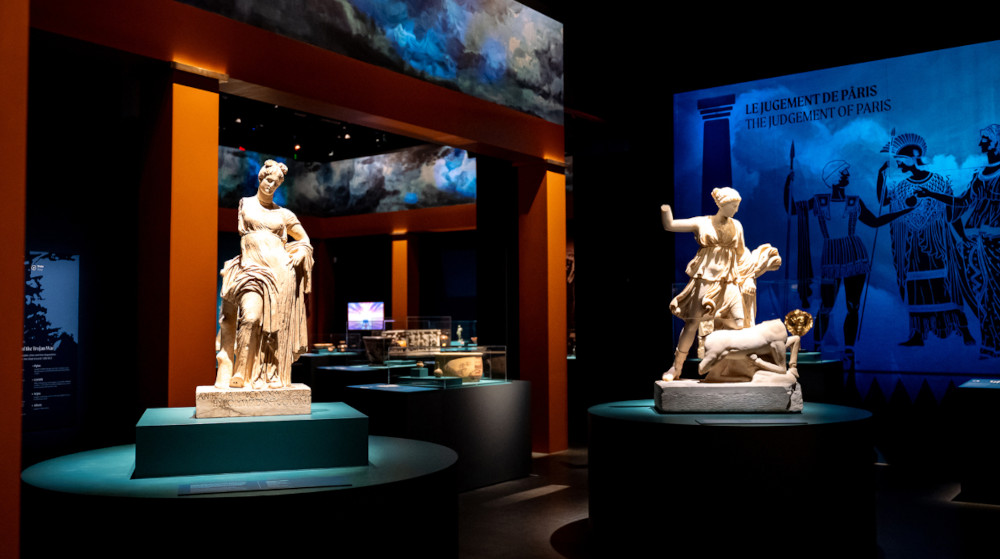
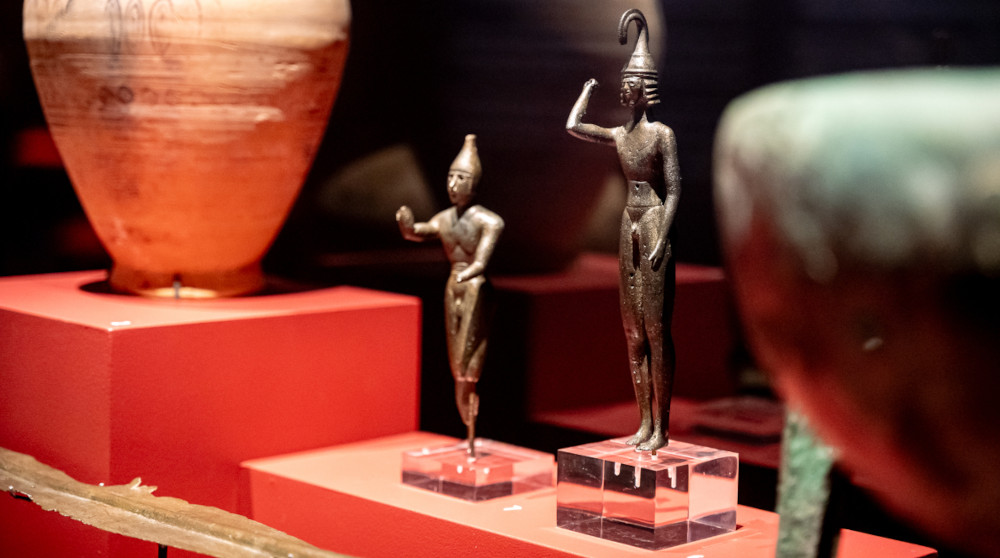
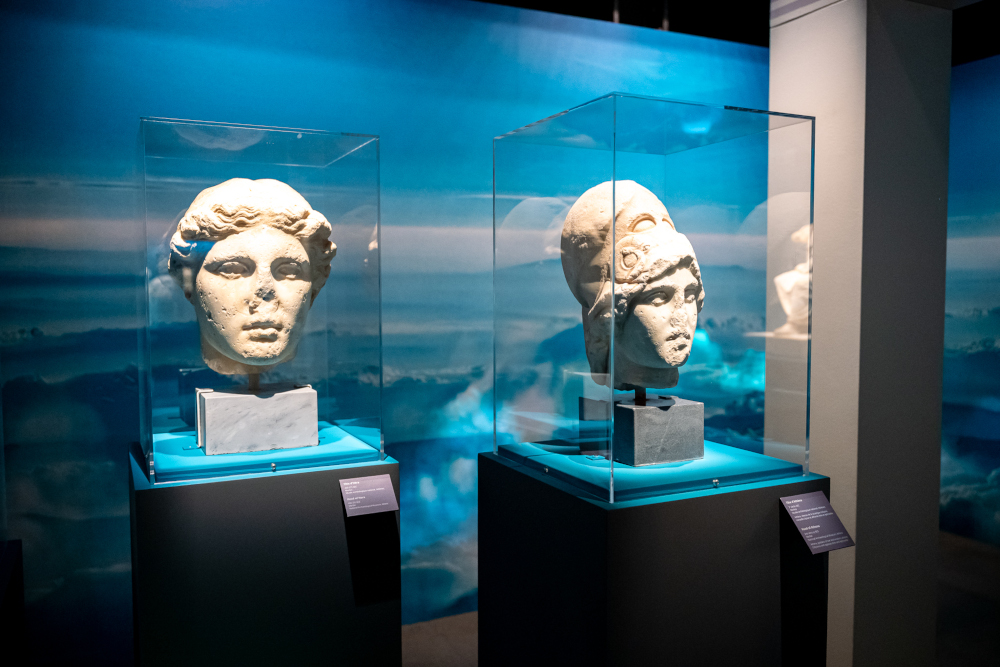
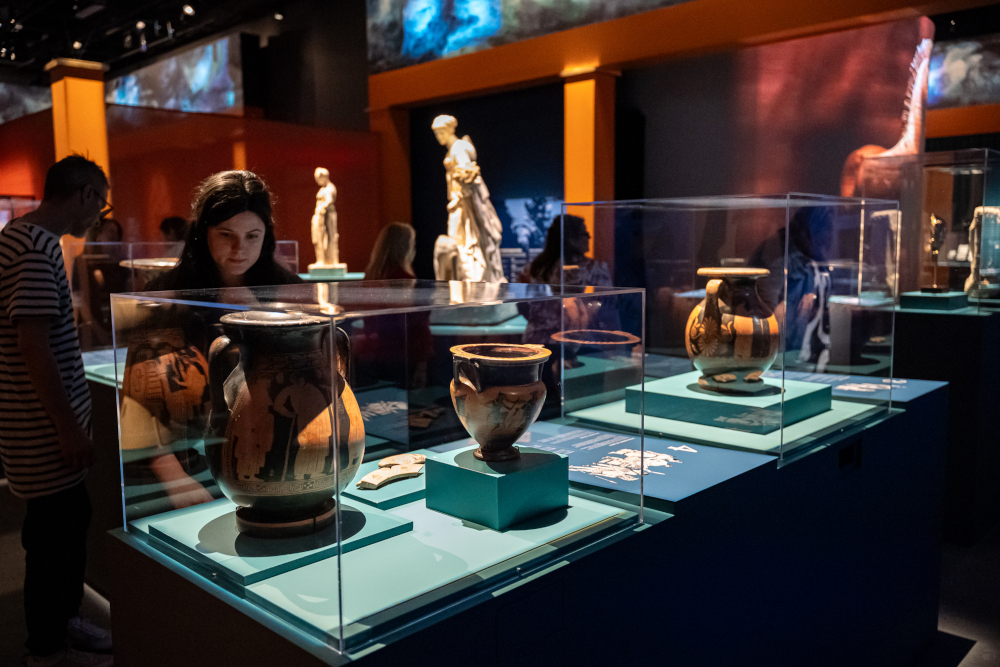
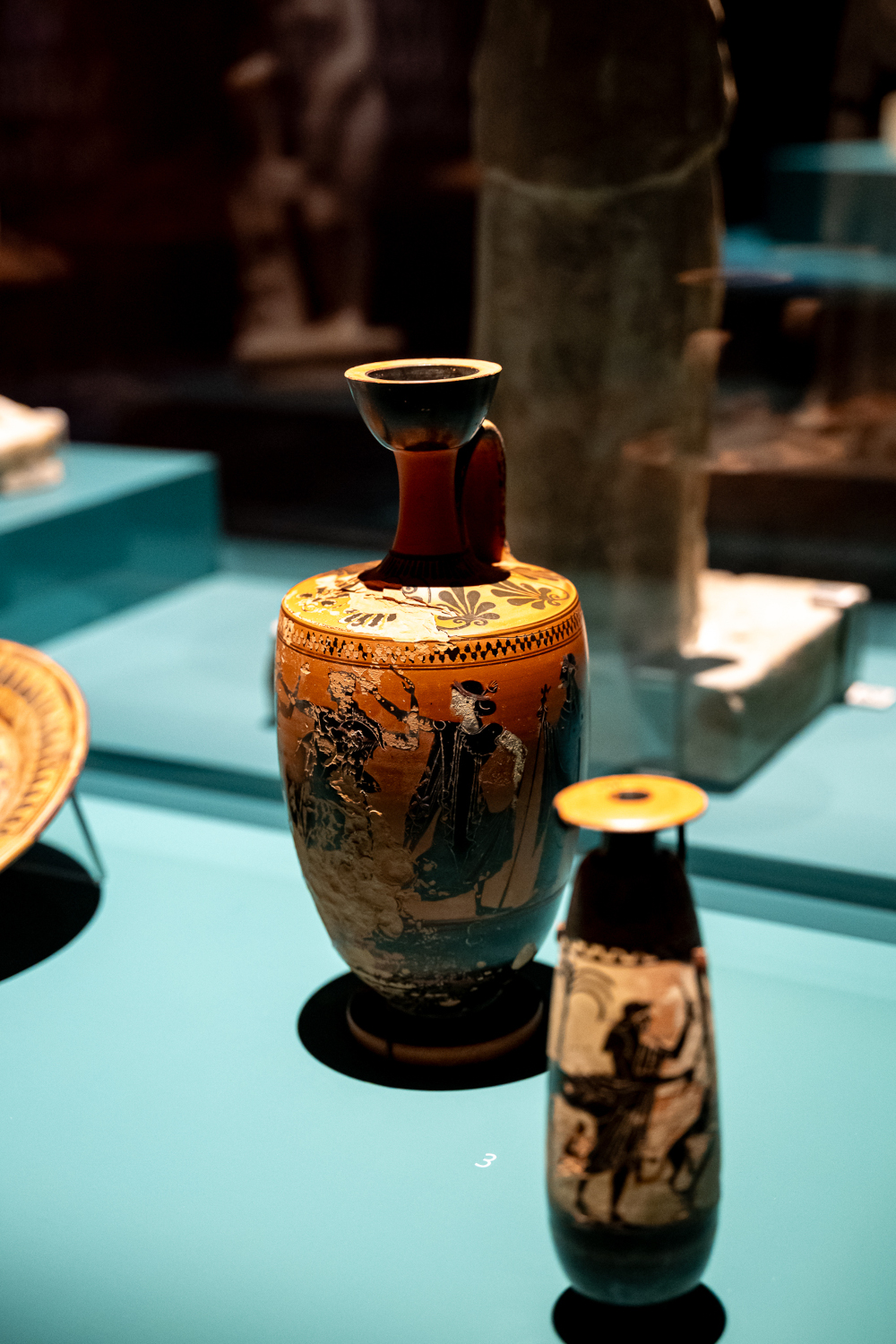
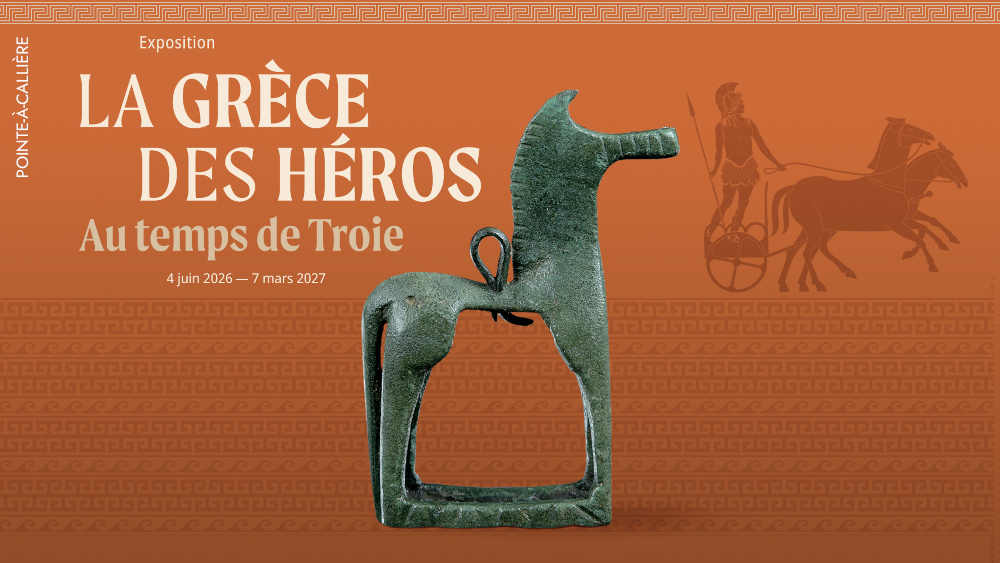
Pointe-à-Callière, ciudad de arqueología e historia de Montreal, presenta una programación cultural que complementa su exposición La Grecia de los héroes. En tiempos de Troya. Conferencias, un espectáculo, un taller de dibujo, un club de lectura y encuentros dedicados a los vinos griegos permitirán al público descubrir la Grecia antigua desde diferentes perspectivas, entre ellas la historia, la arqueología, la literatura, la filosofía, el arte y la cultura gastronómica.
La exposición sumerge a los visitantes en el universo de los relatos homéricos de La Ilíada y La Odisea, entre mitología, historia y arqueología. La programación que la acompaña ofrece nuevas maneras de profundizar en estos grandes relatos y en las figuras heroicas que han trascendido los siglos.
Conferencias sobre los héroes y los grandes relatos de la Grecia antigua
Un ciclo de cuatro conferencias reunirá a especialistas en filosofía, literatura e historia para explorar los grandes relatos fundacionales y los héroes de la Antigüedad griega.
- 19 de noviembre de 2026, a las 19 h — Homero bajo la mirada de los filósofos, con Louis-André Dorion, profesor titular del Departamento de Filosofía de la Universidad de Montreal.
- 3 de diciembre de 2026, a las 19 h — Homero, poeta de la literatura occidental, con Jacques Bouchard, profesor emérito de la Universidad de Montreal.
- 21 de enero de 2027, a las 19 h — Aquiles y la figura del héroe, con Marie-Hélène Mainguy, profesora del Departamento de Literatura, Teatro y Cine de la Universidad Laval.
- 4 de febrero de 2027, a las 19 h — La guerra de Troya: del mito a la historia, con el historiador Raphaël Weyland.
Tarifas: 6 $ para miembros / 10 $ para no miembros.
Un taller de dibujo en el corazón de la exposición
El 27 de septiembre de 2026, de 9 h a 10 h 30, los participantes podrán observar las obras de la exposición y experimentar diferentes técnicas de dibujo, desde el croquis rápido hasta el trabajo de sombras.
El taller estará a cargo de Jonathan Sardelis y Nathan Derome, profesores de los Cours du samedi de la UQAM. La actividad está dirigida tanto a principiantes como a personas con experiencia en dibujo.
Tarifas: 15 $ para miembros / 30 $ para no miembros.
Reservación – Taller de dibujo
Thomas Hellman revisita los mitos griegos
El 7 de octubre de 2026, a las 19 h, Thomas Hellman presentará Mythomane, contes et légendes de la Grèce antique. Acompañado por el multiinstrumentista Olaf Gundel, el autor, compositor y narrador quebequense propone un viaje musical a través de los dioses del Olimpo, los héroes y los grandes relatos de la mitología griega.
El espectáculo, dirigido por Michel Faubert, combina narración, teatro y concierto.
Tarifas: 6 $ para miembros / 10 $ para no miembros.
Reservación – Espectáculo « Mythomane »
Club de lectura: El canto de Aquiles
El 14 de octubre de 2026, a las 18 h 30, el club de lectura de Pointe-à-Callière estará dedicado a la novela El canto de Aquiles, de la escritora estadounidense Madeline Miller, que recrea la figura de Aquiles y el universo de la guerra de Troya.
La conversación será dirigida por Elsa Bouchard, profesora de lengua y literatura griegas de la Universidad de Montreal. El encuentro continuará en pequeños grupos alrededor de una copa en el bistró L’Arrivage del museo.
Tarifas: 15 $ para miembros / 20 $ para no miembros.
Grecia y sus islas: tres encuentros dedicados al vino
Los amantes del vino podrán descubrir los principales cepajes, denominaciones de origen y terruños griegos durante una serie de tres talleres dirigidos por el sommelier Patrick Blondin. Cada encuentro incluye una degustación comentada de seis vinos acompañados de aperitivos.
20 de octubre de 2026, de 18 h 30 a 20 h 30
Los grandes cepajes griegos: tipicidad, historia y expresión
- 10 de noviembre de 2026, de 18 h 30 a 20 h 30 Las denominaciones griegas: comprender las regiones, los estilos y las tradiciones
- 1 de diciembre de 2026, de 18 h 30 a 20 h 3 Terruños, climas: la Grecia moderna del vino
Tarifa por taller: 75 $ para miembros / 95 $ para no miembros.
Los niños ofrecen su propia mirada sobre la Grecia antigua
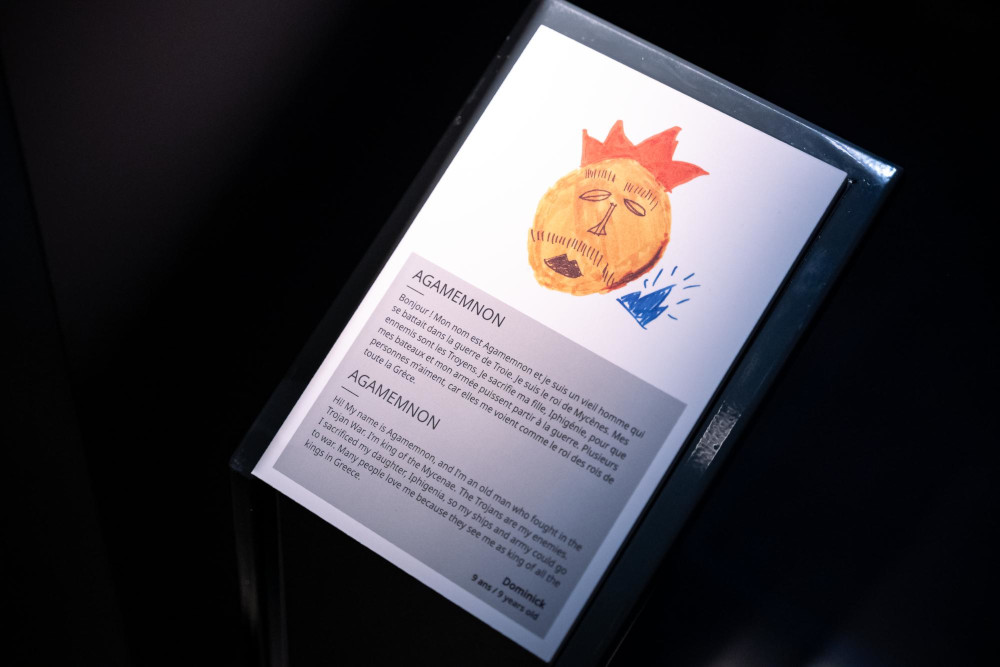
Como parte de una colaboración con la Escuela Socrates-Démosthène, 21 alumnos de cuarto año fueron invitados a redactar e ilustrar una selección de textos explicativos para las obras de la exposición.
La iniciativa permite descubrir las piezas y objetos desde la perspectiva de los niños y ofrece especialmente a las familias una manera original y accesible de acercarse a la Grecia antigua.
Una publicación para profundizar en el tema
Para prolongar la experiencia, Pointe-à-Callière ofrece también la publicación La Grecia de los héroes. En tiempos de Troya, ricamente ilustrada y dedicada a los objetos y artefactos, así como a las dimensiones históricas y culturales de la exposición.
68 páginas — 19,95 $ + impuestos.
Con esta programación, Pointe-à-Callière invita al público a descubrir la Grecia antigua más allá de la exposición, creando vínculos entre historia, arqueología, mitología, literatura, filosofía, arte y cultura gastronómica.
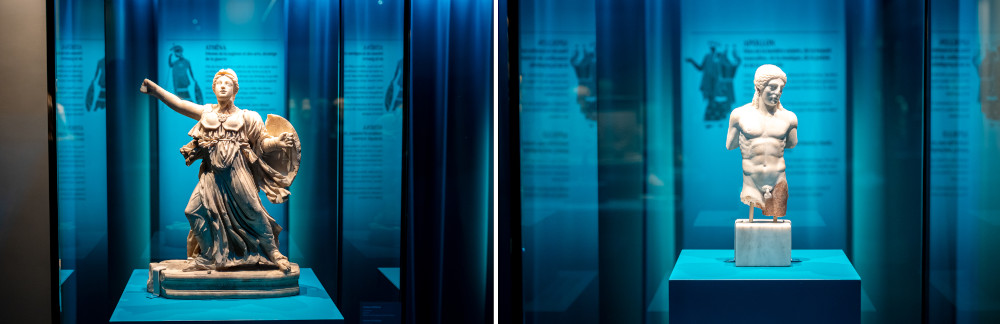
Pointe-à-Callière, cité d’archéologie et d’histoire de Montréal, propose une programmation culturelle en complément de son exposition La Grèce des héros. Au temps de Troie. Conférences, spectacle, atelier de dessin, club de lecture et dégustations de vins grecs permettront au public d’explorer la Grèce antique sous différents angles, de l’histoire et l’archéologie à la littérature, la philosophie, l’art et la gastronomie.
L’exposition plonge les visiteurs dans l’univers des récits homériques de L’Iliade et de L’Odyssée, entre mythologie, histoire et archéologie. La programmation qui l’accompagne propose différentes façons de prolonger cette découverte.
Conférences : les héros et les grands récits de la Grèce antique
Quatre rencontres réuniront des spécialistes de la philosophie, de la littérature et de l’histoire :
- 19 novembre 2026 à 19 h — Homère sous l’œil des philosophes, avec Louis-André Dorion, professeur titulaire au Département de philosophie de l’Université de Montréal.
- 3 décembre 2026 à 19 h — Homère, poète de la littérature occidentale, avec Jacques Bouchard, professeur honoraire à l’Université de Montréal.
- 21 janvier 2027 à 19 h — Achille et la figure du héros, avec Marie-Hélène Mainguy, chargée d’enseignement à l’Université Laval.
- 4 février 2027 à 19 h — La guerre de Troie : du mythe à l’histoire, avec l’historien Raphaël Weyland.
Tarifs : 6 $ pour les membres / 10 $ pour les non-membres.
Atelier de dessin au cœur de l’exposition
Le 27 septembre 2026, de 9 h à 10 h 30, les participants pourront observer les œuvres de l’exposition et expérimenter différentes techniques de dessin, du croquis rapide au travail des ombres.
L’atelier sera animé par Jonathan Sardelis et Nathan Derome, enseignants aux Cours du samedi de l’UQAM. Il s’adresse aussi bien aux débutants qu’aux personnes expérimentées.
Tarifs : 15 $ pour les membres / 30 $ pour les non-membres.
Réservation – Atelier de dessin
Thomas Hellman revisite les mythes grecs
Le 7 octobre 2026 à 19 h, Thomas Hellman présentera Mythomane, contes et légendes de la Grèce antique. Accompagné du multi-instrumentiste Olaf Gundel, l’auteur-compositeur et raconteur québécois proposera un voyage musical à travers les dieux de l’Olympe, les héros et les grands récits de la mythologie grecque.
Le spectacle, mis en scène par Michel Faubert, se situe entre le conte, le théâtre et le concert.
Tarifs : 6 $ pour les membres / 10 $ pour les non-membres.
Réservation – Spectacle « Mythomane »
Club de lecture : Le Chant d’Achille
Le 14 octobre 2026 à 18 h 30, le club de lecture de Pointe-à-Callière sera consacré au roman Le Chant d’Achille de Madeline Miller, qui revisite la figure d’Achille et l’univers de la guerre de Troie.
La discussion sera animée par Elsa Bouchard, professeure de langue et littérature grecques à l’Université de Montréal. La rencontre se poursuivra en petit groupe autour d’un verre au bistro L’Arrivage du Musée.
Tarifs : 15 $ pour les membres / 20 $ pour les non-membres.
La Grèce et ses îles : trois ateliers autour du vin
Les amateurs de vin pourront découvrir les cépages, les appellations et les terroirs grecs lors d’une série de trois ateliers animés par le sommelier Patrick Blondin.
Chaque rencontre comprend une dégustation commentée de six vins accompagnés de bouchées apéritives.
- 20 octobre 2026, de 18 h 30 à 20 h 30 Les grands cépages grecs : typicité, histoire et expression
- 10 novembre 2026, de 18 h 30 à 20 h 30 Les appellations grecques : comprendre les régions, les styles et les traditions
- 1er décembre 2026, de 18 h 30 à 20 h 30Terroirs, climats : la Grèce moderne du vin
Tarifs par atelier : 75 $ pour les membres / 95 $ pour les non-membres.
Les enfants posent leur regard sur la Grèce antique
Dans le cadre d’une collaboration avec l’École Socrates-Démosthène, 21 élèves de 4e année ont été invités à rédiger et à illustrer une sélection de cartels pour l’exposition.
Cette initiative permet de découvrir les œuvres et les objets à travers le regard des jeunes et offre notamment aux familles une façon originale et accessible d’explorer la Grèce antique.
Une publication pour approfondir la découverte
Pour prolonger l’expérience, Pointe-à-Callière propose également la publication La Grèce des héros. Au temps de Troie, richement illustrée et consacrée aux artefacts ainsi qu’aux dimensions historiques et culturelles de l’exposition.
68 pages — 19,95 $ + taxes.
Avec cette programmation, Pointe-à-Callière invite ainsi le public à découvrir la Grèce antique au-delà de l’exposition, en créant des liens entre histoire, archéologie, mythologie, littérature, philosophie, art et culture gastronomique.

Montréal, le 4 août 2026 - En attendant votre prochain envol vers la Martinique, la destination orchestre une nouvelle escale gourmande dans le Vieux-Port de Montréal et dans une quarantaine de restaurants à travers le Québec. Du 8 au 19 septembre, le Festival Martinique Gourmande célèbrera cette année sa 19e édition avec un rendez-vous phare : le Marché Créole et ses animations. Placée sous le thème du « Goût du partage », cette édition accueillera plusieurs chefs martiniquais qui feront le déplacement depuis la Martinique afin de proposer une véritable immersion dans la richesse et l'authenticité de leur gastronomie.




ANDINA/Editora Perú


Momento Histórico - Aprobacion del Marco Mundial de la Diversidad Biologica en la COP15 en Montreal. Foto CDB

Emi Mahmoud | Poet, Activist, founder | UNHCR Goodwill Ambassador - Photo by: emi-mahmoud.com