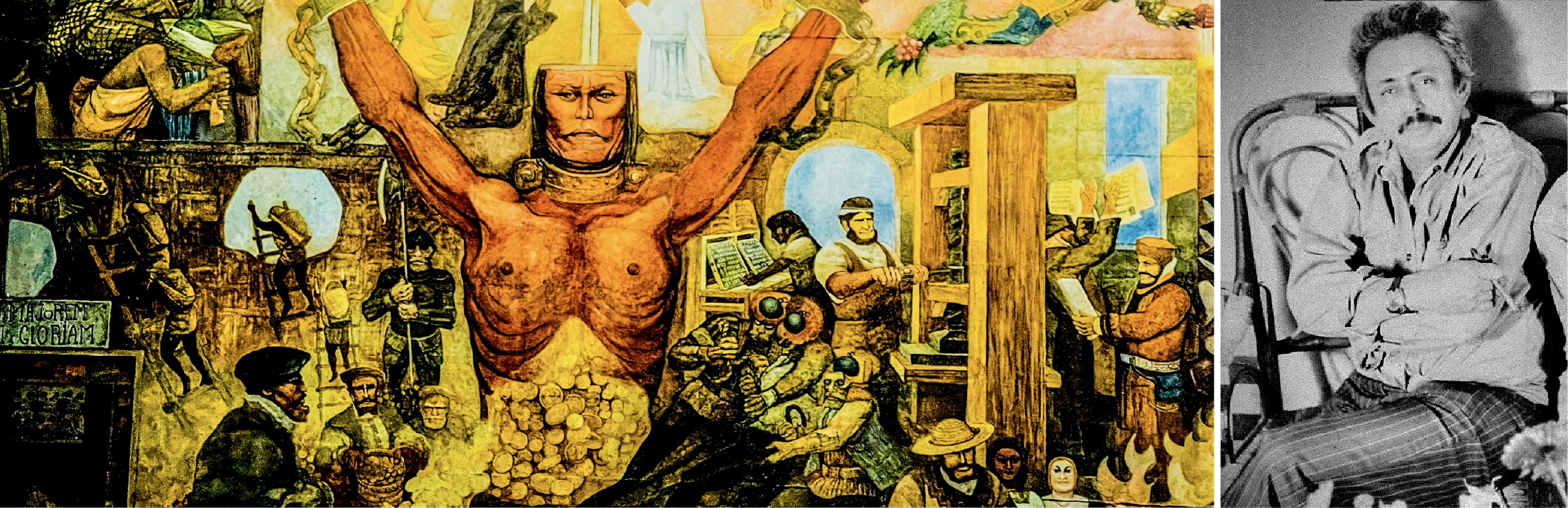


Daniel Ponce Montuy, best known simply as Montuy, was born in Frontera, Tabasco, in 1925. He grew up surrounded by jungle and river landscapes, immersed in a syncretic mythology that fused Indigenous roots with popular traditions—an ecosystem that would later become one of the imaginative foundations of his paintings and murals. His life and work span more than half a century of contemporary Mexican history, from the tensions of late muralism to the political, social, and cultural upheavals that shaped the second half of the twentieth century. Montuy was a painter, muralist, poet, activist, and a critical witness to his time: an unruly creator who understood painting not only as a means of expression, but as a battleground and an act of memory.
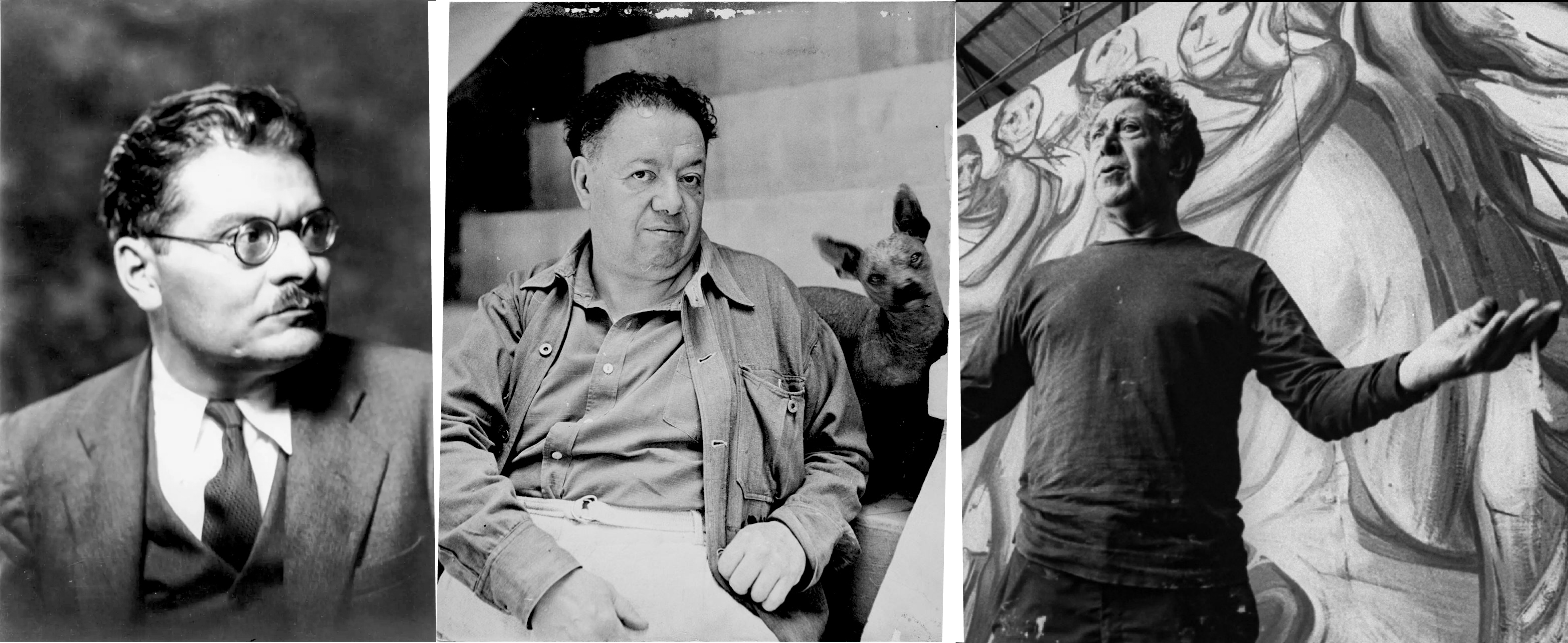
Montuy’s trajectory moves—like a silent bridge—across the historical distance separating classical Mexican muralism of the first half of the twentieth century from the artistic explorations that followed. For those less familiar with the context, Mexican muralism emerged in the aftermath of the 1910 Mexican Revolution. Its early precursor was Dr. Atl (Gerardo Murillo), who later devoted himself primarily to easel painting and to depicting erupting volcanoes. The muralists chose to narrate Mexico’s history visually rather than through written texts, so that even those who could not read or write might understand and claim their own history and social struggles. They sought to create a nationalist art that expressed Mexican identity and the ideals of the Revolution—an art rooted in Mexico’s territories rather than dictated by Europe, grounded in pre-Hispanic heritage. Montuy belonged to the generation that inherited this tradition, transformed it, and made it his own, carrying it toward a language that combines technical experimentation with a deeply personal imaginary, where the mythic, the social, and the intimate coexist.
The three Mexican muralists, from left to right: José Clemente Orozco (1883–1949), Diego Rivera (1886–1957), and David Alfaro Siqueiros (1896–1974). Their precursor was Dr. Atl (Gerardo Murillo), whose vision of a public, nationalist art laid the foundations for the artistic and cultural movement they would later consolidate.
Far from disappearing with the physical departure of the so-called “Three Greats”—José Clemente Orozco, Diego Rivera, and David Alfaro Siqueiros—Mexican muralism continued its course, evolving toward new forms and visual languages. Montuy stands as the missing link connecting that foundational generation to the present: a bridge between the pioneering murals of 1921–1922 and the centennial commemorations unfolding in the post-pandemic years of 2021–2022. Yet Montuy’s name rarely surfaces in discussions of late muralism, as if a void existed between the canonical masters and the ruptures of the 1960s and 1970s, between the surrealist women painters—Remedios Varo, Leonora Carrington, María Izquierdo—and the final figures of so-called “third-wave” surrealism, such as Pedro Friedeberg and Alan Glass. It is precisely within this apparent gap that Montuy belongs: the bridge that allows us to understand how the energy, technique, and narrative force of muralism endured beyond the early twentieth-century mythologization, consolidating a legacy that remains alive and still awaits full recognition.
One of the most authoritative voices to affirm Montuy’s place within the Mexican artistic genealogy was Angélica Arenal, widow of David Alfaro Siqueiros, who stated of Montuy:
“I hold him in great admiration. He is a man of remarkable ability; he embodies the experience of the great muralists, rediscovering the vigorous line of José Clemente Orozco, the pre-Hispanic symbolism of Diego Rivera, and the denunciatory themes of Siqueiros—enriched by a luminous and singular use of color.”
This is an extraordinary statement. It not only situates Montuy in direct dialogue with the great masters, but it comes from a figure whose words carried exceptional moral, historical, and aesthetic weight. Angélica Arenal—war correspondent, writer, cultural advocate, and, after Siqueiros’s death, the principal guardian of his legacy—did not dispense praise lightly. She was, by her own account, almost reluctantly persuaded to see Montuy’s work, and the first piece she encountered was the mural La Noche del Jaguar. For Arenal, muralism was not merely a formal tradition but a political and ethical responsibility that had shaped decades of the master’s life. After Siqueiros’s death, she assumed the task of preserving and defending his work during what she described as a period of profound desolation. According to her own interviews, it was through letters, testimonies, and encounters with younger artists that she regained the impetus to remain active within the public cultural sphere.
For a woman of such trajectory—capable of recognizing in art not only technical mastery but the historical force of an idea—to assert that Montuy combined Orozco’s vigorous line, Rivera’s symbolism, and Siqueiros’s spirit of denunciation is to place him squarely within the direct continuity of the great muralist tradition. Her praise is not a gesture of courtesy, but an acknowledgment that Montuy did not imitate his predecessors; rather, he synthesized and renewed them, articulating within his work a personal evolution situated at the most demanding lineage of Mexican public art.
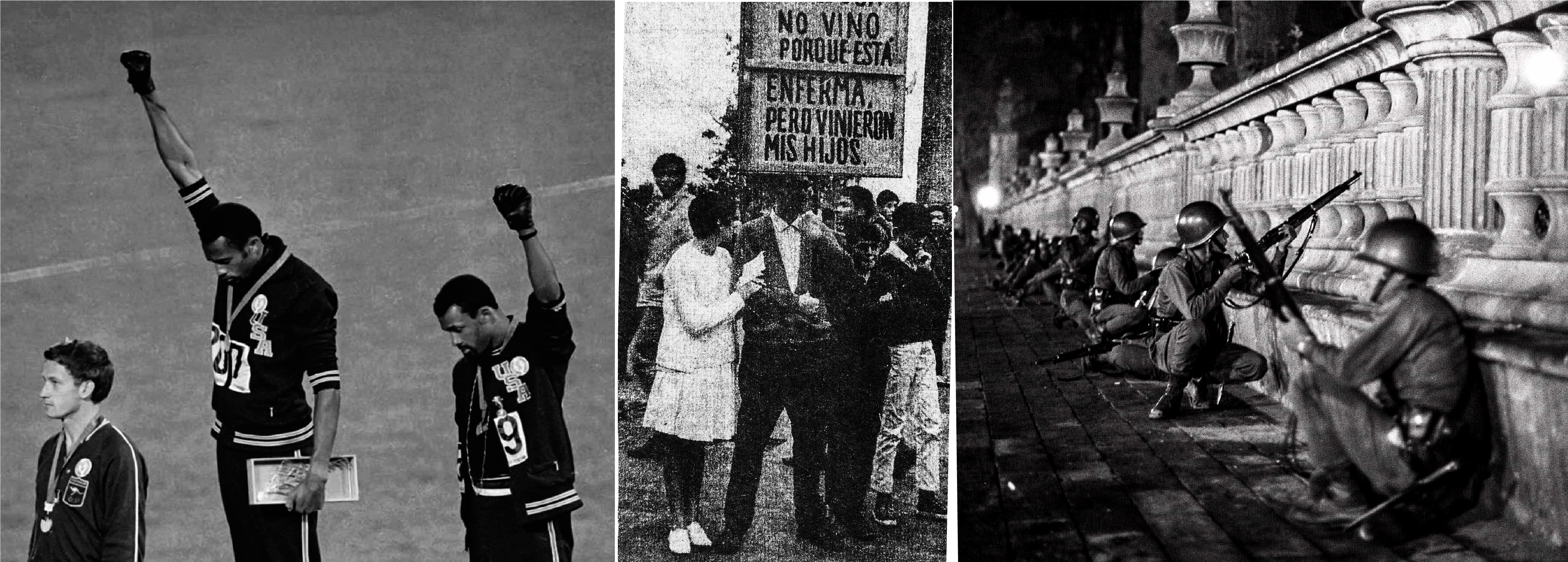
By the late 1960s, Montuy had begun to stand out as an easel painter in Mexico City, at a moment when cultural life was in full effervescence and the country oscillated between the desire to open itself to the world and the reality of social repression. Mexico hosted the first televised Olympic Games of the modern era, even as political violence unfolded in the streets. The traumatic events of October 2, 1968—an experience that affected him directly—left an indelible mark on his visual thinking. From these years onward, his work acquired the symbolic density that would come to define it: a fabric woven from Mesoamerican mythology, ritual imagery drawn from México profundo, a critique of power, heroic figures, and subjugated bodies that expose Mexico’s historical tensions.
From left to right: on October 16, Tommie Smith and John Carlos raising their fists in protest at the 1968 Mexico City Olympics; in the center, on October 2, 1968, Daniel Ponce Montuy with his three children in the Plaza de las Tres Culturas in Mexico City, holding a banner; on the right, soldiers sent by Mexican President Gustavo Díaz Ordaz in what is known as the October 2 Massacre.
In 1971, he exhibited at the Salón Verde of the Palacio de Bellas Artes, alongside two other artists from Tabasco, in the exhibition Tres artistas tabasqueños, organized by museologist Carlos Pellicer Cámara.
In 1972, Montuy received his first mural commissions in Tabasco, initiating a monumental trajectory that would lead him to create more than thirty murals across Mexico City, Tabasco, and Coatzacoalcos. Among the most significant are La Rebeldía de los pueblos sojuzgados and A pesar de todo, installed facing the capital’s Zócalo—two works in which Mexican history is approached through resistance, dignity, and collective mourning. His iconography—among the most singular of late muralism—brings together symbols that had rarely coexisted with such intensity: Cuauhtémoc crucified upside down, subdued Eagle warriors, transfigured men, grieving women who embody a mourning of both sacred and Indigenous resonance, peasants, workers, and everyday figures elevated to the status of anonymous heroes. These are not historical illustrations, but scenes charged with ritual, sacrifice, violence, hope, and a spirituality that spans from the Maya cosmos to Christian imagery re-signified through the wound of colonial history.
Montuy explored with audacity the tortured body as a metaphor for historical oppression—the Conquest, colonization, and twentieth-century political repression—while simultaneously elevating these images toward a broader reflection on human resistance and rebirth. His figures are not passive martyrs, but axes of concentrated symbolic energy: bodies that denounce, and bodies that illuminate.
Parallel to his mural practice, Montuy’s easel painting—virtuosic, complex, intimate, and monumental at once—constitutes one of the most powerful corpora of his generation. Thirty of these works from key periods are held in a private collection in Málaga, Spain, forming the largest group of his paintings assembled outside Mexico. There, his absolute command of drawing becomes evident, along with his dramatic use of light and a palette that moves from dense, earthen tones to intense luminosities that evoke his cosmic imaginary.
Throughout his career, Montuy never ceased to conceive of art as both a political and a spiritual act. He believed muralism should evolve without renouncing its humanist roots; that painting could give form to what official history chose to omit; and that pain and resistance were inseparable from Mexican identity. His work ultimately constitutes a worldview: a universe in which myth, history, and memory enter into dialogue to reveal the enduring dignity of peoples.
Montuy died in Villahermosa—where he had lived for fifteen years—the capital of Tabasco, in 2005, leaving behind a legacy that is now beginning to be recognized as an essential link between classical muralism and contemporary re-readings of identity, spirituality, and historical trauma in Mexico. His painting remains a living force: unsettling, luminous, and necessary.
The Indigenous Body as a Historical Archive
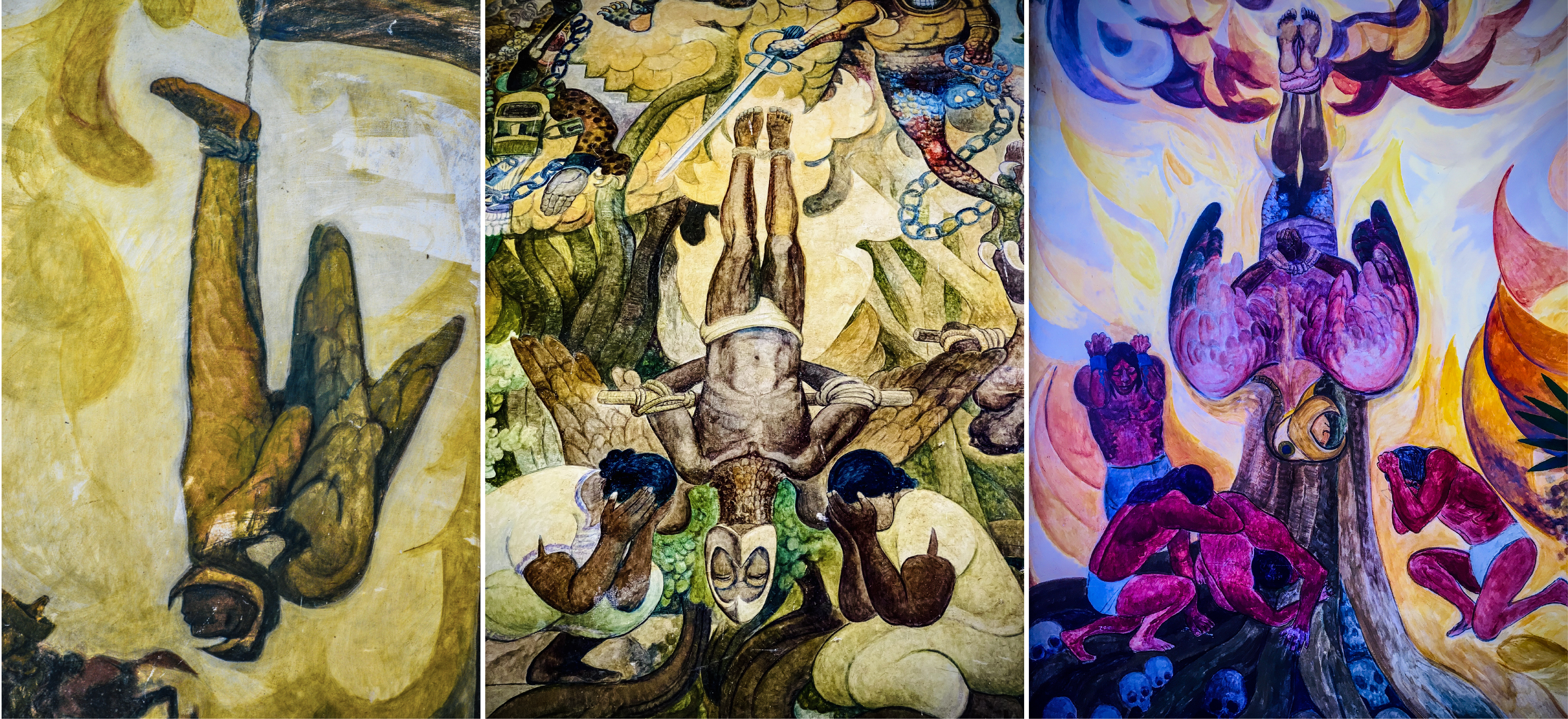
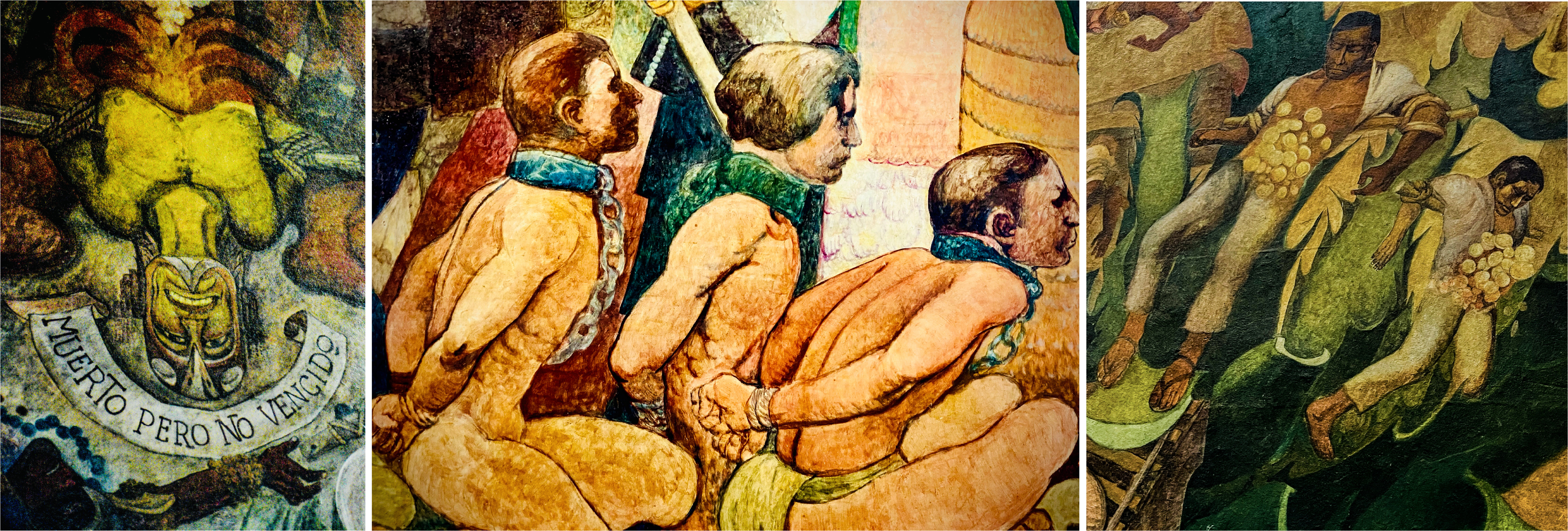
The depiction of Cuauhtémoc, or the eagle warrior, explored across three different murals: the first, Our Cosmic Right to Protest (1973); the second, You Shall Inherit the Universe (1991); and the third, The Struggle for the Integration of National Unity and the Survival of Our Universe (2003).
In Montuy’s paintings and murals, Indigeneity does not appear as folkloric ornament or aesthetic exoticism; it emerges as active thought and as a historical force. Montuy presents figures that embody this tension: Indigenous bodies rendered as sacrificed, crucified, or bound, bellies from which gold coins spill—images that synthesize, with brutal clarity, the extraction of wealth that has defined the colonial and capitalist relationship with Indigenous peoples. At the same time, modernity appears disguised as mechanical beasts—iron hawks, mechanized vultures—and as emblematic figures of capitalist accumulation: top-hatted industrialists, cigars in hand, riding these predatory machines. This visual dialectic—cosmic order versus the devouring machine—constructs a narrative that does more than denounce; it exposes genealogies of plunder while placing Indigenous memory at the center of a possible future narrative.
Among the most recurrent and powerful motifs in his iconography is the figure of Cuauhtémoc, or alternatively that of the Eagle warrior, an archetype of the sacrificed hero. Montuy reclaims the Indigenous body as a site of historical truth: he inverts the crucifixion, suspends the warrior by the feet, burns him, dresses him in the ceremonial regalia of the Eagle warrior, and surrounds him with grieving women whose expressiveness recalls mestizo iconographies of mourning. This scene is not an illustrative gesture, but a symbolic operation: it represents a communal pain that spans centuries, a continuity of grievances linking the violence of the Conquest to the persistent forms of exploitation in twentieth-century Mexico.
The force of these images resonates with the Indigenous perspective recovered by Miguel León-Portilla in The Broken Spears, which gathers omens, testimonies, and Nahua chronicles recounting the invasion from the voices of those who witnessed the collapse of their world, their cosmology, and their ways of life with the arrival of the Iberians. Montuy incorporates this epistemological horizon: his warrior suspended upside down is not a heroic martyr in the Western sense, but the embodiment of that wounded Indigenous memory that León-Portilla restored to the historical canon.
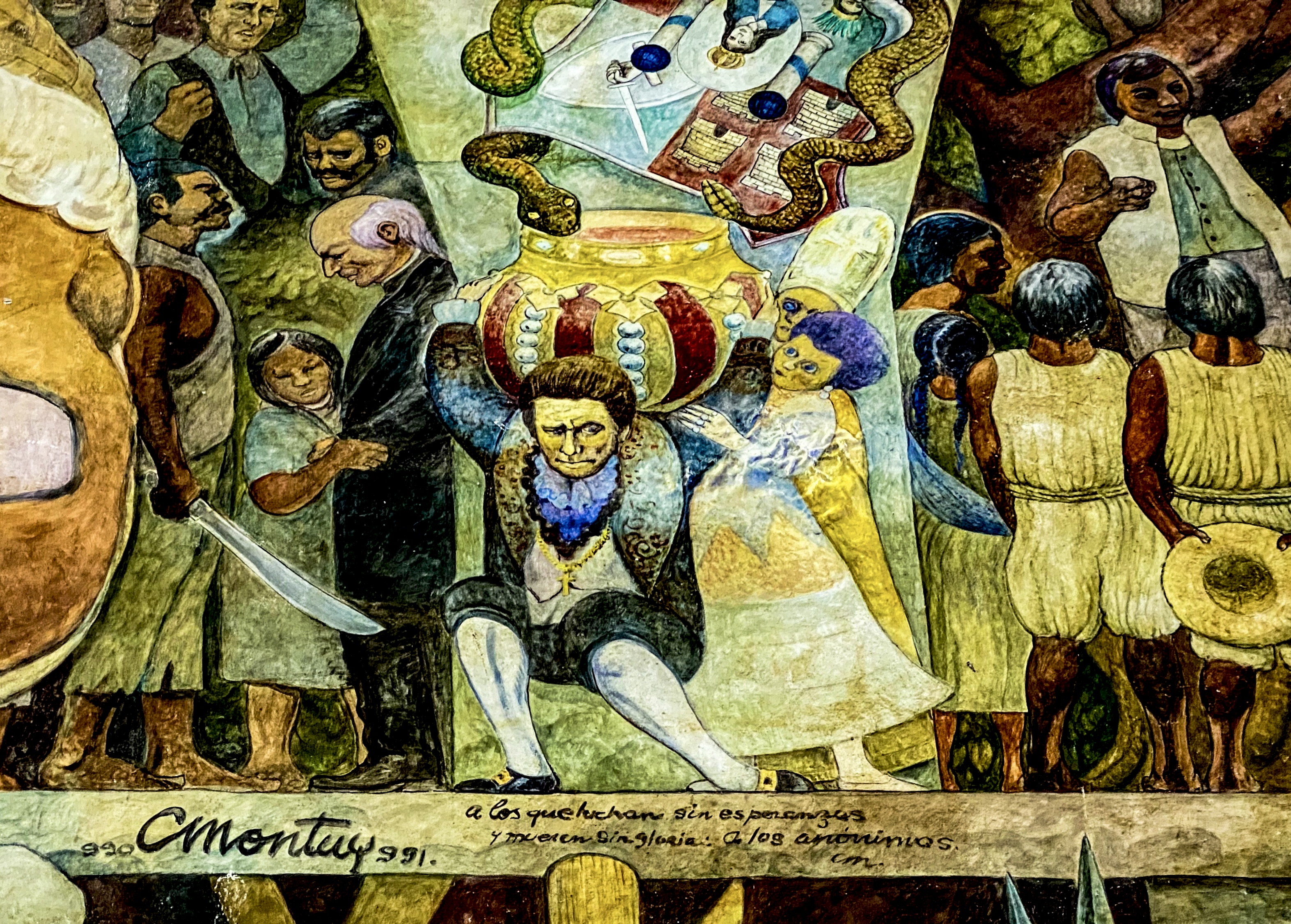
Detail from the mural You Shall Inherit the Universe (1991) by Montuy. Dedicated “to those who struggle without hope and die without glory: to the anonymous.” This mural is located in the Congress of the State of Tabasco. In the scene, a noble European figure carries the heavy crown of Spain; atop it rests the coat of arms of Tabasco—one of the oldest in the country still in use today—while a serpent coils around him, emphasizing the symbolic tension between conquest, power, and territory.
For this reason, in Montuy’s work the figure of the warrior does not operate as a nationalist quotation or as a univocal emblem of identity; it multiplies until it becomes a symbol of the anonymous heroes of colonization, of the sacrificed bodies that official history has sought to silence beneath layers of appropriation, folklorization, and erasure. With violence and tenderness at once, his painting exposes the systematic instrumentalization of the Indigenous body and restores, through the image, the memory of those who disappeared without name across the long arc of the Conquest and its aftermath.
In this regard, the assessment of Carlos Pellicer Cámara—poet, museographer, mentor, and a decisive promoter of Montuy’s career—is particularly revealing. Pellicer wrote of him:
“Montuy paints in three or four different ways. In all of them he succeeds. He possesses personality and develops it with unquestionable talent. The poetic quality of his work bears witness to the fact that he is a remarkable artist. Tenderness and violence: Tabasqueño.”
Pellicer’s observation not only captures the duality that runs through Montuy’s entire oeuvre—this oscillation between historical pain and human compassion—but also legitimizes his place within the genealogy of muralism. In Montuy, the violence of history and the tenderness of the pictorial gesture coexist as a form of aesthetic truth: a poetics of memory that could only emerge from the Tabascan sensibility that Pellicer recognizes and celebrates.
Montuy also occupies an unusually self-critical position: he does not exempt the artist from moral scrutiny. He frequently portrayed himself in states of amputation, immolation, or rupture, presenting himself as part of the historical machine—a subject who suffers, who errs, and who must therefore be judged through his own corporeality. This visual self-immolation renders his work doubly unsettling: on the one hand, it denounces external violence; on the other, it enacts the internal conflict of the creator who, as both witness and participant, offers himself as the symbolic subject of sacrifice. This ethical and aesthetic tension is one of the defining keys of his production, distinguishing it from many contemporary practices. Montuy does not evade complexity, nor the emotional cost of narrating history from within the flesh.
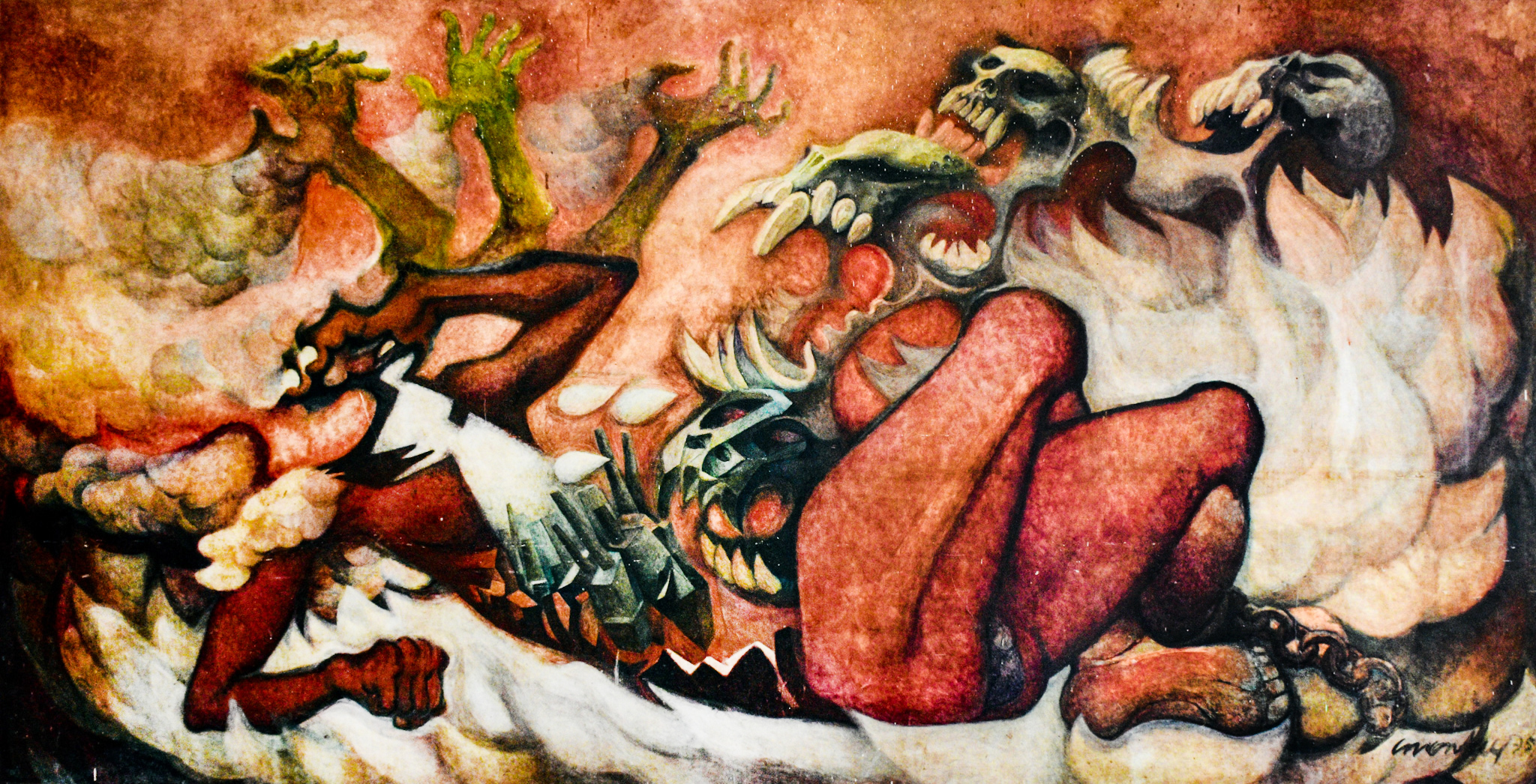
El Sacrificio, también llamado El hombre vive para escapar de la Muerte, mural pintado por Montuy en 1975, para la Universidad Juárez Autónoma de Tabasco, actualmente se encuentra en el teatro de la Universidad en estado de conservación delicado.
Portable Architectures: Rolling Murals and the Montuy – Carrasco Isoplastic Technique
Montuy’s technical innovation emerged from a concrete and practical necessity: many of the buildings where he was commissioned to execute murals did not yet exist or were still under construction. The solution—one he recounts himself in his book Heredarás el Universo (2004)—was to build provisional structures in his studio using perforated steel angles, cover them with fiberglass mesh, and prepare a flexible support on which the entire mural could be painted, lowered, rolled, and transported overland in cylindrical form.
Describing the execution of a particularly challenging wall at the Congress of the State of Tabasco, Montuy explained:
“The first thing I did was scrape the wall and apply a suitable acrylic base, followed by a layer of silica sand mixed with the same material. Next, I placed strips of stainless-steel mesh from top to bottom, fixing them to the wall with orthopedic nails of the kind used to reinforce bone fractures in human medicine. Immediately afterward, a high-tensile fiberglass covering was applied with special acrylic, followed by another layer of silica sand mixed with pulverized marble stone, then a second fiberglass veil with acrylic, and finally an acrylic plaster mixed with powdered marble stone, onto which I applied the pigments directly with acrylic. This produced a surface fully integrated with the movements caused by temperature changes in the wall, adhering with great elasticity and resistance, waterproof, fracture- and craquelure-proof, and resistant to all kinds of fungi and moss.”
Prior to this, Montuy had already developed the inventive “mural en taco” (rolled mural), successfully applied in murals for the Secretaría de Finanzas and the Casa de la Cultura in Cárdenas, Tabasco, where transportation logistics posed a decisive challenge.
This technique not only resolved issues of transport and conservation; it also allowed Montuy to explore new textures, chromatic densities, and malleable surfaces, anticipating a dialogue between monumentality and easel painting that would later give rise to the so-called “murales en chiquito”—small-scale murals conceived beyond the conventional canvas. Montuy referred to this innovation as the “Montuy Technique,” while Julio Carrasco Bretón named it the “Carrasco Isoplastic Method,” reflecting a shared contribution of pictorial creativity and technical expertise, grounded in collaboration rather than exclusive authorship.
According to Carrasco, the technique consists of “a fiberglass sheet combined with pulverized silicon-treated marble, incorporating within it a fine mesh supported by metal profiles of specific dimensions, along with a precisely formulated resin and reactive concentration. This allows the sheet to remain crack-free and rollable, enabling it to be transported anywhere in the world.” Carrasco demonstrated this most recently in 2023, when he shipped by airplane a 220-square-meter mural from Mexico to Israel. I visited this monumental work in person, where I was able to verify firsthand its construction, resistance, and remarkable flexibility.
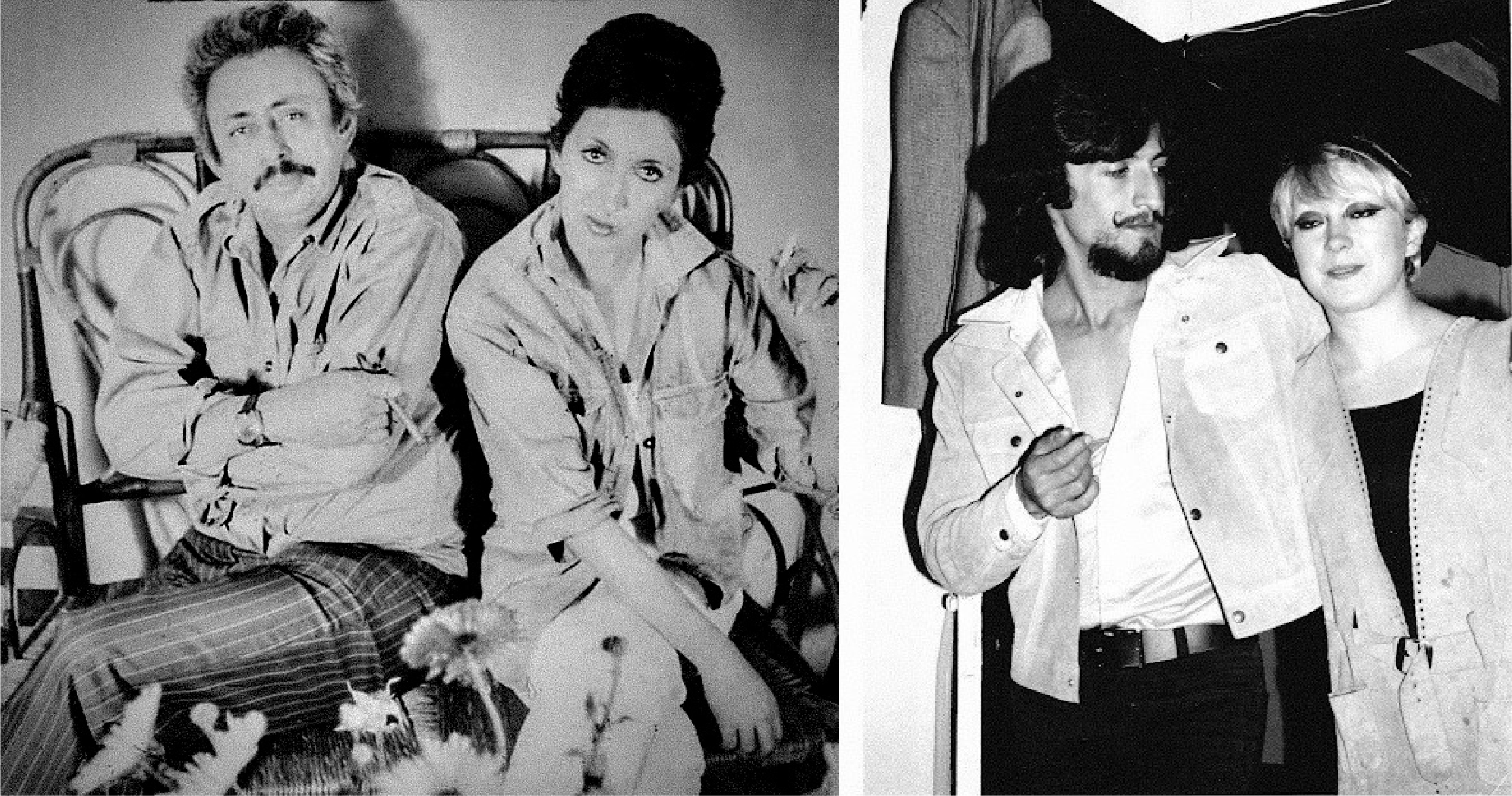
The collaboration that made this innovation possible originated within the social and cultural life of Mexico City. Montuy, then fifty years old, had established himself in a spacious studio rented to him by his close friend, painter and poet Graciela Romero Erazo, in her legendary house in the Colonia Roma, at Colima 315. On Friday evenings, Graciela hosted artistic gatherings that brought together painters, poets, actors, and musicians. It was at one of these soirées that Montuy met Julio Carrasco Bretón, a twenty-five-year-old artist and chemical engineer, husband of Diana Mariscal—an experimental film actress, theater performer, and rock a go-gó singer, and Graciela’s daughter.
Carrasco had been a student of the legendary master Don Lino Picaseño y Cuevas, a background that consolidated both his rigorous technical training and artistic sensitivity. Despite the generational gap, Montuy and Carrasco recognized one another immediately. They shared the formative experience of the 1968 generation, having both been present during the university occupation and the events of October 2 in Tlatelolco.
On the right, Montuy with Graciela Romero Erazo (poet and painter), circa 1976, at her house in Colonia Roma (photograph by Adolfo Patiño); on the left, Julio Carrasco Bretón with actress and singer Diana Mariscal.
In that studio, amidst wide-ranging conversations on philosophy, politics, and dialectical logic, Montuy presented a concrete problem concerning the preparation of his murals for Cárdenas, Tabasco. Carrasco proposed the technical solution, drawing on his knowledge of chemical engineering and materials science, suggesting how to prepare the fiberglass mesh, the silicon-treated marble polymer, and the application of pigments and varnishes to ensure both strength and flexibility. Montuy, with his capacity for invention and execution, realized the idea and applied it successfully, transforming the solution into a fundamental tool for creating transportable and durable murals.
Later, this technique was adapted to his easel paintings, consolidating a creative dialogue between technical innovation and pictorial sensitivity. In this way, what began as a practical necessity became one of the most significant contributions to late Mexican muralism, a testament to the collaboration between two generations, combining complementary contributions of creativity and engineering, and establishing that the achievement was the result of intergenerational cooperation.
Montuy Restored: Memory, Resistance, and the Mexican Muralist Legacy
Montuy’s work is not only relevant today; it speaks with renewed urgency. His murals and paintings embody subversion, dissent, humor, ingenuity, political critique, and a visual force that resonates powerfully. Above all, Montuy belongs to an intermediate generation—more specifically, to the second half of the twentieth century—a shadowed zone in the history of Mexican art: those artists who inherited the momentum of classical muralism and reinvented it in a Mexico marked by rapid modernization, urbanization, the fading of the post-revolutionary project, and the redefinition of cultural identities.
For a long time, narratives about Mexican muralism focused almost exclusively on Rivera, Orozco, and Siqueiros, relegating both the foundational role of Dr. Atl and the contributions of those who, in their wake, continued and transformed the tradition. Essential figures were left at the margins: Electa Arenal, Elena Huerta, Fernando Castro Pacheco, and later Julio Carrasco Bretón, each extending, expanding, or challenging the muralist language through different approaches, techniques, and sensibilities.
Montuy is part of that hidden lineage. He is not an isolated exception: he is a link in a living but fragmented tradition, whose archives remain incomplete and whose works survive dispersed across private collections, institutions that never documented or preserved them, and the oral memory of those who knew him.
To recover Montuy today is to address a historical omission: to restore visibility to those who built the second and third generations of muralism, to reinstate continuity, and to demonstrate that muralism did not vanish—it evolved, adapted, became portable and experimental. It reconnects us with an aesthetic sensibility that is urgent once again, for his work speaks to identity, colonial history, the Indigenous body, mestizaje, historical pain, and resistance—issues that continue to shape contemporary Mexico. It is to recognize Montuy’s innovation, from material experimentation to the integration of myth, history, and social commitment. And above all, it is to look again—with broader eyes—at the map of twentieth-century Mexican art, not only through the canon but through its margins, its fractures, and its unexpected continuities.
Recovering Montuy is not an act of nostalgia; it is an act of historical justice and forward-looking vision. It is to understand that, to comprehend ourselves today, we need to reclaim those who painted the questions we have yet to fully answer.
This is the first of three articles published in the framework of Montuy’s Centennial (1925–2025).
Montuy — A Centennial Reassessment: The Return of a Hidden Master of Mexican Art