
There are festivals one attends, and there are festivals one inhabits. The 44th edition of the Festival International du Film sur l’Art (FIFA), held in Montreal, belongs unmistakably to the latter.
Founded in 1981 by René Rozon, FIFA has grown into the most important festival in the world dedicated to the international promotion and circulation of films on art and media arts. With an initial mission “to increase the knowledge and appreciation of art among the public,” the festival has, over more than four decades, built a remarkable legacy: over 5,000 films presented from nearly 80 countries and more than 400 awards granted. What began as a six-day event is now an 11-day celebration of artistic expression in cinematic form.
A City of Festivals, A Festival Apart
Montreal is a city that breathes festivals, with a cultural calendar that spans the entire year. In less than a year, I had already encountered several, each offering a distinct lens into cinema and culture.
Yet FIFA stood apart. Within this rich cultural landscape, it asserts a presence that is both precise and singular.
What makes FIFA distinctive is not only its longevity, but the clarity of its focus: a festival devoted to films that engage with art as subject, form, and experience. Moving fluidly across disciplines (cinema, visual arts, photography, architecture, dance, music, design, and digital and media-based practices) it expands the possibilities of what the moving image can hold.
What makes this discovery particularly meaningful for me is that it emerges from a broader trajectory shaped by experiences in film programming and curatorial practice. Before arriving in Montreal, I had the opportunity to engage with festivals such as the San Sebastián International Film Festival (Zinemaldia) and Punto de Vista in Pamplona, experiencing them both as a spectator and through more curatorial and institutional perspectives.
This dual position (between observation and internal understanding) has shaped the way I approach festivals not as isolated events, but as complex cultural systems. From this perspective, FIFA reveals its singularity not in opposition to other festivals, but through a distinct logic: one that prioritizes thematic coherence and artistic focus over scale.
It is precisely in this deliberate narrowing (this focus on art as both subject and practice) where its strength becomes visible.
FIFA does not limit itself to being an event. It functions as an ecosystem. Its professional hub, FIFA Connexions, its international network (FOAN), and its streaming platform ARTS.FILM extend its presence far beyond the eleven days of screenings. In contrast to festivals that sometimes concentrate their energy into a single temporal peak, FIFA distributes its influence across the year, sustaining a continuous circulation of art films, ideas, and collaborations.
This structural continuity is not anecdotal; it is ideological. It suggests that films on art and media practices should not be consumed as an isolated moment, but as an ongoing practice.
Entering the Festival: A Volunteer’s Perspective
My first real contact with FIFA came not through the screen, but through participation. I took part in the festival as a volunteer, joining a team of around 130 volunteers for this edition.
The room was full, an immediate indication of the scale and enthusiasm surrounding FIFA. During those sessions, we were introduced to the artistic and executive director, Philippe U. del Drago, as well as to the teams behind the festival’s different sections and programs.
But beyond the formal presentations, what struck me most was the atmosphere.
Entering the festival’s offices, I was greeted by a large Jean-Michel Basquiat poster dominating the wall, a bold statement of artistic intent. Surrounding it were framed posters from past editions, some featuring the unmistakable visual language of Keith Haring. It was not just decoration; it was a declaration: this is a festival that lives and breathes art.
Opening and Closing: A Full Circle Experience
I had the privilege of attending both the opening night and the closing screening of the festival, witnessing its beginning and its conclusion.
The festival officially opened on March 12 at the Monument-National, one of Montreal’s emblematic cultural venues. The theater was completely full, a powerful testament to the audience’s anticipation. The opening film, Mon Amour c’est pour le restant de mes jours, set the tone for what was to come, not only as a cinematic experience, but as a conceptual entry point into the festival itself.
Days later, the closing film, The Way We Move, offered a different but equally resonant perspective, bringing the experience to a meaningful close.
As someone deeply connected to visual arts, cinema, and the moving image, being able to inhabit the festival across its duration felt like entering a sustained artistic atmosphere, one shaped not only by films, but by encounters, conversations, and shared sensibilities. The experience was not only cinematic, but profoundly artistic, while extending into a sense of community and shared collaboration.
Watching the Festival: A Curated Immersion
Beyond my role as a volunteer, I attended seven film sessions across different sections of the program, including the Carte Blanche selection More-Than-Human Worlds, curated by Pauline Soh, Senior Curator of Programmes at the National Gallery Singapore, presenting a program of six works by contemporary Southeast Asian artists and filmmakers. From there, the program shifted into other sections and perspectives: Viktor, Two Strangers Trying Not to Kill Each Other, The Designer is Dead, Farruquito: A Flamenco Dynasty, and the closing film, The Way We Move.
This selection of films offers only one possible reading of the festival. Had I chosen a different set of screenings or Carte Blanche programs, I would have inevitably encountered another constellation of works and, with it, another version of FIFA. With hundreds of films presented across the festival, it is impossible to grasp it in its entirety. Yet there is also something rewarding in this partial access: the freedom to build one’s own path through the program, and to construct a personal reading based on what time, curiosity, and circumstance allow.
This sense of partiality becomes even more evident when considering the scale of the 44th edition: 178 titles from 52 countries, including 60 Canadian films, with 41 world premieres. Notably, 93 films were (co-)directed by women, reflecting a strong commitment to diverse voices in contemporary films on art. The official competitions included 23 international and 17 national entries, highlighting a careful balance between global reach and local presence.
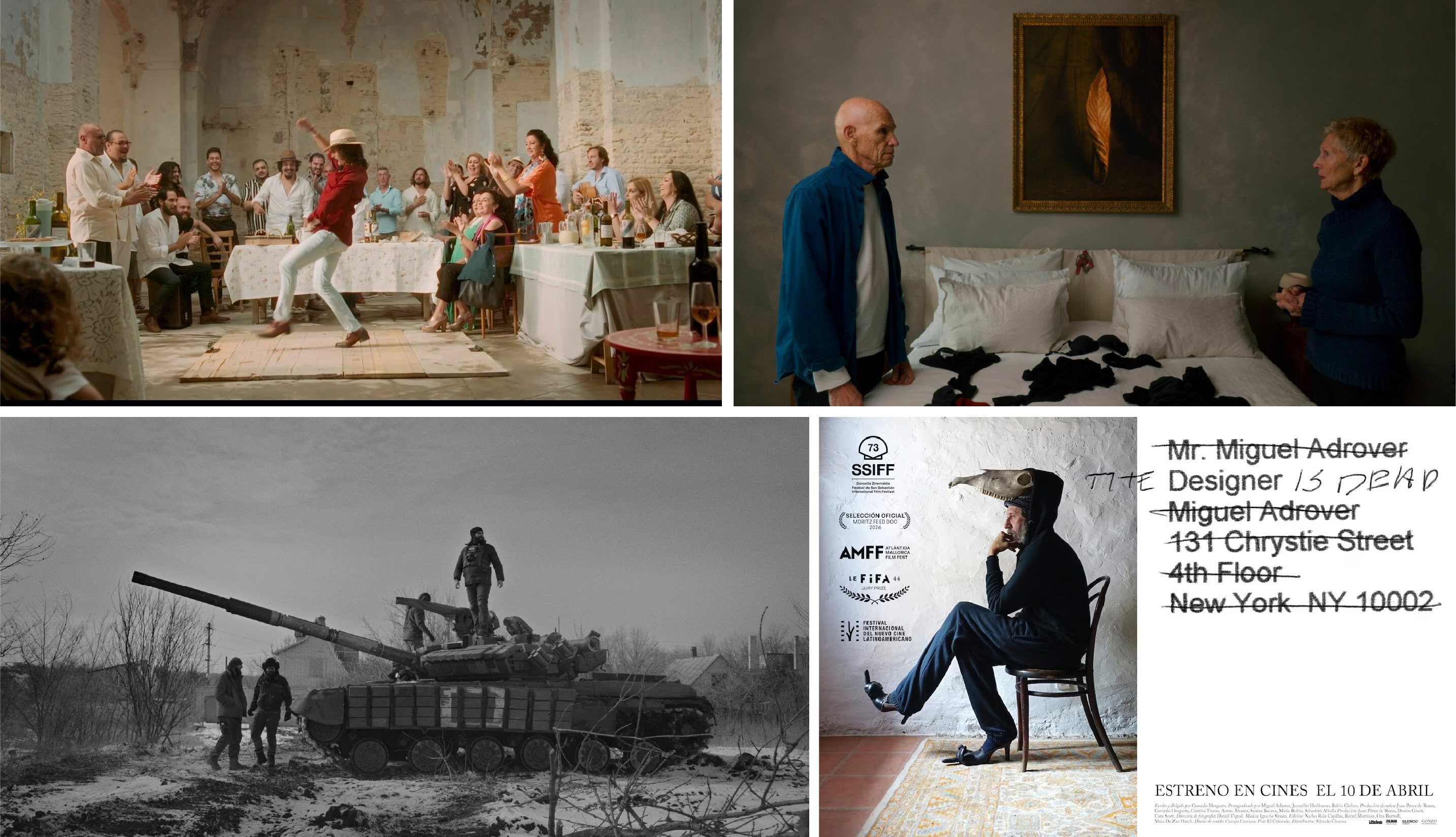
Stills from selected films, from left to right: Farruquito: A Flamenco Dynasty, Two Strangers Trying Not to Kill Each Other, Viktor and The Designer is Dead.
Recurring Themes: Art, Mortality, and the Human Condition
Across the screenings I attended, a pattern began to emerge, one that I had not anticipated, yet felt deeply coherent within the festival’s curatorial vision: a sustained reflection on mortality.
Mon Amour c’est pour le restant de mes jours, centered on Quebec filmmaker Robert Morin, emerged as one of the most striking films in my selection. As a newcomer to Montreal, I was searching for traces of non-commercial, local cinema, voices that exist beyond mainstream recognition. Discovering his work through this intimate lens felt like an initiation into a lesser-known cultural lineage.
This reflection on life and its finitude reappeared in Two Strangers Trying Not to Kill Each Other, where photographer Joel Meyerowitz and writer Maggie Barrett confront aging, artistic frustration, and the inevitability of death through the prism of their relationship. Similarly, the documentary on Farruquito carries an underlying awareness of legacy and generational continuity, unfolding between glory and tragedy, while The Designer is Dead plays with the ambiguity of disappearance, revealing a creator, Miguel Adrover, who has not died, but has instead withdrawn from the systems that once defined him.
In all these works, death is not treated as spectacle, but as a condition, something to think with, rather than something to fear. It appears less as an event than as a structure, quietly shaping how time, memory, and artistic gesture unfold.
Alongside this line of inquiry, another thematic thread emerged around the relationship between art, the body, and access. In the words of FIFA’s Artistic Director Philippe U. del Drago, art can be understood as “a laboratory for the expansion of human language,” where it constantly shifts imaginaries, reconfigures perception, and redefines what is visible, audible, and thinkable. He further writes that cinema, perhaps more than any other art form, becomes the space where these languages meet, collide, and translate one another, asking us to “learn the language of the other” not as assimilation, but as a form of openness and displacement.
Within this framework, films such as The Way We Move explore how deaf communities experience and collectively translate music, expanding the sensory boundaries of performance. In a more politically charged register, Viktor follows a deaf Ukrainian man during the ongoing war, whose desire to enlist in the army confronts the structural limits imposed by his condition. Unable to serve as a soldier, he turns to photojournalism in search of purpose and participation. Here, deafness is not only a question of accessibility, but of agency, usefulness, and belonging within a nation at war.
Even indirectly, projects like Song of the Hands point toward a redefinition of how art can be transmitted, translated, and felt. Taken together, these films suggest that FIFA is not only about representing art, but about interrogating who art is for, and under what conditions it can be experienced, shared, or even lived.
FIFA Connexions: A Global Network of Art and Cinema
For its 44th edition, FIFA signals a shift in its professional program through FIFA Connexions, conceived not merely as an industry platform but as a dynamic space for exchange, learning, and professional development. Through round tables, conferences, workshops, and pitch sessions, it creates conditions for dialogue around key contemporary challenges, creation, distribution, financing, and the circulation of works.
What distinguishes Connexions is its deliberate inclusivity: it places emerging voices and early-career professionals in direct conversation with established figures, fostering an environment where knowledge is shared horizontally rather than hierarchically. In this sense, it functions as a laboratory for future collaborations and as a bridge between local and international ecosystems.
FOAN: Extending the Network
FOAN (Festival of Films on Art Network) operates as a distinct but complementary structure. Composed of member institutions across North America, South America, Europe, and Asia, it facilitates the exchange of knowledge and practices while supporting the production, circulation, and visibility of films on art.
More than a formal alliance, FOAN acts as a space of dialogue and collaboration, where partners collectively reflect on the evolving role of art films within a global cultural landscape. In this context, such films can be understood as sensitive indicators of social and cultural change, carrying meanings that extend beyond the screen.
A Festival Beyond Time and Space
One of FIFA’s most compelling evolutions is its digital extension: ARTS.FILM. This online platform transforms the festival into a year-round experience, offering access to more than 600 films that are otherwise difficult (or impossible) to find.
During the festival period and beyond, audiences can continue exploring its programming from home, extending the life of the festival beyond its physical duration.
Belonging Through Festivals
As a recent arrival in Montreal, my experience of FIFA is inseparable from my process of building a sense of belonging within the city.
What becomes evident over time is that Montreal’s festivals do not compete, they coexist. Each occupies a specific space within an annual cultural cycle, addressing different audiences, disciplines, and sensibilities. Together, they form a living ecosystem.
Within this landscape, FIFA stands out as the festival with which I feel the strongest intellectual and professional affinity. Its focus on art, its curatorial rigor, and its expanded structure resonate with contemporary practices in curatorial studies and film programming, particularly those concerned with expanded notions of exhibition and circulation.
To encounter such a festival not only as a spectator, but also as a volunteer, is to engage with it on multiple levels.
Beyond the Festival
FIFA ultimately invites a broader reflection on what a film festival can be today. In an era where images circulate endlessly and attention is fragmented, FIFA proposes an alternative model: one rooted in depth, continuity, and dialogue across artistic practices. Its commitment to art is not static or self-referential, but oriented toward a transdisciplinary space in which perception itself is reshaped, particularly at a moment marked by global instability and the ongoing violence of multiple conflicts, where artistic practices also become sites of reflection, resistance, and solace.
If traditional festivals often seek to frame the present of film, FIFA seems to ask a different question: what is the place of art within it?
And perhaps more importantly, who is it for, and under what conditions does it become accessible, perceptible, and shared?
On Discovering the 44th FIFA Festival in Montreal: Toward a Shared Space of Perception, Even Beyond Sound