

On January 16, during Montreal’s Critics’ Week, I attended the screening of Magellan, a daring collaboration between the renowned Mexican actor Gael García Bernal and the Filipino filmmaker Lav Diaz. The screening was accompanied by a brief introduction and a post-film conversation with Lav Diaz, whose reflections offered rare insight into a work that is at once historically rigorous, aesthetically radical, and ethically fearless.
Magellan is not a conventional historical epic. Rather than reaffirming the dominant Western narrative of Ferdinand Magellan’s circumnavigation, the film deliberately destabilizes it by adopting a Filipino perspective, one that questions not only colonial historiography, but also the myths that nations construct around their founding heroes. Lav Diaz spent nearly seven years researching the project, consulting archives and libraries across multiple countries, including Spain, Portugal, and the United States. This prolonged investigation is felt throughout the film, not as didactic exposition, but as a slow, deliberate reconstruction of history that refuses simplification.
Filipino director Lav Diaz on January 16 at Cinéma du Musée during the Q&A.
The narrative follows Magellan from his early military campaigns in Southeast Asia to the final stages of his expedition in the Philippine archipelago. Central to the film is Enrique, Magellan’s slave and translator, displaced from Malacca (city in Malaysia) through early colonial trade networks. It is through Enrique’s perspective that the film ultimately overturns historical convention: the legendary figure of Datu (chieftain) Lapu-Lapu, long celebrated as the architect of Magellan’s death, is revealed as a fabrication. Instead, the film suggests that Magellan was killed by Rajah Humabon and his forces, a revelation that radically reframes the story of conquest, resistance, and historical memory.
This narrative choice is profoundly controversial. In the Philippines, Lapu-Lapu is a national hero, commemorated by monuments and statues. To question his existence is to question the very foundations of a national historical narrative. Yet Lav Diaz approaches this provocation not as an act of negation, but as an invitation to reconsider how history is written, remembered, and instrumentalized. Magellan does not seek to replace one heroic myth with another; it seeks to expose the mechanisms by which myth itself is produced.
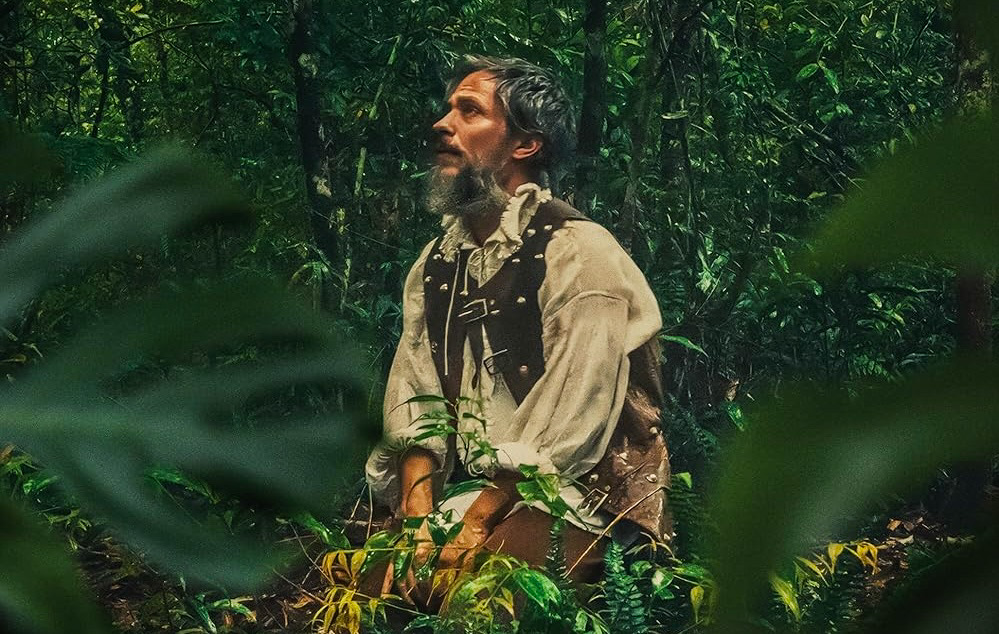
Gael García Bernal as Magellan in the dense Philippine jungle.
The casting of Gael García Bernal as Magellan reinforces the film’s transhistorical and transnational dimension. Lav Diaz has pointed to the profound parallels between the colonial histories of Mexico and the Philippines, both shaped by Spanish expansion during the same historical moment, yet articulated across opposite geographic poles of the empire. This resonance is particularly striking from a Mexican perspective. In Tabasco, where the Spanish first established a foothold on the mainland and faced early indigenous resistance at the Battle of Centla, the figure of Hernán Cortés emerges as a historical counterpoint to Magellan, who was another conqueror whose legacy is inseparable from violence, mythmaking, and the erasure of Indigenous voices. In this sense, Magellan gestures toward a broader, interconnected colonial history that transcends national boundaries.
Formally, the film is as radical as its historical thesis. Lav Diaz rejects cinematic ostentation, working instead with minimal equipment and a reduced crew. The opening shot presents an Indigenous woman encountering the white invader for the first time: her surprise and flight dominate the scene, while the man’s face remains off-screen. Filmed entirely by Lav Diaz on his own, the shot establishes an intimate visual language that runs throughout the film. The cinematography is marked by high contrasts, extended takes, and a deliberate pacing that resists narrative urgency. Each shot unfolds according to its own internal rhythm, allowing time to accumulate rather than dissipate.
One of the film’s most striking strategies is its systematic demystification of the conquistadors. Rather than portraying them as triumphant or heroic figures, Lav Diaz reduces them to fallen humans, mere mortals, vulnerable bodies that are often grotesquely human. In the end, the camera confronts the consequences of their actions without glorification, underscoring their mortality and fragility. In one memorable scene following a military victory in Malacca, Afonso de Albuquerque delivers a rousing speech only to collapse drunkenly onto the ground, where he remains, inert and undignified. Across the film, battlefields are littered with bodies (dead, dying, or already lifeless) lying in various positions, stripped of narrative emphasis or heroic framing. This repeated imagery of fallen or sleeping bodies serves a dual purpose: it highlights the human cost of conquest and emphasizes the vulnerability and mortality of the oppressors, stripping away any illusion of glory.
This attention to the body extends beyond death to everyday existence. Magellan includes numerous scenes of complete nudity, portraying men and women as they would have lived in the early sixteenth century. Lav Diaz has spoken openly about the difficulty of filming these scenes, noting that he spent months convincing performers that the nudity was neither pornographic nor exploitative, but historically and ethically necessary. The result is a naturalistic depiction of the human body as historical evidence, an archive inscribed with vulnerability, labor, and exposure.
Violence, too, is treated with remarkable restraint. Rather than staging executions or massacres in graphic detail, Lav Diaz often directs the camera toward those who order the violence, not those who physically enact it. The act itself frequently occurs off-screen. This choice stands in stark contrast to contemporary cinema and television, where violence is often aestheticized and fetishized. In Magellan, violence is neither sensationalized nor sanitized; it is rendered through absence, implication, and moral weight.
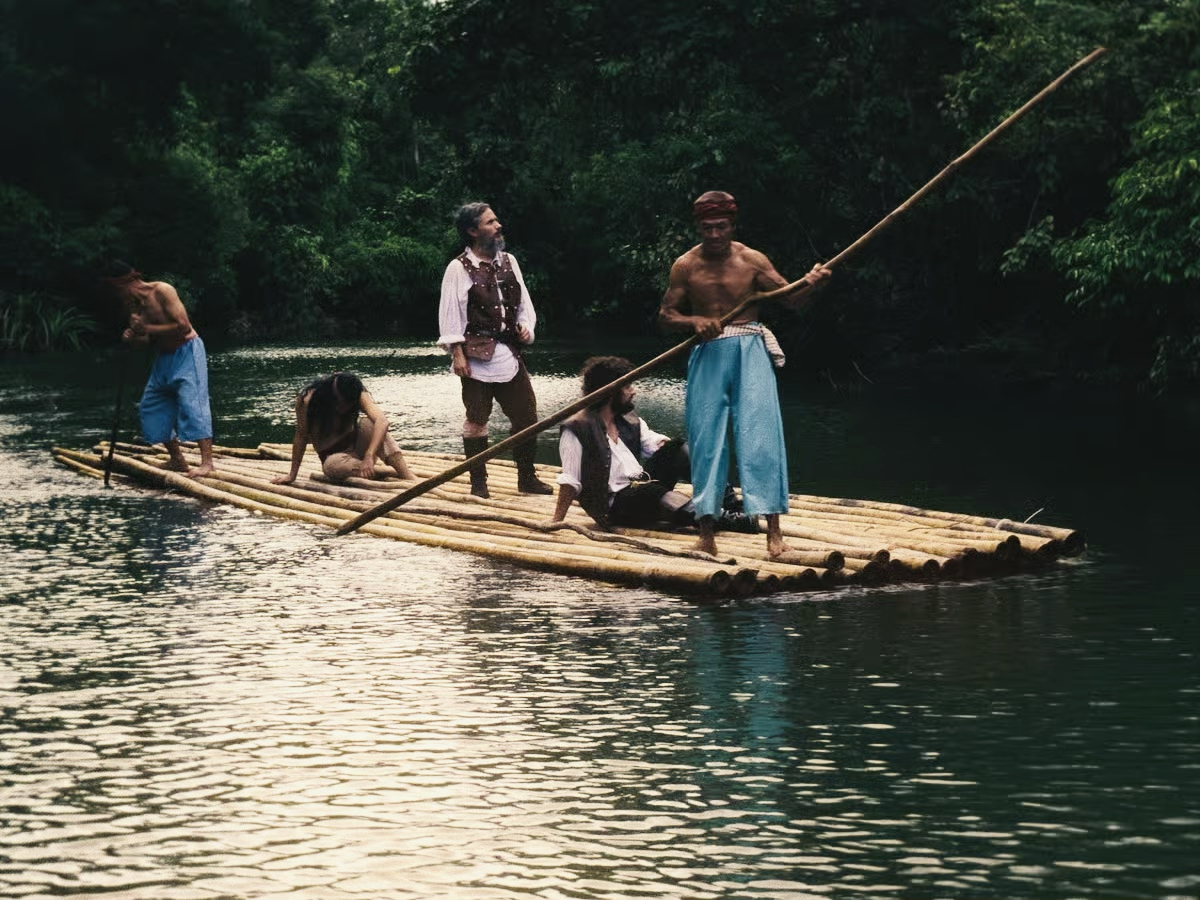
Magellan on a raft on a river. Photo courtesy of Janus Films.
Although often described as contemplative cinema, Magellan goes beyond mere contemplation. What the viewer is invited to contemplate is not only the image, but the slow, laborious process of historical reconstruction itself. Lav Diaz refuses to accelerate history for the sake of narrative efficiency. Instead, he allows time to function as an ethical dimension of the film, time to observe, to endure, and to reckon with the consequences of colonial violence.
It is also worth noting that Magellan was co-produced by Albert Serra, the Catalan filmmaker known for his radically subversive approach to historical cinema. Serra’s involvement situates the film within a lineage of contemporary auteurs who systematically dismantle heroic narratives and challenge the aesthetic conventions of the historical genre. His presence as co-producer reinforces Magellan’s commitment to anti-spectacle, temporal rigor, and ethical discomfort. Furthermore, Magellan marks Lav Diaz’s first color film in over a decade, following a long period in which his work was predominantly shot in black and white. The return to color is not ornamental but deeply considered, aligning with the film’s project of historical reconstruction and sensory immersion, and signaling a new yet coherent phase in Lav Diaz’s cinematic practice.
Ultimately, Magellan is a film about perspective, power, and historical authorship. By ultimately redirecting the narrative toward the enslaved Enrique and dismantling the myth of the conquering hero, Lav Diaz reveals history as a contested terrain rather than a closed record. The film reminds us that history is not a neutral inheritance, but a construction shaped by omission, domination, and repetition. In reclaiming cinema as a space for historical interrogation, Magellan offers not answers, but a profoundly necessary disturbance, one that resonates far beyond the Philippines, reaching into the shared colonial histories of the global South.
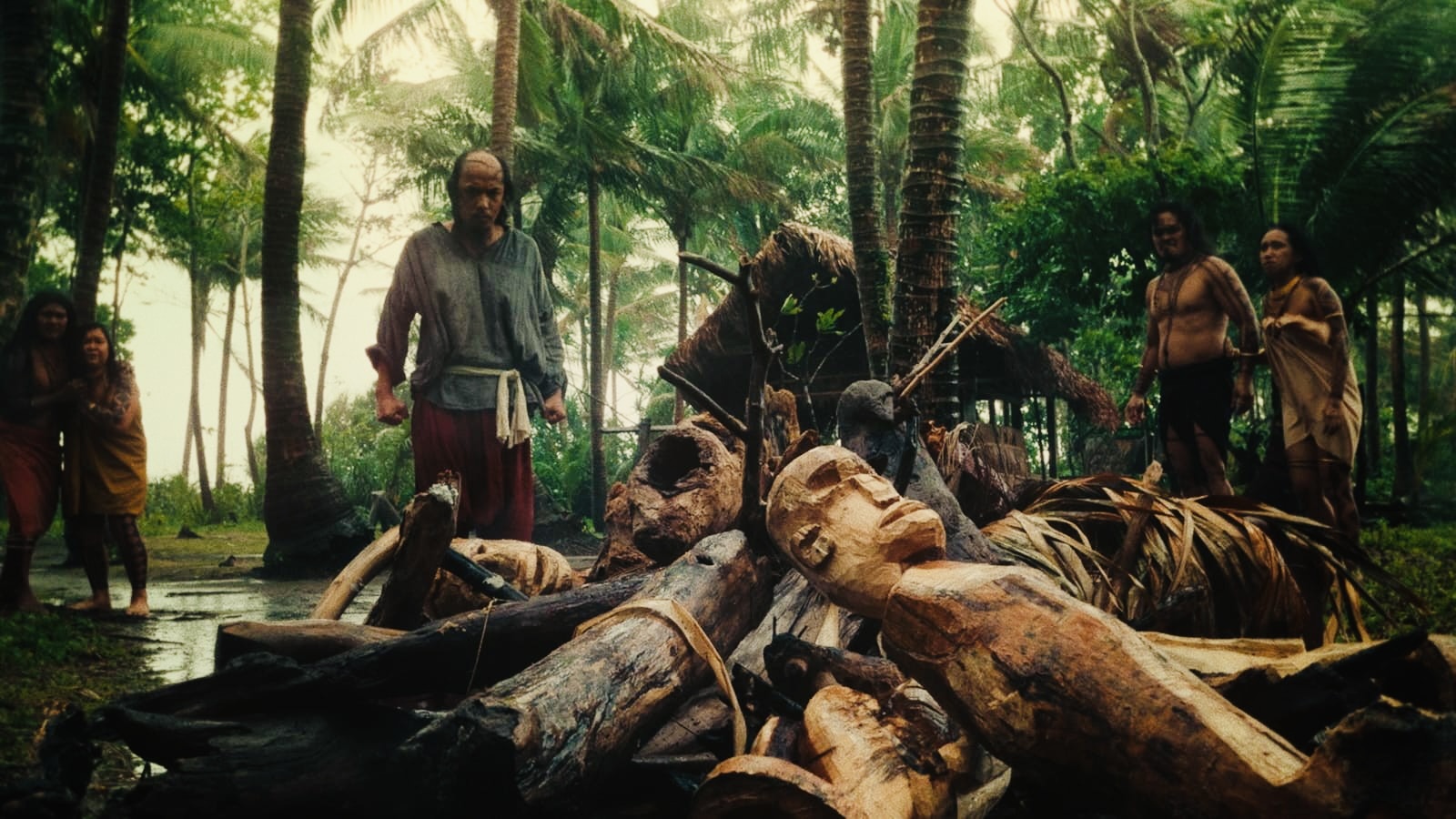
Wooden idols burned following the community’s conversion to Christianity, as villagers watch in silence. Photo courtesy of Janus Films.
Against the Hero: Lav Diaz’s Magellan and the Undoing of Colonial History at Montreal Critics’ Week