

The 28th edition of the Montreal International Documentary Festival (RIDM) opened with an inaugural screening that, from the very first moment, encapsulated the spirit of the festival: cinema attentive to the human condition, to the margins, and to contemporary ways of inhabiting the world. Opening night took place on Thursday, November 20, at the Monument-National, in a particularly frigid Montreal, contrasted by a warm and enthusiastic audience that filled the theater completely, with even standing room occupied. Applause lingered for the filmmakers, programmers, and the team that sustains this vibrant festival, reaffirming RIDM as a living meeting point between documentary cinema and its community.
The opening film was Letters from Wolf Street, by filmmaker Arjun Talwar, a documentary that constructs a tender and deeply nuanced portrait of a Warsaw neighborhood, observed through the sensitive gaze of a director with a migrant background in search of connection and belonging. Talwar makes a brave and honest gesture here: he films himself and becomes the protagonist of his own story, embracing the risks of autobiographical documentary without falling into narcissism.
The cinematography, dominated by pale and yellowish tones, evokes a Poland suspended in time, almost spectral as if the visual residues of a communist era still linger in the texture of the walls, in the light, and in the bodies. The inhabitants of the street whom Talwar insists on filming do not need to perform or adopt poses in order to exist within the frame: they are singular, endearing characters who offer themselves just as they are. Their presence sustains the film with a rare naturalness, rendering the documentary apparatus nearly invisible.
In this sense, Letters from Wolf Street clearly dialogues with Daguerréotypes (1976) by Agnès Varda, that meticulous portrait of the everyday lives of shopkeepers and neighbors on rue Daguerre in France. Both Varda and Talwar transform the ordinary into a poetic and political space: they observe the everyday not as something banal, but as a living archive of postmodernity its confusions, contradictions, and affections. Both filmmakers understand the neighborhood as a microcosm where the major tensions of the contemporary world are inscribed.
The film resonated with me on a deeply personal level. It brought me back to my own experience as an immigrant in the Basque Country, where I lived for three years while studying cinema at the then newly founded Elias Querejeta Zine Eskola (EQZE). We experienced the pandemic there (lockdowns and curfews) a suspended temporality that redefined our relationship to space and to others. I remember the intermittent interactions with bar and café owners, local figures full of character—tough yet charming, and as complex as the Polish residents Talwar portrays in Warsaw.
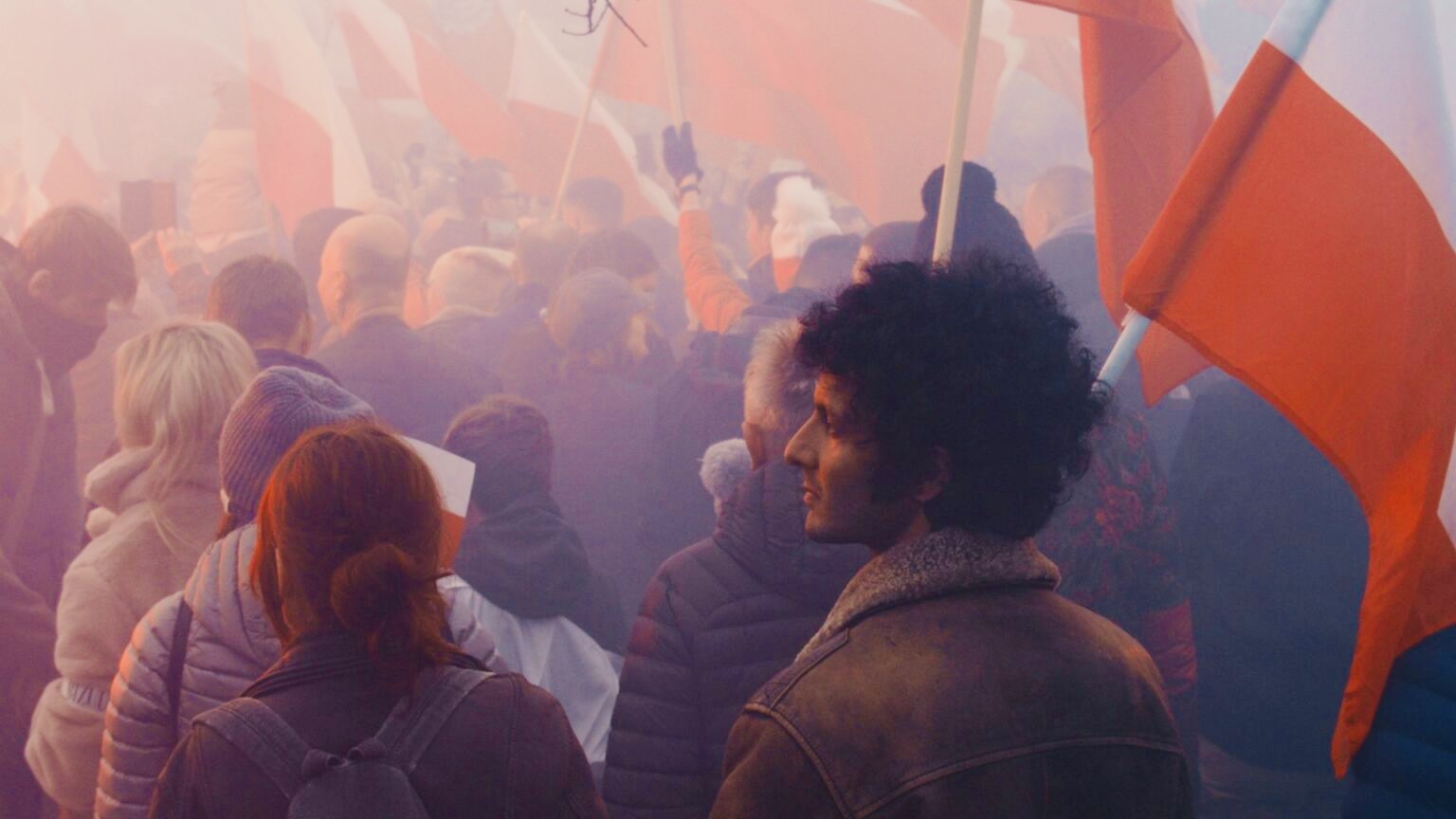
The sequence of the demonstration in the film (shot during Poland’s Independence Day, with banners of the Virgin Mary) inevitably brought me back to the post-lockdown months, when we took to the streets in support of Black Lives Matter and, suddenly, young people and LGBTQ communities appeared from everywhere, forming an unexpected and luminous multitude. It was a march marked by grief, but also by a collective hope reclaiming public space. In Letters from Wolf Street, this political dimension emerges without stridency: the street becomes a site where the intimate and the social intersect, where even the smallest gesture can contain a form of resistance.
With this film, RIDM not only inaugurated its 28th edition but also set the tone for a reflection on community, displacement, and belonging, reminding us that documentary cinema remains a privileged tool for observing the world through its most human fissures.
Still from Letters from Wolf Street directed by Arjun Talwar, 2025, photo: MDAG.
Chance Encounters and a Cinema Guided by Intuition: El mundo al revés
While standing in line at the RIDM opening night, one of those serendipitous encounters that only festivals seem to generate took place. There we met Leon Schwitter, director of El mundo al revés (The World Upside Down) Swiss, with impeccable Spanish, he told us he was in Montreal to present his 77-minute film at the festival. The conversation was brief, but enough to spark curiosity about his work. A few days later, I decided to attend the film’s second screening, this time at Cinéma du Parc, where Schwitter and his Argentine partner (co-director of the film) were again present.
During the introduction, they both confessed that the project was born under the influence of a filmmaker (whose name they did not reveal) who had the radical drive to make three films a year, sometimes with money and sometimes without. More than a production model, it was an ethic of making: filming without overthinking, trusting impulse and circumstance. El mundo al revés emerged precisely from that challenge. They were going to spend three months in a small town in Córdoba, Argentina, and decided that this time and place were the perfect opportunity to make a film by surrendering to the process, without over-intellectualizing it.
Although the film does not feel strictly like a documentary (it leans more toward fiction) its protagonists are local families from the region. People the directors encountered and selected almost intuitively: “she has to be in the film.” And so, one by one, they became part of the narrative.
The synopsis immediately sets the tone:
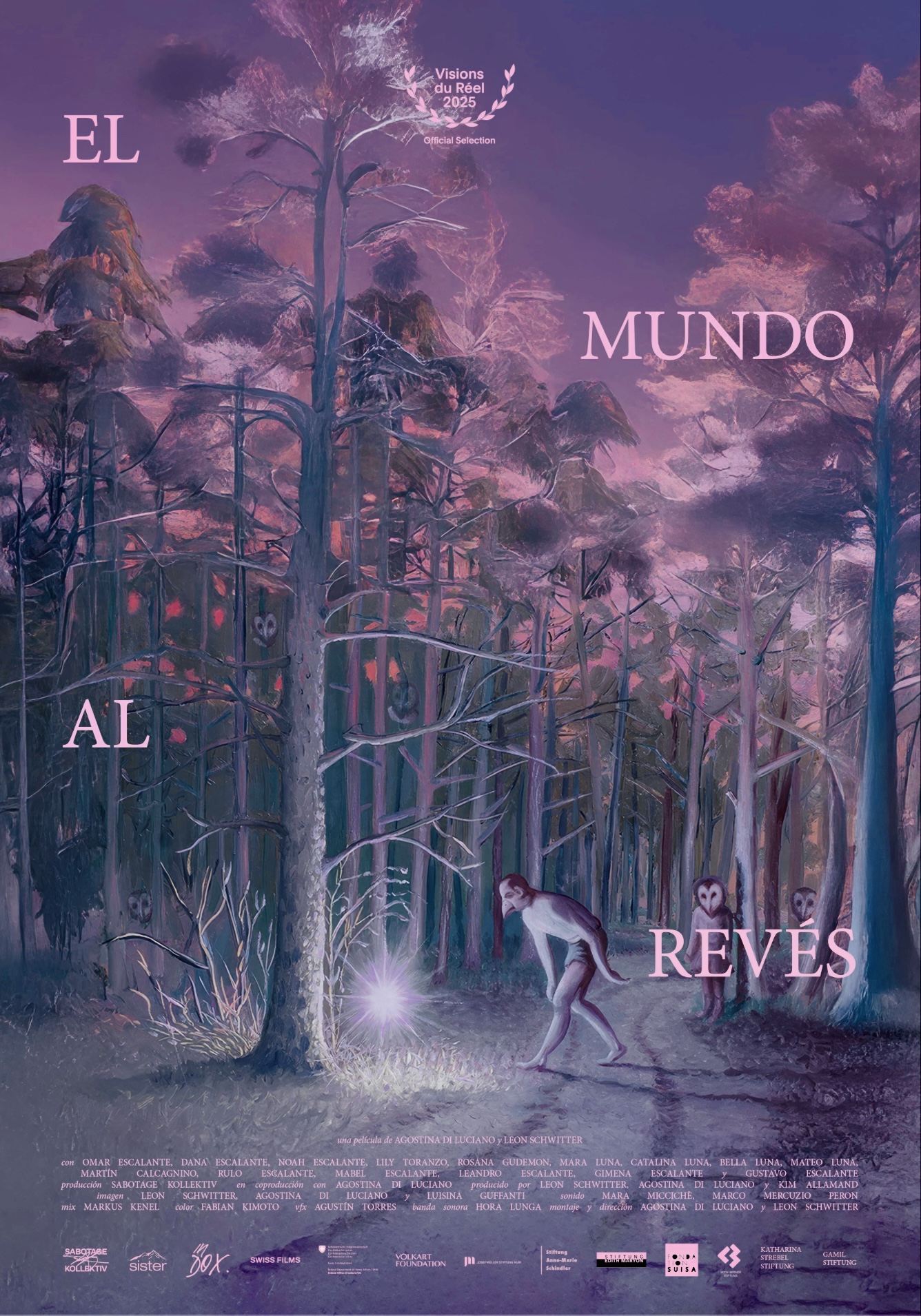
In a small rural Argentine town, inhabitants live a life shaped by nature and routine. When a light appears to the elderly farmer Omar one night, he embarks on a journey in search of meaning alongside his grandson Noah. In a vacation home whose owners are never present, two domestic workers, Rosana and Lily, make a discovery that opens for them a new form of knowledge.
The film begins with a delicate and unsettling scene: a group of people seated on a church bench in a small town, facing the altar. On the slightly dusty white wall, the faithful believe they can discern the shadow of the Virgin. And indeed, something appears in the frame: an ambiguous, suggestive shape that leaves room for interpretation, establishing from the outset an atmosphere of popular faith and everyday mystery.
In parallel, two women cleaning a country house listen through a loudspeaker to their employers calling from Buenos Aires who—as always—announce their arrival without ever actually coming. In one of the rooms, upon opening a closet, they discover a wall sealed with baked clay bricks, as if something had been hidden inside. This abrupt space soon becomes an object of devotion: they decorate it with candles and petitions, transforming it into an improvised altar where the inexplicable finds form.
However, the central axis of the film is Omar’s story, the grandfather who cares for his grandson Noah. One night, while the boy’s mother goes out dancing at a town celebration, Noah sleeps and Omar sits outside taking in the cool air, facing the sidewalk. Suddenly, a ball of light emerges from his mouth, moving horizontally, gliding through the brush until it disappears. Omar remains stunned. From that moment on, he begins to inquire, to ask questions, and to recount what happened without exaggeration or dramatization. His story sounds less like a medical episode than a rural mystical tale, told with the serenity of someone who accepts the inexplicable as part of life.
Poster of the movie El Mundo al revés, directed by Leon Schwitter, 2025, source: IMDb.
The co-director explained that their work with non-professional actors from the region was based on principles of pedagogical theater, privileging improvisation, especially in the case of the child, Noah. That decision is palpable on screen: gestures, silences, and actions seem to arise organically from the environment, without affectation.
El mundo al revés is an unpretentious yet effective film. Despite its seemingly slow pace, it never becomes tedious. On the contrary, it draws the viewer into its naturalistic atmosphere, where a subtle rural suspense seeps through the interplay between nature and routine. The sound design reinforces this mood: the sounds of the countryside, the wind, the prolonged silences contribute to a mystical climate that inevitably evokes magical realism, not as stylistic artifice, but as a way of perceiving the world.
Within the context of RIDM, El mundo al revés serves as a reminder that cinema (whether documentary or fiction) can be born from impulse, from attentive observation, and from trust in places and people. A cinema made in reverse to industrial logic, yet in favor of a deeply human sensibility.
In Montreal, at the 28th edition of RIDM, these films collectively reaffirmed what the festival has long represented: a space where the everyday becomes politically resonant, where community is not an abstract concept but a lived and fragile construction. From the streets of Warsaw to the rural landscapes of Córdoba, RIDM reminds us that documentary cinema continues to locate meaning not in spectacle, but in gestures, neighborhoods, and shared spaces. In doing so, it frames the ordinary as a political site: subtle, intimate, and profoundly human.
RIDM 28: Opening Night, Community, and the Everyday as Political Space